Scarlet Sage, Scarlet Salvia, Blood Sage, Texas Sage, Tropical Sage, Hummingbird Sage, Red Sage, Indian Fire


Salvia coccinea – better known as Scarlet Sage, Tropical Sage, or Blood Sage – is one of those plants that quietly overdelivers. Give it warmth, sun, and reasonably drained soil, and it rewards you with tubes of vivid color for months. The flowers look like tiny neon beacons to hummingbirds and butterflies, and the plant itself is pleasantly unfussy – a big win for gardeners who want maximum bloom with minimum drama.
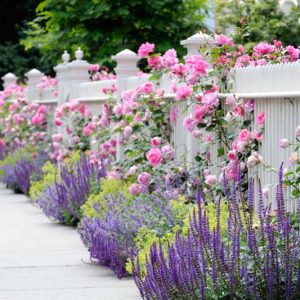
It also fits beautifully into today’s most popular planting styles: pollinator gardens, cottage borders, naturalized meadows, and low-water landscapes. Once established, it can handle dry spells and heat surprisingly well, especially when planted in the right place. If you like plants that look lively, move with the breeze, and keep wildlife visiting, Salvia coccinea is a smart cornerstone.
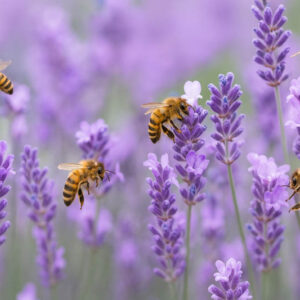
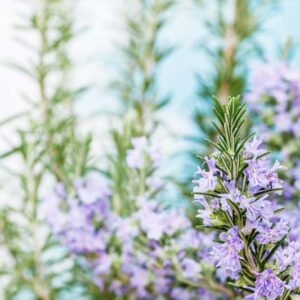
Salvia belongs to the Lamiaceae family – the same aromatic, pollinator-friendly group that includes rosemary, basil, and lavender. If you love the idea of a garden that smells good, blooms long, and supports beneficial insects, salvias are basically a cheat code. What is Salvia? Understanding its role in gardening and beyond
Quick note on the name “Scarlet Sage”: it can also refer to other red-flowering salvias, including Salvia elegans (Pineapple Sage) and Salvia splendens. This guide focuses on Salvia coccinea.
Summary: Upright, airy herbaceous perennial in warm climates and often grown as an annual elsewhere, with spikes of tubular red flowers (also pink, coral, or white in cultivars) from early summer to frost.
Use: Ideal for pollinator gardens, cottage borders, naturalized plantings, wildflower meadows, and containers.
Highlight: Long bloom season plus steady visits from hummingbirds, butterflies, and bees.
Note: Best in sun with well-drained soil; once established it is often considered drought tolerant.
| Botanical Name | Salvia coccinea |
|---|---|
| Family | Mint family (Lamiaceae) |
| Common Names | Scarlet Sage, Tropical Sage, Blood Sage |
| Native Range | Southeastern United States and tropical America (Mexico, Central America, Caribbean, northern South America) |
| Plant Type and Habit | Herbaceous perennial (warm zones) or annual (cool zones) with an upright, branching habit |
| Hardiness (approx. USDA) | Hardy in USDA Zones 8-10 (often grown as an annual elsewhere) |
| Height | 2-3 ft. (60-90 cm) |
| Spread | 12-30 in. (30-75 cm) |
| Spacing | 12-24 in. (30-60 cm) |
| Sun and Exposure | Full sun for best bloom; tolerates light shade (especially afternoon shade in intense heat) |
| Soil | Moderately fertile, well-drained soil; sandy is ideal, clay is fine if drainage is good |
| Seasonal Interest | Early summer through fall (often until first frost) |
| Flower Color | Scarlet red most common; also pink, white, coral |
| Foliage Color | Mid-green, softly hairy leaves |
| Fragrance | Mildly aromatic foliage when crushed |
| Drought Tolerant | Yes (once established) |
| Heat Tolerant | Yes |
| Nectar – Pollen | Yes – nectar-rich flowers |
| Attracts | Bees, butterflies, hummingbirds |
| Deer | Often considered deer resistant |
| Toxicity | Generally considered non-toxic to pets (ornamental use) |
| Invasive Status | Not considered invasive in typical garden use |
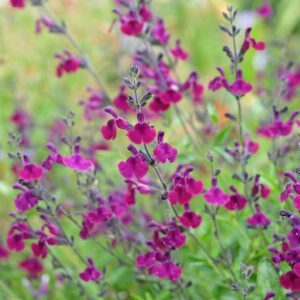
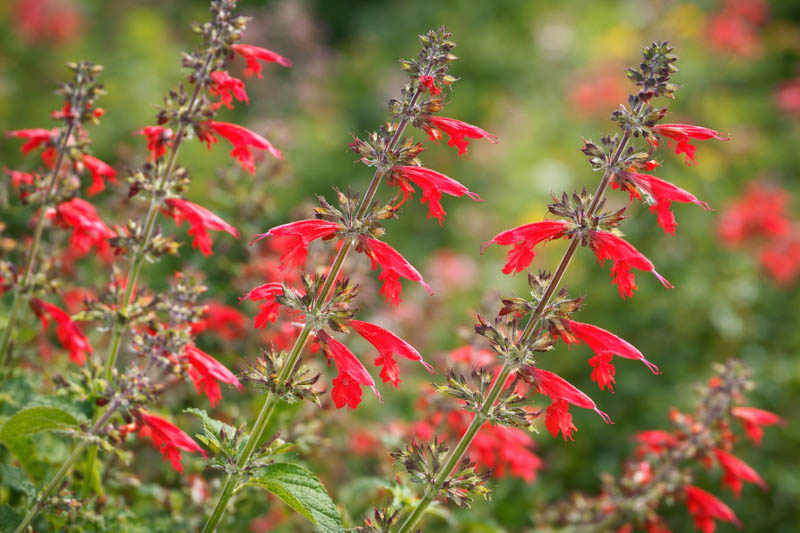
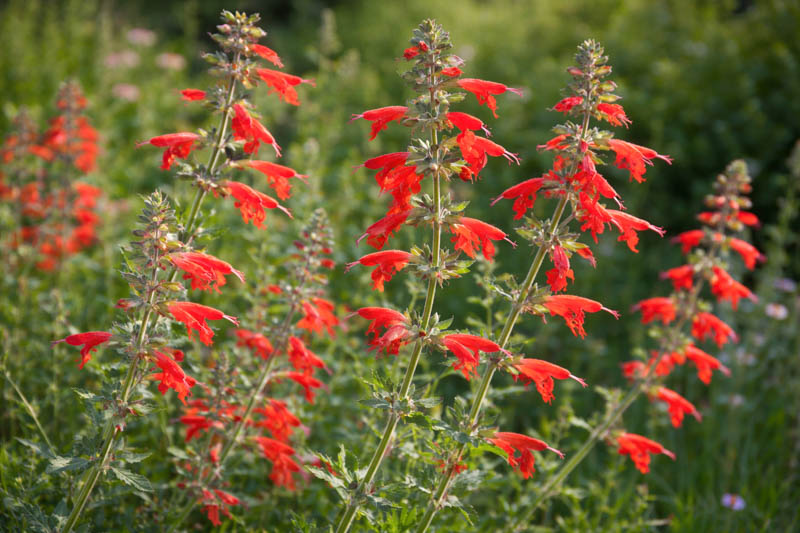
Salvia coccinea is an upright, clump-forming plant with square stems, soft green leaves, and flower spikes lined with bright, tubular blooms. Each flower is roughly 1 inch (2.5 cm) long, and the overall effect is airy and vertical – like a natural exclamation point in the border.
Scarlet Sage is native to parts of the southeastern United States and tropical America (Mexico, Central America, the Caribbean, and parts of South America), and it has also spread through cultivation and naturalization in warm regions. In its preferred habitats, it thrives in open, sunny spaces with reasonably drained soils – field edges, open woods, and disturbed areas are common “happy places” for this plant.
Expect a plant around 2-3 feet tall (60-90 cm) and 12-30 inches wide (30-75 cm). It grows with an open, branching structure that mixes easily with grasses and other perennials. In warm winter climates, it can self-seed freely – not in an aggressive, take-over-the-yard way, but in a cheerful “I’ll be back next year” way.
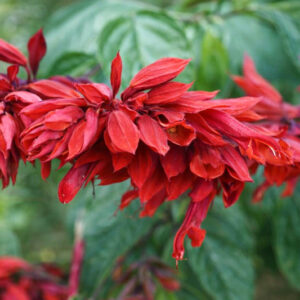
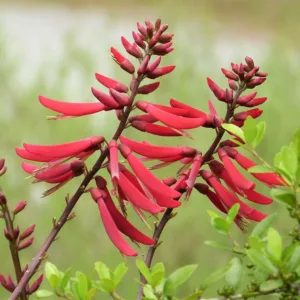
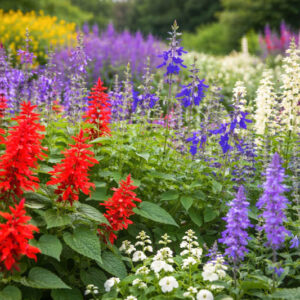
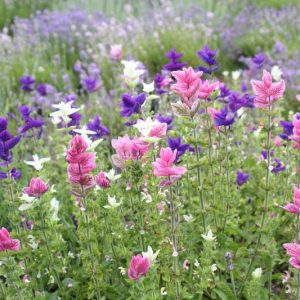
The signature look is scarlet-red tubular flowers arranged in spaced whorls along tall spikes. Red is the classic, but you’ll also see cultivars in pink, coral, and white. Bloom typically runs from early summer to fall and often continues until the first frost in cooler climates.
Deadheading (snipping off spent blooms) is optional, but it can keep the plant looking fresh and encourage more flowers. If you let the flowers mature, seeds form in the calyces – and birds like goldfinches may show up to snack.
The leaves are mid-green, ovate, and softly hairy, with a mild herbal scent when crushed. The foliage is a supportive backdrop – it’s the flowers that steal the show – but that soft green texture makes Scarlet Sage easy to pair with bolder leaves, ornamental grasses, and summer annuals.
Salvia coccinea is typically hardy in USDA Zones 8-10. In colder zones it’s usually grown as an annual, but it can still be a standout performer in one season – and may reseed in protected spots when conditions line up.
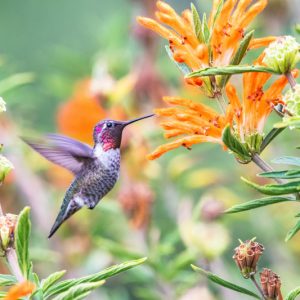
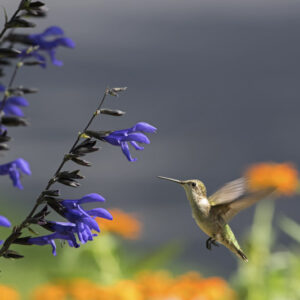
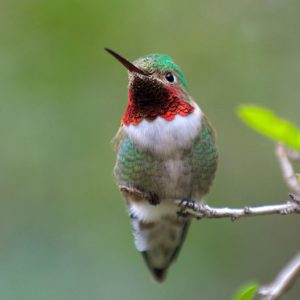
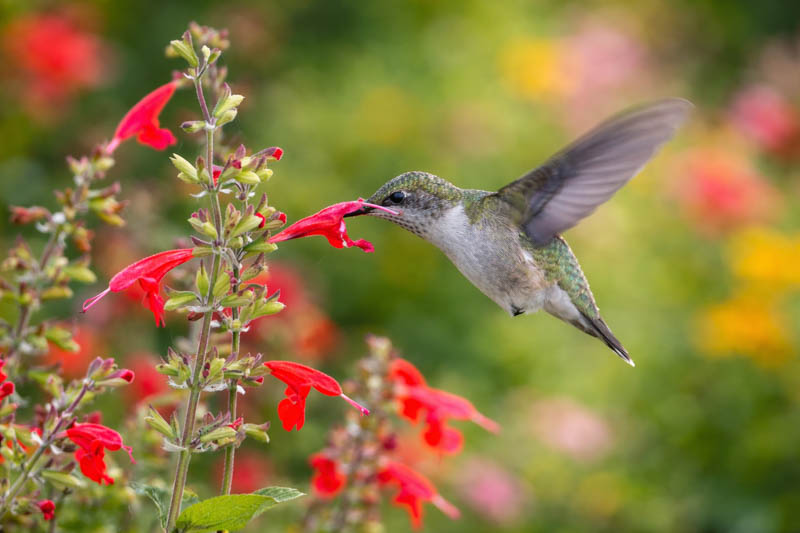
Scarlet Sage is a favorite with bees, butterflies, and hummingbirds. Those tubular flowers are shaped for efficient feeding, which is why the plant can look like a tiny wildlife airport on a sunny morning.
Scarlet Sage’s aromatic foliage makes it less appealing to browsing animals, and it is often described as deer resistant. See: deer.
Once established, Salvia coccinea is often considered drought tolerant. It performs best with deep watering during establishment, then occasional watering during extended dry spells. In many gardens, a little extra water during peak heat equals more flowers – but it is still a solid choice for water-wise designs.
According to the ASPCA, Scarlet Sage (Salvia coccinea) is listed as non-toxic to dogs, cats, and horses.
Salvia coccinea is not considered invasive in typical garden use. It can self-seed in favorable conditions, but seedlings are easy to spot and remove (or move to a better spot if you like free plants).
Keep feeding light and practical. A little compost or a balanced fertilizer during active growth is plenty. Over-fertilizing can create lush foliage and fewer blooms, and can make plants leggier than you want.
Control small outbreaks with strong water sprays, insecticidal soap, or neem oil.
Salvia coccinea is more than “a red flower for pollinators.” It’s a vertical accent, a color amplifier, and a season-long filler that plays nicely with lots of garden styles. The key is to treat it like a repeating rhythm plant: use it in small groups, then echo it again a few feet away so the color feels intentional.
Salvia coccinea is a short-lived perennial in warm climates (USDA Zones 8–10) and is most often grown as an annual in cooler regions. In frost-free areas, it may return for several years or reseed naturally.
Yes. Salvia coccinea is native to parts of the southeastern United States, particularly Alabama, Florida, Georgia, Louisiana, Mississippi, and Texas. It is also native to Mexico, Central America, and parts of the Caribbean.
Yes. Scarlet Sage is an excellent hummingbird plant. Its tubular red flowers are perfectly shaped for hummingbird feeding and consistently attract them throughout the blooming season.
Once established, Salvia coccinea is moderately drought tolerant. It survives dry spells well but blooms more abundantly with occasional deep watering during hot weather.
Salvia coccinea blooms best in full sun, with at least 6–8 hours of direct light per day. In very hot climates, light afternoon shade can help reduce stress without reducing flowering too much.
Scarlet Sage blooms from early summer through fall and often continues until the first frost. Regular deadheading can encourage faster rebloom and a tidier appearance.
Salvia coccinea is often considered deer resistant due to its aromatic foliage. While no plant is completely deer-proof, it is usually not a preferred food source.
Yes. In warm climates, Salvia coccinea readily self-seeds. Seedlings are easy to recognize and manage, making it simple to control or encourage natural spread.
No. Salvia coccinea is not considered invasive. While it may self-seed, seedlings are easily removed and do not aggressively displace other plants.
Salvia coccinea is a long-blooming, sun-friendly salvia that delivers tubular color, strong pollinator value, and easy-care performance – especially in warm climates and well-drained soils.
Gardenia.net – Salvia care, drought tolerance, and pollinator value
UF – IFAS Gardening Solutions and UF – IFAS EDIS – cultural guidance and seasonal bloom notes
ASPCA – non-toxic listing for Scarlet Sage (Salvia coccinea)
Updated: January 2026 – Reviewed by Gardenia Editors
| Hardiness |
8 - 10 |
|---|---|
| Climate Zones | 12, 13, 14, 15, 16, 17, 18, 19, 20, 21, 22, 23, 24, H1, H2 |
| Plant Type | Annuals, Perennials |
| Plant Family | Lamiaceae |
| Genus | Salvia |
| Common names | Red Sage, Sage, Scarlet Sage |
| Exposure | Full Sun, Partial Sun |
| Season of Interest | Summer (Early, Mid, Late), Fall |
| Height | 2' - 3' (60cm - 90cm) |
| Spread | 1' - 3' (30cm - 90cm) |
| Spacing | 18" - 30" (50cm - 80cm) |
| Maintenance | Low |
| Water Needs | Average |
| Soil Type | Clay, Loam, Sand |
| Soil pH | Acid, Alkaline, Neutral |
| Soil Drainage | Moist but Well-Drained, Well-Drained |
| Characteristics | Showy, Cut Flowers |
| Native Plants | United States, Southeast, Louisiana, Mississippi, Alabama, Florida, Georgia, Southwest, Texas |
| Tolerances | Drought, Deer, Dry Soil, Heat |
| Attracts | Bees, Birds, Butterflies, Hummingbirds |
| Garden Uses | Beds And Borders, Wall-Side Borders |
| Garden Styles | City and Courtyard, Coastal Garden, Informal and Cottage |
| Toxic to Humans | No known toxicity |
| Toxic to Cats | Not toxic |
| Toxic to Dogs | Not toxic |
| Toxic to Horses | Not toxic |


| Hardiness |
8 - 10 |
|---|---|
| Climate Zones | 12, 13, 14, 15, 16, 17, 18, 19, 20, 21, 22, 23, 24, H1, H2 |
| Plant Type | Annuals, Perennials |
| Plant Family | Lamiaceae |
| Genus | Salvia |
| Common names | Red Sage, Sage, Scarlet Sage |
| Exposure | Full Sun, Partial Sun |
| Season of Interest | Summer (Early, Mid, Late), Fall |
| Height | 2' - 3' (60cm - 90cm) |
| Spread | 1' - 3' (30cm - 90cm) |
| Spacing | 18" - 30" (50cm - 80cm) |
| Maintenance | Low |
| Water Needs | Average |
| Soil Type | Clay, Loam, Sand |
| Soil pH | Acid, Alkaline, Neutral |
| Soil Drainage | Moist but Well-Drained, Well-Drained |
| Characteristics | Showy, Cut Flowers |
| Native Plants | United States, Southeast, Louisiana, Mississippi, Alabama, Florida, Georgia, Southwest, Texas |
| Tolerances | Drought, Deer, Dry Soil, Heat |
| Attracts | Bees, Birds, Butterflies, Hummingbirds |
| Garden Uses | Beds And Borders, Wall-Side Borders |
| Garden Styles | City and Courtyard, Coastal Garden, Informal and Cottage |
| Toxic to Humans | No known toxicity |
| Toxic to Cats | Not toxic |
| Toxic to Dogs | Not toxic |
| Toxic to Horses | Not toxic |
How many Salvia coccinea (Scarlet Sage) do I need for my garden?
| Plant | Quantity | |
|---|---|---|
| Salvia coccinea (Scarlet Sage) | N/A | Buy Plants |
Create a membership account to save your garden designs and to view them on any device.
Becoming a contributing member of Gardenia is easy and can be done in just a few minutes. If you provide us with your name, email address and the payment of a modest $25 annual membership fee, you will become a full member, enabling you to design and save up to 25 of your garden design ideas.
Join now and start creating your dream garden!
Create a membership account to save your garden designs and to view them on any device.
Becoming a contributing member of Gardenia is easy and can be done in just a few minutes. If you provide us with your name, email address and the payment of a modest $25 annual membership fee, you will become a full member, enabling you to design and save up to 25 of your garden design ideas.
Join now and start creating your dream garden!