Dwarf Cavendish Banana, Dwarf Banana, Cavendish, Canary Banana, Chinese Banana, Musa 'Chinese Cavendish', Musa cavendishii

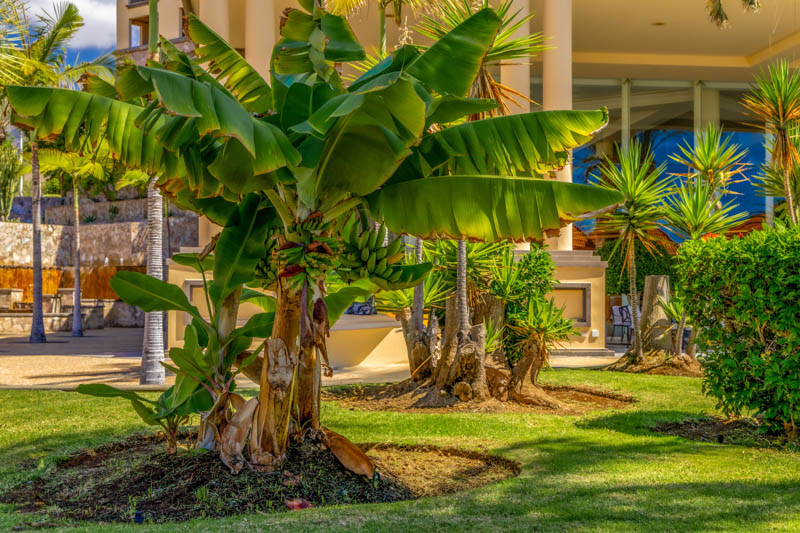
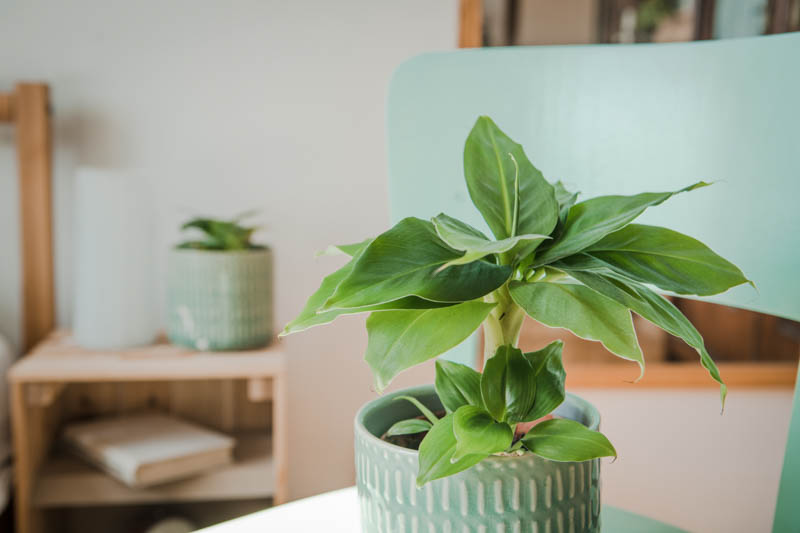


Summary: A compact, fast-growing dessert banana that fits patios, courtyards, and sunny balconies—yet still delivers full-size bunches.
Taste: Classic Cavendish flavor: creamy, sweet, gently aromatic when fully yellow with sugar speckles.
Use: Fresh eating, smoothies, baking, freezing for “nice cream”; leaves for plating and steaming.
Growing Note: AAA triploid Cavendish-group clone; juvenile leaves often show attractive red/purple mottling. Parthenocarpic (seedless) fruit.
| Botanical Name | Musa acuminata (Cavendish Group) ‘Dwarf Cavendish’ — AAA |
|---|---|
| Family | Musaceae |
| Common Names | Dwarf Cavendish, Dwarf Banana, sometimes sold as ‘Nanica’ in trade |
| Plant Type & Habit | Herbaceous perennial with a pseudostem; clumping via underground rhizome (“mat”) |
| Hardiness (USDA) | Best fruiting in 10–11; can be grown in 9b with protection (rhizome hardy above ~28–30°F/-2 to -1°C) |
| Size | Outdoors 6–8 ft (1.8–2.4 m); in large containers 4–6 ft (1.2–1.8 m) |
| Sun & Exposure | Full sun (6–8+ hrs). In very hot, dry sites, give light afternoon shade. |
| Soil | Rich, moisture-retentive but well-drained; pH ~5.5–7.0; loves organic matter |
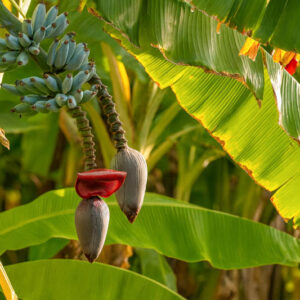
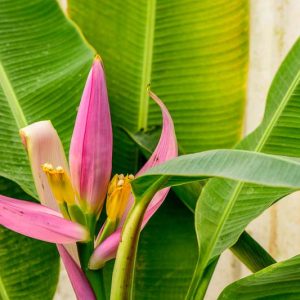
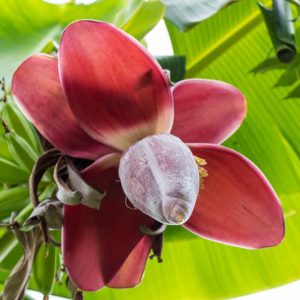
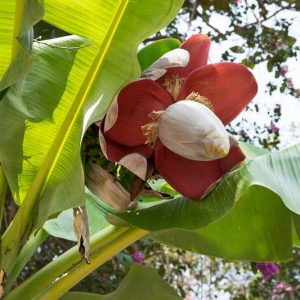
| Bloom & Fruit | Showy purple bracts reveal hands of seedless fruit; flowers/sets fruit when mature size is reached, not by day length |
| Pruning | Remove ragged leaves; after harvest, cut spent pseudostem to soil level; keep 1–2 strong pups |
| Primary Uses | Edible fruit, patio focal point, quick tropical effect; leaves for steaming/serving |
If you want that “instant vacation” look—and actual bananas—without a towering 15-foot (4.5 m) plant, Dwarf Cavendish is your friendly overachiever. It stays compact, rockets out lush paddle leaves, and can produce full-flavored Cavendish bananas in a courtyard or on a sunny deck. Not bad for a so-called “dwarf,” right?
‘Dwarf Cavendish’ is a compact clone in the Cavendish group (AAA). The pseudostem is stout and wind-tolerant, and young leaves often show charming maroon or purple speckles that fade as the canopy matures. It’s parthenocarpic, so fruit develops seedless without pollination—your breakfast won’t crunch.
Dwarf Cavendish is recipient to the prestigious Award of Garden Merit of the Royal Horticultural Society.
Don’t confuse it with ‘Super Dwarf’/‘Truly Tiny’ (much shorter) or larger Cavendish types like ‘Grand Nain’ and ‘Williams’. ‘Dwarf Cavendish’ usually tops out around 6–8 ft (1.6-2.4 m) outdoors, even less in containers, making it one of the most practical choices for small spaces.
Cavendish bananas rose to commercial fame in the 20th century, but for home gardeners the compact ‘Dwarf’ form changed the game: realistic fruiting potential without a farm-sized backyard. Today it’s the most commonly offered banana for patios and conservatories worldwide.
In warm months, expect a new leaf roughly every week. With good heat and feeding, a strong pup can show a flag leaf and bloom in 9–15 months. Add another few months for the fruit to size and mature. Each pseudostem fruits once; then you cut it down and let its pup take over—your clump keeps the relay going.
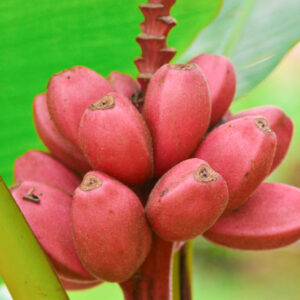
Once the inflorescence emerges, purple bracts lift to reveal “hands” of baby bananas. In warm, humid weather, flower-to-harvest can be ~3–5 months; in cooler nights or shoulder seasons, ~5–7+ months. Home bunches often weigh 15–30 lb with multiple hands; individual fingers typically finish at 6–8 in (15–20 cm).
Ripeness roadmap: fruit fill out until the angular “ridges” smooth, the last hand sizes, and the male tip beyond it finishes. Many growers cut at full but still green and hang the bunch in a cool, airy spot to ripen evenly. Flavor moves from mild and starchy to sweet, creamy, and aromatic with sugar freckling.
| Time to first bloom from pup | ~9–15 months in strong heat & care |
| Flower → harvest (warm) | ~3–5 months |
| Flower → harvest (cool nights) | ~5–7+ months |
Dwarf Cavendish shines in pots. Start at 15–20 gallons (bigger is better) with a high-quality, chunky mix (peat/coir + bark fines + perlite/pumice). Ensure big drainage holes.
| Task | Notes |
|---|---|
| Choose full sun, wind-sheltered spot or warm wall. | 6–8+ hrs sun; fences/hedges help tame wind tatter. |
| Amend soil generously; mound in clay. | Compost + drainage; keep crown at soil level. |
| Water deeply to settle roots. | Then mulch wide (3–4 in / 7–10 cm). |
| Start “little-and-often” feeding rhythm. | Frequent light feedings beat heavy blasts. |
| Keep 1 fruiting stem + 1–2 pups. | Thin extras; stake bunches as they size. |

When to cut: Fingers look plump and rounded (angles smoothed), the final hand has sized, and the male tip has finished flowering. Support the bunch weight, sever the stalk cleanly, and hang it in a shaded, airy spot.
Divide pups from a vigorous clump when they’ve produced some of their own roots—slice cleanly with a sharp, sanitized spade and replant immediately into warm, moist, well-prepared soil or a roomy pot. Commercial plants are often tissue-cultured (uniform and disease-screened).
Good airflow, clean starts, and tidy ground go a long way.
About 6–8 ft outdoors; 4–6 ft in large containers. Keep just 1–2 pups so it stays compact and productive.
With heat, moisture, and feeding: bloom in ~9–15 months from a strong pup, then ~3–5 months to harvest in warm weather.
It can, but you’ll need lots of light (sunroom/grow lights), warmth, and time. Many growers summer it outside, then finish ripening indoors.
No—this is a dessert banana (sweet when ripe). Plantains are starchier and used mainly for cooking.
Use a balanced product at light, regular doses during warm growth, plus compost top-dress. “Little and often” beats heavy single applications.
Updated: September 18, 2025 • Cultivar focus by Gardenia Editors
| Hardiness |
9 - 11 |
|---|---|
| Climate Zones | 8, 9, 14, 15, 16, 17, 18, 19, 20, 21, 22, 23, 24, H1, H2 |
| Plant Type | Fruits, Perennials |
| Plant Family | Musaceae |
| Genus | Musa |
| Common names | Banana |
| Exposure | Full Sun |
| Season of Interest | Spring (Early, Mid, Late), Summer (Early, Mid, Late), Fall, Winter |
| Height | 6' - 8' (180cm - 240cm) |
| Spread | 5' - 6' (150cm - 180cm) |
| Spacing | 60" - 72" (150cm - 180cm) |
| Maintenance | Average |
| Water Needs | Average |
| Soil Type | Chalk, Clay, Loam, Sand |
| Soil pH | Acid, Alkaline, Neutral |
| Soil Drainage | Moist but Well-Drained, Well-Drained |
| Characteristics | Showy, Evergreen, Fruit & Berries, Plant of Merit |
| Garden Uses | Patio And Containers |
| Garden Styles | Mediterranean Garden |
| Toxic to Humans | No known toxicity |
| Toxic to Cats | Not toxic |
| Toxic to Dogs | Not toxic |
| Toxic to Horses | Not toxic |


| Hardiness |
9 - 11 |
|---|---|
| Climate Zones | 8, 9, 14, 15, 16, 17, 18, 19, 20, 21, 22, 23, 24, H1, H2 |
| Plant Type | Fruits, Perennials |
| Plant Family | Musaceae |
| Genus | Musa |
| Common names | Banana |
| Exposure | Full Sun |
| Season of Interest | Spring (Early, Mid, Late), Summer (Early, Mid, Late), Fall, Winter |
| Height | 6' - 8' (180cm - 240cm) |
| Spread | 5' - 6' (150cm - 180cm) |
| Spacing | 60" - 72" (150cm - 180cm) |
| Maintenance | Average |
| Water Needs | Average |
| Soil Type | Chalk, Clay, Loam, Sand |
| Soil pH | Acid, Alkaline, Neutral |
| Soil Drainage | Moist but Well-Drained, Well-Drained |
| Characteristics | Showy, Evergreen, Fruit & Berries, Plant of Merit |
| Garden Uses | Patio And Containers |
| Garden Styles | Mediterranean Garden |
| Toxic to Humans | No known toxicity |
| Toxic to Cats | Not toxic |
| Toxic to Dogs | Not toxic |
| Toxic to Horses | Not toxic |
How many Musa acuminata ‘Dwarf Cavendish’ (Banana) do I need for my garden?
| Plant | Quantity | |
|---|---|---|
| Musa acuminata ‘Dwarf Cavendish’ (Banana) | N/A | Buy Plants |
Create a membership account to save your garden designs and to view them on any device.
Becoming a contributing member of Gardenia is easy and can be done in just a few minutes. If you provide us with your name, email address and the payment of a modest $25 annual membership fee, you will become a full member, enabling you to design and save up to 25 of your garden design ideas.
Join now and start creating your dream garden!
Create a membership account to save your garden designs and to view them on any device.
Becoming a contributing member of Gardenia is easy and can be done in just a few minutes. If you provide us with your name, email address and the payment of a modest $25 annual membership fee, you will become a full member, enabling you to design and save up to 25 of your garden design ideas.
Join now and start creating your dream garden!