Turn your banana patch into instant tropics. Pair bananas with nitrogen-fixers, lush living mulches, and nonstop bloomers to anchor moisture, feed soil, and invite beneficial insects.
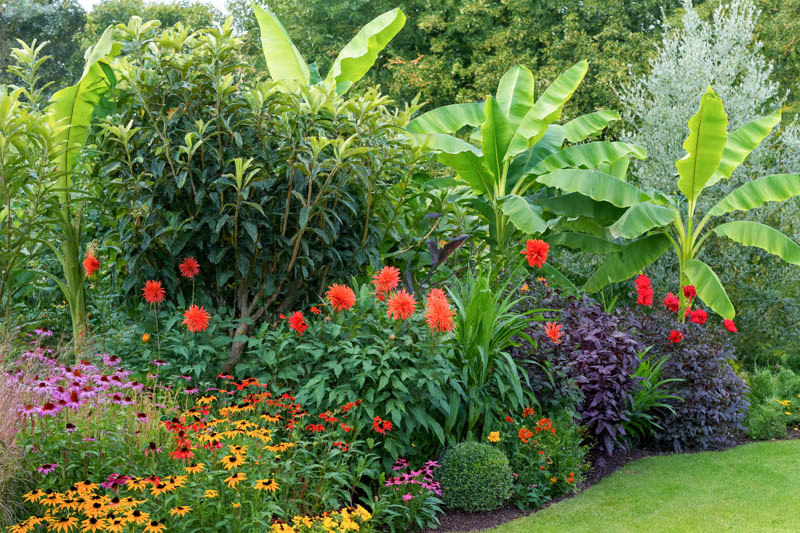


Bananas make any space feel like a tiny rainforest. Big, architectural leaves, fast growth, lush shade, and that satisfying rhythm of unfurling new foliage. With the right companions, a banana mat becomes easier to water and feed, less pest prone, and far more beautiful. This guide gives you a tropical companion plan you can plant this weekend.
Summary: Pair bananas with nitrogen fixers, living mulches, insectary flowers, and ornamental allies. Think pigeon pea, sweet potato, peanuts, comfrey, turmeric, ginger, lemongrass, marigolds — and for lush tropical style, add cannas, colocasia, or palms.
Goals: Soil cover, steady moisture, natural fertility, wind buffering, visual beauty, and beneficial insects.
Avoid: Thirsty tree bullies, dense turf, allelopathic species, and plants that block airflow or invite disease splash.
| Top Allies | Pigeon pea, sunn hemp, peanuts, white clover paths, comfrey, turmeric, ginger, sweet potato, lemongrass, sterile vetiver, marigolds (Tagetes), basil, zinnia |
|---|---|
| Ornamental Allies | Canna lilies, colocasia (elephant ears), palms (areca, dwarf date), heliconias, ti plants, cordylines, caladiums |
| Avoid Near Stems | Dense grasses, invasive mints, root-dense shrubs that rob moisture, tall shade-casters without pruning, allelopathic black walnut |
| Layout Tip | Bananas at center with a weed-free ring, then a doughnut of living mulch and low herbs, with windbreaks, ornamentals, and insectary flowers on the sunny edge |
Mix a few from each role. Keep anything tall outside the inner ring so banana leaves get sun and swift morning airflow.
| Companion | Type or Role | Height or Spread | Key Benefit | Notes |
|---|---|---|---|---|
| Pigeon pea (Cajanus cajan) | Shrubby legume, nitrogen fixer, light windbreak | 4 to 8 ft; airy canopy | Feeds soil, filters wind, edible pulses | Site on windward side and prune after flowering; manage seed set if self-sowing is a concern. |
| Sunn hemp (Crotalaria juncea) | Annual green manure, nitrogen fixer | 3 to 6 ft | Rapid biomass for chop-and-drop mulch | Sow in warm season; cut before stems get woody. Check local guidance for permitted seed sources. |
| Peanuts (Arachis hypogaea) | Low legume, living mulch | Low mats, 8 to 12 in. | Covers soil, adds nitrogen lightly | Best in frost-free areas or long summers. |
| Sweet potato (Ipomoea batatas) | Vining edible, living mulch, weed barrier | Spreads 3 to 6 ft | Shades soil, stabilizes slopes, extra harvest | Keep a clear ring around pseudostems; trim runners that try to climb. |
| Comfrey (Symphytum hybrids) | Dynamic accumulator, mulch source | 1 to 3 ft clumps | Deep roots mine nutrients, leaves for mulch | Plant just beyond the inner ring; cut leaves for chop-and-drop. |
| Turmeric & Ginger (Curcuma longa, Zingiber officinale) | Rhizomatous edibles, dapple shade lovers | 2 to 4 ft foliage | Understory biomass and harvest | Tuck on east/north side of clumps for gentle shade. |
| Lemongrass or Vetiver (Cymbopogon, Chrysopogon zizanioides) | Aromatic grass, wind filter, mulch source | 3 to 5 ft clumps | Slows wind, yields fragrant mulch, path edging | Use sterile vetiver types; space clumps 24–36 in (60–90 cm). Keep out of the inner 2 ft (60 cm). |
| Marigold (Tagetes) & Basil (Ocimum) | Insectary flowers, pest moderation at soil line | 8 to 24 in. | Nectar for beneficials, root zone interest | For nematodes use Tagetes patula/erecta in dense borders or off-season cover strips; sparse dot-planting has limited effect. |
| Zinnia & Cosmos | Tall annual bloom for beneficial insects | 2 to 4 ft, airy stems | Long bloom window supports predators & pollinators | Plant on the sunny outer arc. |
| White clover for paths | Low nitrogen fixer between beds | Low carpet | Soft walkway, living mulch, bee forage | Keep out of the crown ring. |
Tip: Start companions 12–24 in (30–60 cm) from each pseudostem. Maintain 3–6 in (7–15 cm) of coarse mulch, kept 2–3 in (5–8 cm) away from the stem base for fast morning drying.
| Plant | Visual Role | Benefit with Bananas | Notes |
|---|---|---|---|
| Canna lilies (Canna indica) | Tall blooms, tropical flowers | Adds color, quick biomass for chop-and-drop mulch | Plant just outside the banana ring; irrigate separately if they out-drink bananas; divide yearly. |
| Colocasia / Elephant ears | Huge architectural leaves | Moisture-loving, enhances rainforest feel | Best in wetter spots, partial shade; don’t invade the inner ring. |
| Palms (Areca, dwarf date) | Vertical accent, airy canopy | Light windbreak, tropical backdrop | Choose non-invasive species; prune lower fronds to keep airflow. |
| Heliconias / Ornamental gingers | Exotic flowers, upright leaves | Attracts pollinators, adds lush verticality | Keep to the outer edge so bananas still get sun. |
| Ti plants / Cordylines | Colorful foliage contrast | Breaks green monotony, frames mats | Best in partial sun; avoid crown zone; light tip-prune to shape. |
| Caladiums | Low, colorful ground accent | Brightens shade, underplanting in moist soil | Tuck under taller allies for dappled shade; lift in cold winters. |
These either compete too hard, block drying breezes, or raise disease pressure around leaves and fruit.
| Plant | Type | Reason to Avoid Nearby |
|---|---|---|
| Dense turf grasses | Lawns | Rob water and nutrients, invite mower damage to pups |
| Water hungry trees with aggressive roots | Shade trees | Outcompete bananas for moisture in summer heat |
| Allelopathic species like black walnut | Juglone producers | Chemical inhibition of nearby growth |
| Tall dense hedges right upwind | Screens | Trap humidity at leaves, slowing drying after rain |
| Invasive mints in the crown zone | Creeping herbs | Tangle with pups and hold soggy debris near stems |
| Season | Tasks and Companion Moves |
|---|---|
| Late winter to early spring | Clean old leaves, refresh mulch ring. Plant turmeric, ginger, and comfrey offsets. Sow marigolds and basil in trays. |
| Spring to early summer | Set pigeon pea or sunn hemp on the windward arc. Tuck sweet potato slips between clumps. Lay first chop-and-drop mulch before hot weather. |
| Mid to late summer | Maintain clear rings around pseudostems. Add lemongrass clumps where wind shreds leaves. Deadhead zinnias and cosmos to keep nectar flowing. |
| Fall | Harvest sweet potatoes and replant gaps with cool-tolerant flowers if climate allows. Thin pups so next season has a strong successor stem. |
| Winter or cool season | Mulch deeply ahead of cold snaps in marginal zones. Cut and remove spent, disease-spotted leaves so crowns dry fast in weak sun. |
Yes, in wider beds. Keep pineapple as a sunny edge or patch so it does not crowd banana pups. Papaya makes a light overstory if pruned; leave morning sun paths open.
Legumes add nitrogen to the system over time through root turnover and mulch. Combine them with regular compost or slow release organic fertilizer for best yields.
It is vigorous. Keep a clear donut around stems and trim runners that try to climb. The payoff is superb soil cover and bonus tubers.
Start one to two feet from the base so you can water, feed, and prop bunches. That ring also helps leaves dry quickly after rain.
Absolutely. Choose shallow rooted, compact partners like basil, dwarf marigolds, and a small trailing edible. Use a fast draining mix and feed little and often.
Imagine a banana mat as the drum beat and companions as the melody. A clear ring of mulch lets each pseudostem breathe. Beyond it, turmeric leaves and ginger blades arch into warm shade, sweet potato weaves a tidy green carpet, and lemongrass whispers at the edge. Flowers bring in tiny winged allies. You harvest fruit, herbs, greens, and mulch from the same square of soil. That is instant tropics and long-term soil health in one simple, beautiful pattern.
Updated: September 22, 2025 • Reviewed by Gardenia Editors
| Hardiness |
9 - 11 |
|---|---|
| Plant Type | Fruits, Perennials |
| Plant Family | Musaceae |
| Genus | Musa |
| Common names | Banana |
| Exposure | Full Sun |
| Season of Interest | Spring (Early, Mid, Late), Summer (Early, Mid, Late), Fall, Winter |
| Height | 6' - 25' (180cm - 7.6m) |
| Spread | 5' - 15' (150cm - 4.6m) |
| Maintenance | Average |
| Water Needs | Average |
| Soil Type | Chalk, Clay, Loam, Sand |
| Soil pH | Acid, Alkaline, Neutral |
| Soil Drainage | Moist but Well-Drained, Well-Drained |
| Characteristics | Showy, Evergreen, Fruit & Berries |
| Toxic to Humans | No known toxicity |
| Toxic to Cats | No known toxicity |
| Toxic to Dogs | No known toxicity |
| Toxic to Horses | No known toxicity |
| Hardiness |
9 - 11 |
|---|---|
| Plant Type | Fruits, Perennials |
| Plant Family | Musaceae |
| Genus | Musa |
| Common names | Banana |
| Exposure | Full Sun |
| Season of Interest | Spring (Early, Mid, Late), Summer (Early, Mid, Late), Fall, Winter |
| Height | 6' - 25' (180cm - 7.6m) |
| Spread | 5' - 15' (150cm - 4.6m) |
| Maintenance | Average |
| Water Needs | Average |
| Soil Type | Chalk, Clay, Loam, Sand |
| Soil pH | Acid, Alkaline, Neutral |
| Soil Drainage | Moist but Well-Drained, Well-Drained |
| Characteristics | Showy, Evergreen, Fruit & Berries |
| Toxic to Humans | No known toxicity |
| Toxic to Cats | No known toxicity |
| Toxic to Dogs | No known toxicity |
| Toxic to Horses | No known toxicity |
Create a membership account to save your garden designs and to view them on any device.
Becoming a contributing member of Gardenia is easy and can be done in just a few minutes. If you provide us with your name, email address and the payment of a modest $25 annual membership fee, you will become a full member, enabling you to design and save up to 25 of your garden design ideas.
Join now and start creating your dream garden!
Create a membership account to save your garden designs and to view them on any device.
Becoming a contributing member of Gardenia is easy and can be done in just a few minutes. If you provide us with your name, email address and the payment of a modest $25 annual membership fee, you will become a full member, enabling you to design and save up to 25 of your garden design ideas.
Join now and start creating your dream garden!