Blood Banana, Red Banana Tree, Seeded Red Banana, Sumatra Ornamental Banana, Maroon-variegated Banana Plant, Musa zebrina, Musa sumatrana, Musa acuminata 'Sumatrana', Musa acuminata subsp. zebrina, Musa 'Rojo', Musa acuminata 'Bloodleaf'

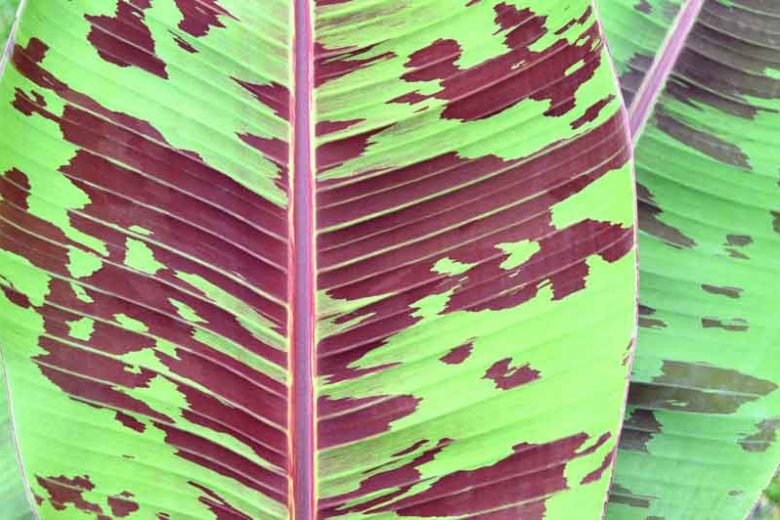


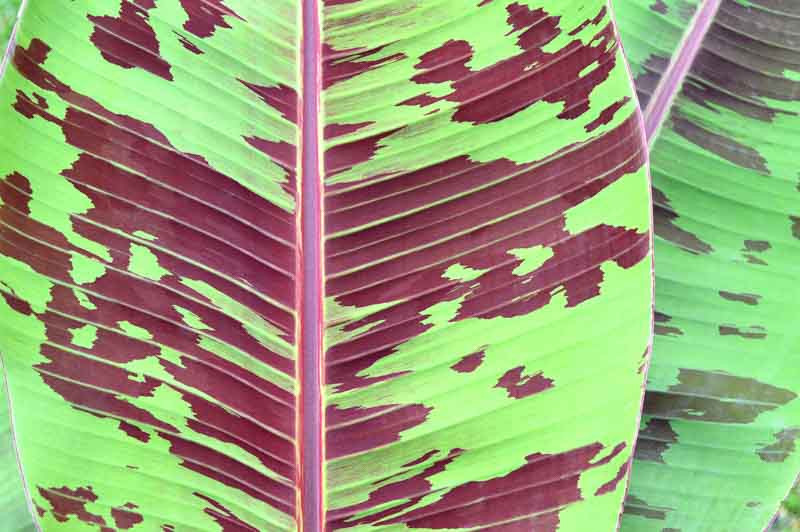
Summary: Grown for its astonishing foliage—broad green leaves slashed and spattered with burgundy red above and rich wine tones beneath. A tropical statement for patios, courtyards, and bright interiors.
Use: Ornamental foliage (primary), container focal point, “instant jungle” effect; fruit is rare outside the tropics and not the goal.
Growing Note: A selection of Musa acuminata (often sold as ‘Zebrina’, ‘Sumatrana’, or ‘Rojo’). Fast, heat-loving, and happiest with humidity.
| Botanical Name | Musa acuminata ‘Zebrina’ (also traded as M. acuminata var. zebrina, Musa ‘Sumatrana’, ‘Rojo’) |
|---|---|
| Family | Musaceae |
| Common Names | Blood Banana, Zebra Banana, Red Banana (ornamental), Sumatra Banana |
| Plant Type & Habit | Herbaceous perennial with a layered pseudostem; forms clumps (mats) by underground rhizomes |
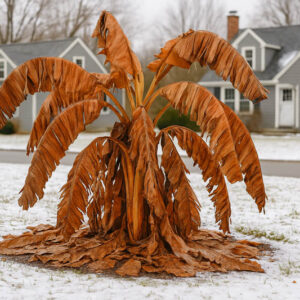
| Hardiness (USDA) | Best outdoors year-round in 10–11; can be grown in warm 9b with protection. Leaves collapse near 32°F (0°C); stems injured around 28–30°F (-2 to -1°C). In cooler zones: container only, overwinter frost-free. |
| Size | 5-8 ft (1.5-2.4 m) tall and wide |
| Sun & Exposure | Bright light to full sun. In hot, arid summers, give light afternoon shade to protect variegation. Indoors: brightest window with several hours of sun. |
| Soil | Rich, moisture-retentive yet fast-draining; pH ~5.5–7.0; loves organic matter |
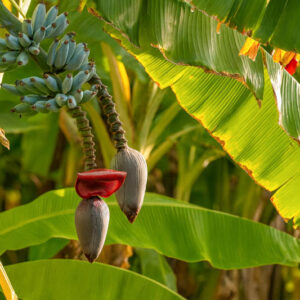
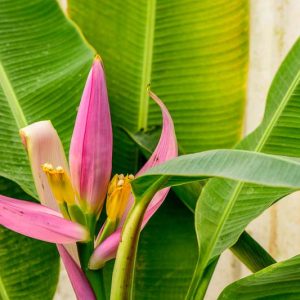
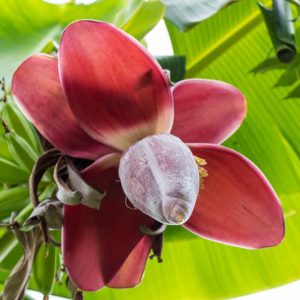
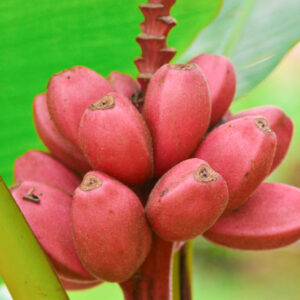
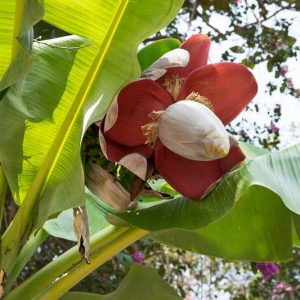
| Bloom & Fruit | Primarily ornamental; flowering/fruiting is uncommon outside the tropics. Any fruit produced can be small and often seedy. |
| Pruning | Trim tattered leaves; remove spent stems to soil level; maintain 1–2 strong pups for a neat clump |
| Primary Uses | Eye-popping foliage in beds and big containers; dramatic indoor specimen in bright rooms |
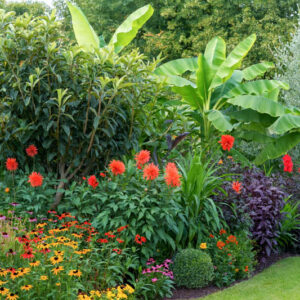
If your garden needs a “whoa, what is that?” moment, ‘Zebrina’ brings it—broad leaves splashed with painterly wine-red streaks that look hand-brushed. It’s the banana you grow when fruit is optional and foliage theater is the main event. In warm climates it thrives outdoors; elsewhere it’s a stellar container diva that summers on the patio and winters indoors without losing its head-turning charm.
The calling card is the foliage. Mature leaves are fresh green with bold burgundy blotches and stripes above, while the undersides glow a deep maroon—spectacular in backlight. Young leaves often emerge more heavily mottled; patterns can soften in lower light or in deep shade. Pseudostems are stout for the size, sheathing to form a “trunk,” and the clump slowly expands via short rhizomes (pups arise near the mother plant).
Zebrina is the recipient of the prestigious Award of Garden Merit of the Royal Horticultural Society.
Because this cultivar is widely traded, you’ll see it labeled as Musa acuminata ‘Zebrina’, M. acuminata var. zebrina, ‘Sumatrana’, or simply “Red Banana (ornamental).” All point to the same showy, red-painted leaf look. Unlike Cavendish dessert bananas, ‘Zebrina’ is grown almost entirely for foliage—any fruit that appears in non-tropical conditions is a novelty, not a harvest strategy.
Musa acuminata is native to Southeast Asia, and red-mottled forms are associated historically with islands like Sumatra and Java. Garden selections collected and propagated by tissue culture gave us today’s reliable ‘Zebrina’—uniform, vigorous, and dramatically colored even when grown in pots.
Bananas belong to the genus Musa in the family Musaceae. Most sweet “dessert” bananas trace primarily to Musa acuminata (A genome), most commonly as AAA triploid or AA diploid clones. Plantains and many starchier cooking types carry Musa balbisiana (B genome) ancestry; their triploid hybrids are historically grouped under Musa × paradisiaca (AAB/ABB). Several other species are important for ornament, local use, or breeding—among them M. basjoo (cold-hardy Japanese fiber banana; chiefly ornamental), M. ornata (showy flowering ornamental), M. velutina (pink banana; ornamental), M. coccinea (scarlet banana; ornamental), and regionally significant wild relatives such as M. sikkimensis, M. itinerans, and M. schizocarpa.
Give it warmth and moisture and it responds quickly. In peak summer, new leaves unfurl in steady succession—each one a fresh canvas of green (and in some cultivars, green splashed with burgundy). Plants typically reach 5–6 ft (1.5–1.8 m) tall and wide; in rich, frost-free climates they often hit 6–8 ft (1.8–2.4 m) and can occasionally touch 10 ft (3 m). In containers they stay more compact, usually 3–6 ft (0.9–1.8 m)—perfect for patios and bright interiors. Pseudostems aren’t woody; after a stem flowers, it’s finished—prune it out and let a pup take over. For the neatest look, keep each clump to one main stem plus one or two successors.
‘Zebrina’ can flower, but outside the humid tropics it rarely fruits to maturity. When it does, fruit is typically small and may be seedy—this cultivar is not the backyard banana bread hero. If your dream is home-grown dessert bananas in a marginal climate, pick early-fruiting dessert types (e.g., ‘Raja Puri’ or ‘Dwarf Orinoco’) for a separate container and let ‘Zebrina’ do the eye-candy job it was born for.
‘Zebrina’ is a natural for big, handsome pots. Start with at least 14–20 in (35–50 cm) wide containers (15–25 gal / 60–95 L). Use a chunky, airy mix: high-quality potting soil cut with bark fines and perlite/pumice for drainage.
| Task | Notes |
|---|---|
| Pick a bright, wind-sheltered spot (or brightest indoor window). | Gentle afternoon shade in hot, arid climates protects color. |
| Amend soil and mound in clay. | Compost + fine bark → fertile and fast-draining. |
| Water in thoroughly; mulch wide. | Keep mulch 2 in (5 cm) off the stem. |
| Adopt “little-and-often” feeding. | Light doses every 2–4 weeks in warmth. |
| Shape the clump: 1 main stem + 1–2 pups. | Remove extras to keep it elegant in pots. |
Divide well-rooted pups from a vigorous mother when they’re at least 12–18 in (30–45 cm) tall and showing their own roots. Slice down between mother and pup with a sharp, sanitized spade, keeping as many pup roots as possible. Pot immediately into a warm, airy mix or plant into prepared, warm ground. Commercial stock is commonly tissue-cultured for uniformity and disease screening.
Good hygiene and airflow keep ‘Zebrina’ looking pristine. Indoors, dry air invites spider mites; outside, sap-suckers may appear on young growth.
Probably not unless you garden in the humid tropics. It’s grown for foliage. If fruit is your goal in a warm-temperate climate, grow a dessert cultivar in a separate pot and enjoy ‘Zebrina’ as your showpiece.
Light is the #1 driver. Move to a brighter exposure (avoid harsh, drying afternoon sun in hot regions). Also check feeding and avoid chronically soggy soil.
Leaves collapse at frost; stems are damaged around 28–30°F (-2 to -1°C). In 9b, protect during cold snaps; elsewhere, overwinter containers indoors, bright and frost-free.
Bananas are generally considered non-toxic to cats and dogs. Still, discourage chewing and avoid pesticide residues on leaves.
Wait until warm weather and the pup has its own roots. Divide with a clean, sharp spade; pot or plant immediately and keep evenly moist while it re-establishes.
Updated: September 22, 2025 • Cultivar focus by Gardenia Editors
| Hardiness |
9 - 11 |
|---|---|
| Climate Zones | 8, 9, 14, 15, 16, 17, 18, 19, 20, 21, 22, 23, 24, H1, H2 |
| Plant Type | Fruits, Perennials |
| Plant Family | Musaceae |
| Genus | Musa |
| Common names | Banana |
| Exposure | Full Sun |
| Season of Interest | Spring (Early, Mid, Late), Summer (Early, Mid, Late), Fall, Winter |
| Height | 5' - 8' (150cm - 240cm) |
| Spread | 5' - 8' (150cm - 240cm) |
| Spacing | 60" - 96" (150cm - 240cm) |
| Maintenance | Average |
| Water Needs | Average |
| Soil Type | Chalk, Clay, Loam, Sand |
| Soil pH | Acid, Alkaline, Neutral |
| Soil Drainage | Moist but Well-Drained, Well-Drained |
| Characteristics | Plant of Merit, Showy, Evergreen, Fruit & Berries |
| Garden Uses | Patio And Containers |
| Garden Styles | Mediterranean Garden |
| Toxic to Humans | No known toxicity |
| Toxic to Cats | Not toxic |
| Toxic to Dogs | Not toxic |
| Toxic to Horses | Not toxic |


| Hardiness |
9 - 11 |
|---|---|
| Climate Zones | 8, 9, 14, 15, 16, 17, 18, 19, 20, 21, 22, 23, 24, H1, H2 |
| Plant Type | Fruits, Perennials |
| Plant Family | Musaceae |
| Genus | Musa |
| Common names | Banana |
| Exposure | Full Sun |
| Season of Interest | Spring (Early, Mid, Late), Summer (Early, Mid, Late), Fall, Winter |
| Height | 5' - 8' (150cm - 240cm) |
| Spread | 5' - 8' (150cm - 240cm) |
| Spacing | 60" - 96" (150cm - 240cm) |
| Maintenance | Average |
| Water Needs | Average |
| Soil Type | Chalk, Clay, Loam, Sand |
| Soil pH | Acid, Alkaline, Neutral |
| Soil Drainage | Moist but Well-Drained, Well-Drained |
| Characteristics | Plant of Merit, Showy, Evergreen, Fruit & Berries |
| Garden Uses | Patio And Containers |
| Garden Styles | Mediterranean Garden |
| Toxic to Humans | No known toxicity |
| Toxic to Cats | Not toxic |
| Toxic to Dogs | Not toxic |
| Toxic to Horses | Not toxic |
How many Musa acuminata ‘Zebrina’ (Blood Banana) do I need for my garden?
| Plant | Quantity | |
|---|---|---|
| Musa acuminata ‘Zebrina’ (Blood Banana) | N/A | Buy Plants |
Create a membership account to save your garden designs and to view them on any device.
Becoming a contributing member of Gardenia is easy and can be done in just a few minutes. If you provide us with your name, email address and the payment of a modest $25 annual membership fee, you will become a full member, enabling you to design and save up to 25 of your garden design ideas.
Join now and start creating your dream garden!
Create a membership account to save your garden designs and to view them on any device.
Becoming a contributing member of Gardenia is easy and can be done in just a few minutes. If you provide us with your name, email address and the payment of a modest $25 annual membership fee, you will become a full member, enabling you to design and save up to 25 of your garden design ideas.
Join now and start creating your dream garden!