Flowering Banana, Ornamental Banana, Bronze Banana, Rose Banana, Musa mexicana, Musa speciosa, Musa troglodytarum var. rubrifolia

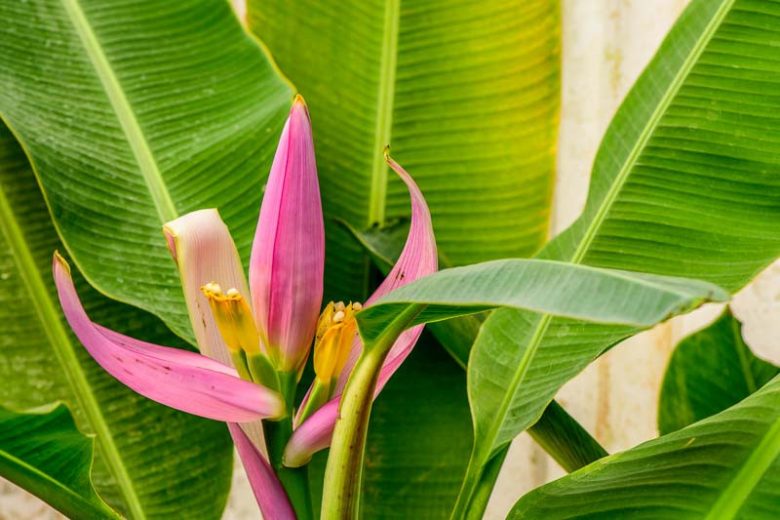
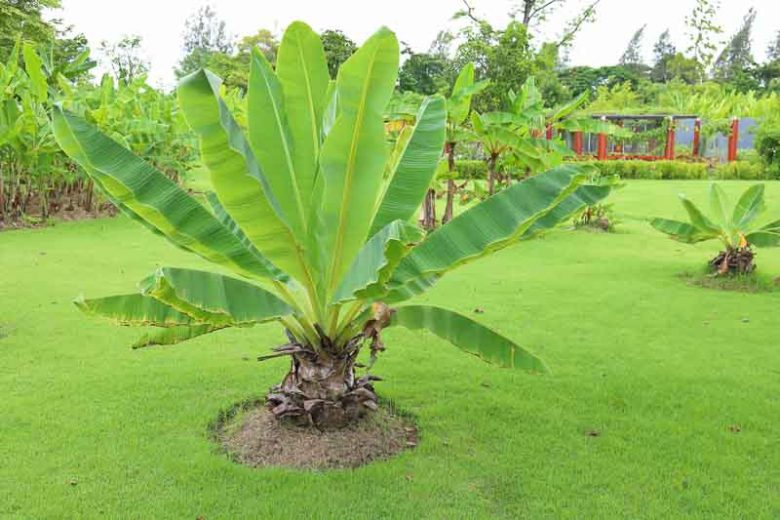


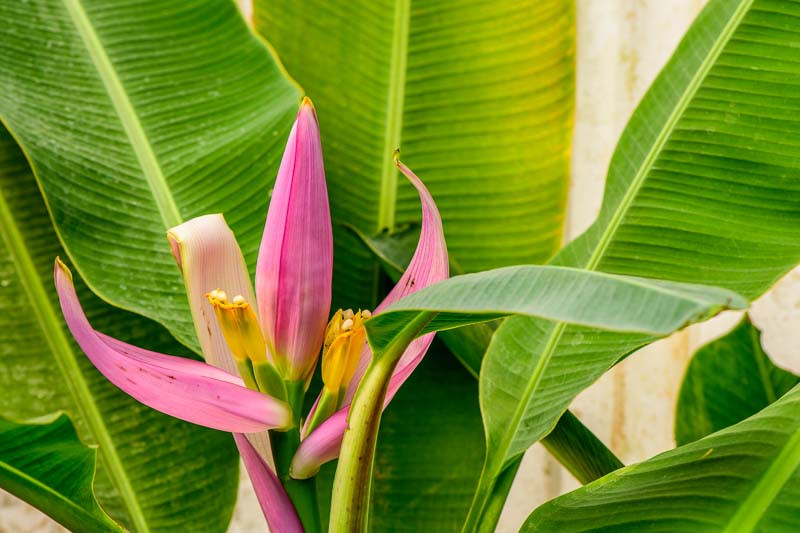
Summary: A compact, ultra-showy ornamental banana with pink to lilac bracts and cheerful yellow-orange flowers that pop for weeks. Perfect for containers, courtyards, poolside beds, and anywhere you want tropical glam without towering height.
Use: Ornamental accent, statement container, cut inflorescences, wildlife-friendly display.
Growing Note: Loves heat and humidity; not a cold-hardy banana (think tender perennial). In cooler zones, grow in pots and winter indoors.
| Botanical Name | Musa ornata Roxb. (Flowering Banana) |
|---|---|
| Family | Musaceae |
| Common Names | Flowering Banana, Ornamental Banana (pink) |
| Plant Type & Habit | Tender, clump-forming herbaceous perennial with pseudostems (spreads slowly by short rhizomes/pups) |
| Hardiness (USDA) | Best outdoors year-round in Zones 10–11. In warm 9b, possible with microclimate & freeze protection. Treat as a container plant and overwinter frost-free in colder zones. |
| Size | Height: typically 6–9 ft (1.8–2.7 m). Spread: 5-7 ft (1.5–2.1 m). |
| Sun & Exposure | Full sun to bright part shade (light afternoon shade inland/hot, arid sites) |
| Soil | Rich, moisture-retentive but free-draining; pH ~5.5–7.0; thrives with ample organic matter and warmth |
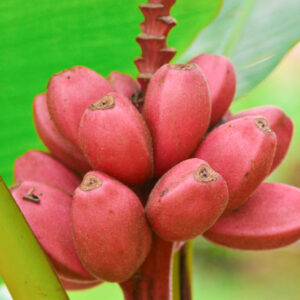
| Bloom & Fruit | Showy pink–lilac bracts revealing yellow/orange flowers; small, seedy ornamental fruit may follow—not grown for eating |
| Pruning | Remove tattered leaves; cut spent stems at soil line after flowering; maintain 1–2 successor pups |
| Primary Uses | Ornamental banana plant for containers & beds, tropical border color, cut inflorescences, wildlife interest |
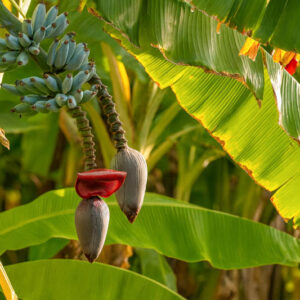
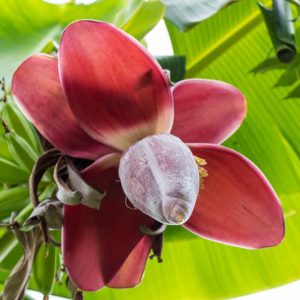
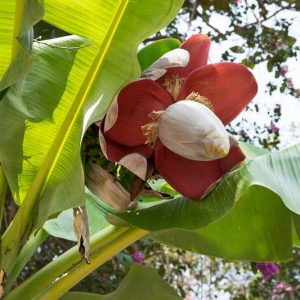
If your design vibe is “tropical lounge,” Musa ornata delivers instant resort energy. The bracts are lipstick-pink to lilac, stacked like chic parasols above glossy green leaves. It’s compact enough for patios and small courtyards, yet dramatic enough to headline a border. And unlike fruiting dessert bananas, Flowering Banana focuses on the show.
Musa ornata forms a tight clump of pseudostems (leaf bases wrapped into a sturdy cylinder). Leaves are elongated and satiny, mid-green with a softly glaucous cast in some clones. The inflorescence is the reason you grow it: elegant, upward-angled or slightly arching spikes with pink to lilac bracts that hold color for weeks, revealing rows of yellow to orange tubular flowers inside. Small, hard-seeded fruits may follow; they’re decorative, not dessert.
This flowering banana is the recipient of the prestigious Award of Garden Merit of the Royal Horticultural Society.
Native to the eastern Himalayan foothills and adjoining South/Southeast Asia—think Northeast India (Assam), Bangladesh, Myanmar—M. ornata thrives in monsoonal climates: warm, wet summers, and frost-free winters with drying periods. That heritage explains its love of humidity, rich soils, and steady summer moisture. It’s not a cold-hardy banana like M. basjoo, so plan for protection or containers in temperate gardens.
Bananas belong to the genus Musa in the family Musaceae. Most sweet “dessert” bananas trace primarily to Musa acuminata (A genome), most commonly as AAA triploid or AA diploid clones. Plantains and many starchier cooking types carry Musa balbisiana (B genome) ancestry; their triploid hybrids are historically grouped under Musa × paradisiaca (AAB/ABB). Several other species are important for ornament, local use, or breeding—among them M. basjoo (cold-hardy Japanese fiber banana; chiefly ornamental), M. ornata (showy flowering ornamental), M. velutina (pink banana; ornamental), M. coccinea (scarlet banana; ornamental), and regionally significant wild relatives such as M. sikkimensis, M. itinerans, and M. schizocarpa.
In heat, Flowering Banana is enthusiastic. Expect a new leaf every 7–14 days in midsummer. A well-fed stem reaches flowering size in 12–18 months. Each pseudostem flowers once, then retires; the clump continues via pups. For a tidy silhouette, keep one show stem plus 1–2 successors, removing extras.
With warmth, light, and regular feeding, plants commonly bloom in their second warm season (sometimes sooner from robust divisions). The bracts stay vivid for weeks, especially in humid, sheltered courtyards. Consider the fruits ornamental; birds may investigate. If you prefer tidy borders in frost-free climates, remove the fruiting hand before seeds mature.
Musa ornata shines in pots—arguably the best strategy outside Zones 10–11. Choose a sturdy, wide container (at least 16–20 in / 40–50 cm across for young plants; 20–24 in / 50–60 cm for long-term displays) and a chunky, airy mix: quality potting soil + bark fines + perlite/pumice. Cluster with contrasting foliage and let those pink bracts steal the scene.
| Task | Notes |
|---|---|
| Pick a warm, wind-sheltered spot or large, well-drained pot. | South-facing walls/courtyards add heat and color longevity. |
| Amend soil generously; mound in clay. | Compost + fine bark improves drainage while holding moisture. |
| Water in deeply; mulch wide. | Keep mulch 2 in (5 cm) off the pseudostem to prevent rot. |
| Start your “little-and-often” feeding rhythm. | Regular light feedings beat occasional heavy doses. |
| Shape the clump for elegance. | Keep 1 flowering stem + 1–2 pups; remove extras. |
Division (fastest): Separate robust, well-rooted pups when 12–18 in (30–45 cm) tall and showing their own roots. Slice cleanly between mother and pup with a sanitized spade, pot immediately into a warm, airy mix, and shade lightly while it reestablishes.
Seed (variable): Species plants can set seed, but ornamental clones are shy. If you sow, expect warmth (75–85°F / 24–29°C) and patience—germination is erratic and slow.
Healthy, well-sited plants are resilient, especially with good airflow and tidy ground. Still, keep an eye on the usual suspects—especially indoors or under cover.
Updated: September 2025 • Reviewed for clarity and horticultural accuracy
Treat it as ornamental. Small fruits sometimes follow the flowers, but they’re hard-seeded and not grown for eating—the floral display is the main event.
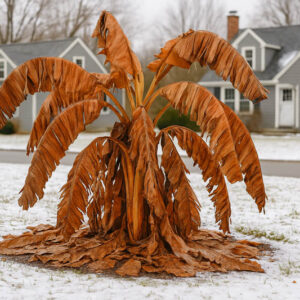
Leaves scorch at frost. It’s reliable outdoors in Zones 10–11; in 9b, give a warm wall and protect during freezes. Elsewhere, grow in containers and overwinter frost-free.
Yes—give heat, bright light, steady moisture, and regular feeding. A well-grown potted plant often flowers in its second warm season.
In warm weather, expect a new leaf every week or two. With good care, a pup can reach flowering size within 12–18 months.
For a tidy clump and consistent blooms, keep one flowering stem plus 1–2 successors. Remove extras so energy goes into the show.
Updated: September 2025 • Reviewed by Gardenia Editors
| Hardiness |
9 - 11 |
|---|---|
| Heat Zones |
10 - 11 |
| Plant Type | Perennials |
| Plant Family | Musaceae |
| Genus | Musa |
| Common names | Banana |
| Exposure | Full Sun |
| Season of Interest | Spring (Early, Mid, Late), Summer (Early, Mid, Late), Fall, Winter |
| Height | 6' - 9' (180cm - 270cm) |
| Spread | 5' - 7' (150cm - 210cm) |
| Spacing | 60" - 84" (150cm - 210cm) |
| Maintenance | High |
| Water Needs | Average |
| Soil Type | Chalk, Clay, Loam, Sand |
| Soil pH | Acid, Alkaline, Neutral |
| Soil Drainage | Moist but Well-Drained, Well-Drained |
| Characteristics | Plant of Merit, Showy, Evergreen, Fruit & Berries |
| Tolerances | Heat |
| Garden Uses | Wall-Side Borders |
| Garden Styles | Coastal Garden, Mediterranean Garden |
| Toxic to Humans | No known toxicity |
| Toxic to Cats | No known toxicity |
| Toxic to Dogs | No known toxicity |
| Toxic to Horses | No known toxicity |


| Hardiness |
9 - 11 |
|---|---|
| Heat Zones |
10 - 11 |
| Plant Type | Perennials |
| Plant Family | Musaceae |
| Genus | Musa |
| Common names | Banana |
| Exposure | Full Sun |
| Season of Interest | Spring (Early, Mid, Late), Summer (Early, Mid, Late), Fall, Winter |
| Height | 6' - 9' (180cm - 270cm) |
| Spread | 5' - 7' (150cm - 210cm) |
| Spacing | 60" - 84" (150cm - 210cm) |
| Maintenance | High |
| Water Needs | Average |
| Soil Type | Chalk, Clay, Loam, Sand |
| Soil pH | Acid, Alkaline, Neutral |
| Soil Drainage | Moist but Well-Drained, Well-Drained |
| Characteristics | Plant of Merit, Showy, Evergreen, Fruit & Berries |
| Tolerances | Heat |
| Garden Uses | Wall-Side Borders |
| Garden Styles | Coastal Garden, Mediterranean Garden |
| Toxic to Humans | No known toxicity |
| Toxic to Cats | No known toxicity |
| Toxic to Dogs | No known toxicity |
| Toxic to Horses | No known toxicity |
How many Musa ornata (Flowering Banana) do I need for my garden?
| Plant | Quantity | |
|---|---|---|
| Musa ornata (Flowering Banana) | N/A | Buy Plants |
Create a membership account to save your garden designs and to view them on any device.
Becoming a contributing member of Gardenia is easy and can be done in just a few minutes. If you provide us with your name, email address and the payment of a modest $25 annual membership fee, you will become a full member, enabling you to design and save up to 25 of your garden design ideas.
Join now and start creating your dream garden!
Create a membership account to save your garden designs and to view them on any device.
Becoming a contributing member of Gardenia is easy and can be done in just a few minutes. If you provide us with your name, email address and the payment of a modest $25 annual membership fee, you will become a full member, enabling you to design and save up to 25 of your garden design ideas.
Join now and start creating your dream garden!