Pink Banana, Hairy Banana, Pink Fruiting Banana, Pink Velvet Banana, Self-peeling Banana, Fuzzy Pink Banana, Velvet Banana, Musa dasycarpa

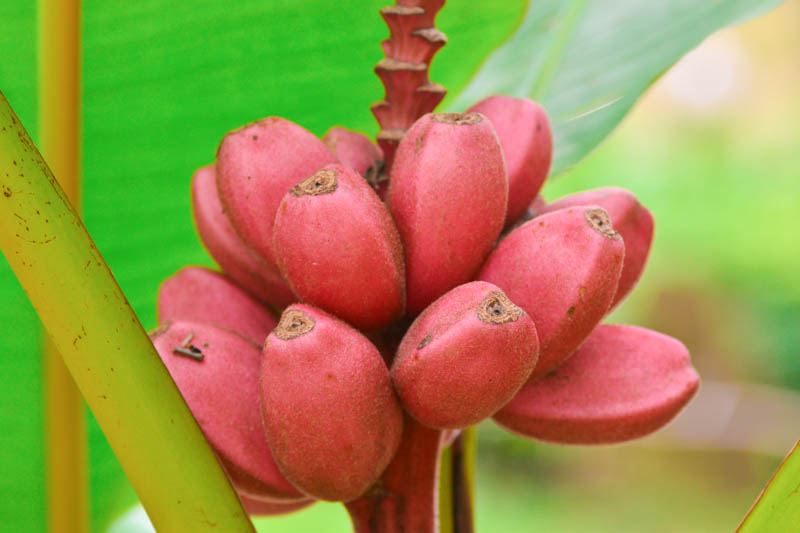
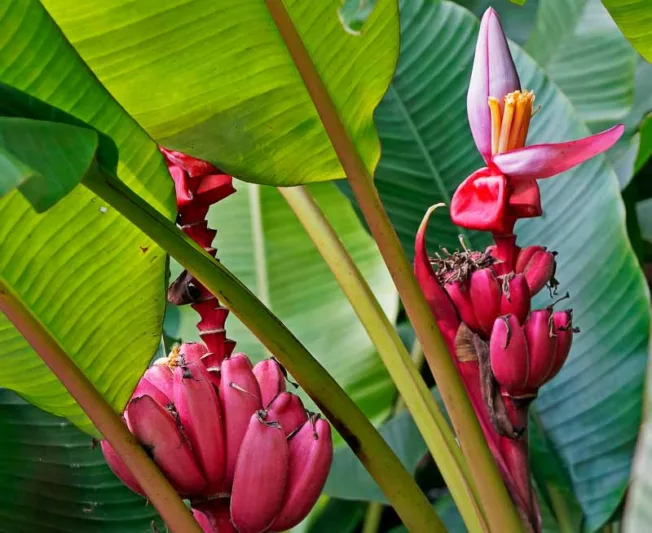


Summary: Compact, fast, and flamboyant, Musa velutina makes clusters of small, fuzzy pink bananas that split open on the plant to reveal inky black seeds. It’s the banana that stops guests in their tracks.
Use: Ornamental focal point, wildlife-friendly fruit (edible but very seedy), bold container accent, tropical bedding.
Growing Note: More cold-tolerant than many ornamentals—often root-hardy with protection—yet happiest in warmth and steady moisture.
| Botanical Name | Musa velutina (syn. M. dasycarpa) |
|---|---|
| Family | Musaceae |
| Common Names | Pink Banana, Hairy Banana, Self-Peeling Banana |
| Plant Type & Habit | Herbaceous perennial; clump-forming via short rhizomes (pups) |
| Hardiness (USDA) | Year-round outdoors in 9–11. Often rhizome-hardy in 8a–8b with deep, dry winter mulch and shelter. In very protected 7b microclimates, some gardeners report rhizome survival with heavy mulch—treat as experimental. Leaves collapse at light frost; pseudostems usually die below ~28–30°F (−2 to −1°C) but can resprout from protected crowns in spring. Grow in containers and overwinter frost-free in colder zones. |
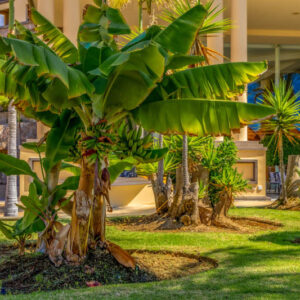
| Size | Height: typically 4–7 ft (1.2–2.1 m), occasionally to ~8 ft (2.4 m) in ideal heat & humidity. Spread: typically 3–5 ft (0.9–1.5 m). |
| Sun & Exposure | Full sun to bright part shade; afternoon shade in hot, arid regions |
| Soil | Rich, moisture-retentive, fast-draining; pH ~5.5–7.0; high organic matter |
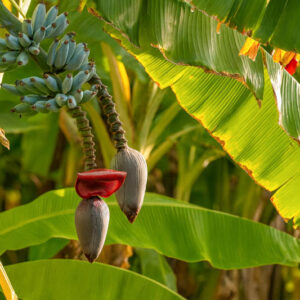
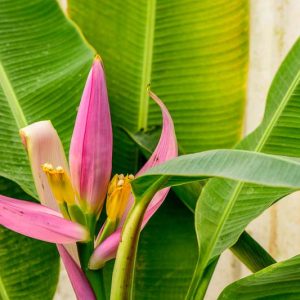
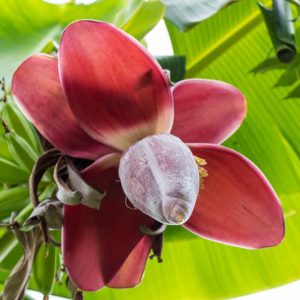
| Bloom & Fruit | Showy pink bracts; fuzzy pink bananas split open when ripe, exposing black seeds; edible pulp but very seedy |
| Pruning | Remove tattered leaves; cut spent stems at soil line after fruiting; keep 1–2 pups |
| Primary Uses | Tropical accent, container showpiece, pollinator & wildlife interest |
If your garden style leans “joyful maximalist,” Musa velutina is your plant. It’s compact enough for patios and small courtyards, yet theatrical—fresh green leaves, rosy-pink flower bracts, and those fuzzy little bananas that split themselves like party favors. Even folks who’ve “seen it all” will stop and grin.
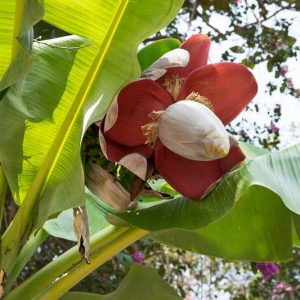
Pink Banana is an ornamental banana plant that grows as a tight clump of pseudostems (leaf bases wrapped into a trunk-like cylinder). Leaves are elongated and lush, mid-green to slightly bluish depending on light and nutrition. The inflorescence emerges with rosy bracts, followed by short, fat bananas dressed in soft fuzz—like tiny velvet sausages. As they ripen, the peels split open by themselves along three seams, revealing pale pulp packed with glossy black seeds. The pulp is technically edible with a mild, sweet-acid taste, but the hard seeds make it more of a curiosity (wildlife don’t mind!).
Pink Banana is the recipient of the prestigious Award of Garden Merit of the Royal Horticultural Society.
Native to the eastern Himalayan region and surrounding parts of South and Southeast Asia—think Northeast India (Assam), Bangladesh, Myanmar, and adjacent highlands—Musa velutina is adapted to monsoonal rhythms: warm, wet summers and drier, cooler winters. That heritage explains its love of humidity, fertile soils, and steady moisture during the growing season.
Bananas belong to the genus Musa in the family Musaceae. Most sweet “dessert” bananas trace primarily to Musa acuminata (A genome), most commonly as AAA triploid or AA diploid clones. Plantains and many starchier cooking types carry Musa balbisiana (B genome) ancestry; their triploid hybrids are historically grouped under Musa × paradisiaca (AAB/ABB). Several other species are important for ornament, local use, or breeding—among them M. basjoo (cold-hardy Japanese fiber banana; chiefly ornamental), M. ornata (showy flowering ornamental), M. velutina (pink banana; ornamental), M. coccinea (scarlet banana; ornamental), and regionally significant wild relatives such as M. sikkimensis, M. itinerans, and M. schizocarpa.
Given warmth and water, it grows fast. Expect ~4–7 ft (1.2–2.1 m) outdoors in a good season; in large containers it’s often ~3–5 ft (0.9–1.5 m). It can flower in its second year (sometimes first, from robust starts). Each pseudostem flowers once and then is finished; the clump continues via pups. For a tidy look, keep a “triangle” of one show stem plus one or two successors at different ages.
Pink Banana, a striking ornamental banana plant, often flowers dependably in warm summers. Outdoors in Zones 9–11, fruits are common; in big containers in 8–9, you’ll still see a show with good heat. This surprisingly cold-hardy banana produces fruits that split as they ripen—it’s normal, not a problem. The pulp is edible but seedy; most gardeners grow it for spectacle and wildlife value. If you’d rather avoid volunteer seedlings in frost-free gardens, cut off the fruiting hand before the seeds mature.
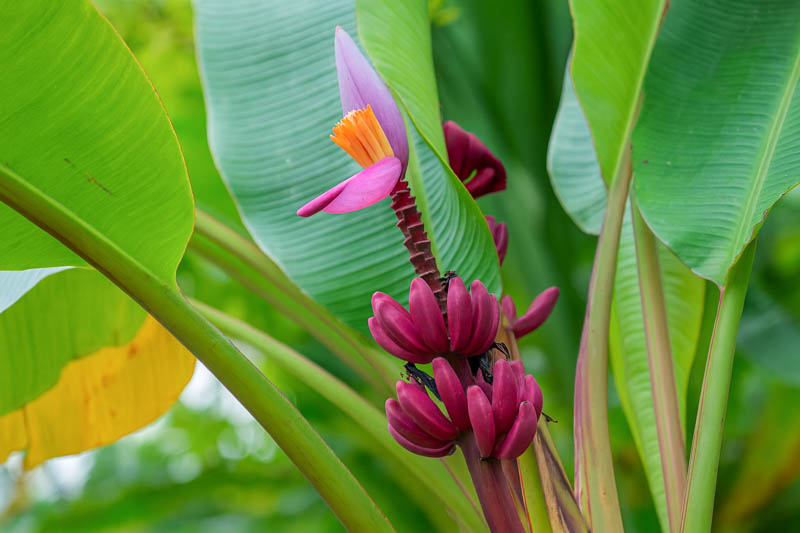
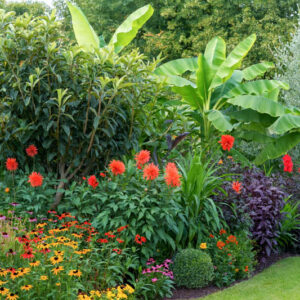
Pink Banana is tailor-made for statement containers. Choose a sturdy, wide pot—at least 14–18 in (35–45 cm) across for young plants; 20–24 in (50–60 cm) for long-term displays. Use a chunky, airy mix: quality potting soil + bark fines + perlite/pumice. Outdoors, cluster with foliage companions for instant tropical drama.
| Task | Notes |
|---|---|
| Pick a bright, wind-sheltered site (or brightest window). | PM shade in hot, dry climates prevents leaf scorch. |
| Improve soil for drainage + fertility. | Compost + fine bark = moisture-holding without waterlogging. |
| Water in deeply; mulch wide. | Keep mulch 2 in (5 cm) off the pseudostem. |
| Set your feeding rhythm. | Light, regular doses in warm months. |
| Shape the clump. | Keep one main stem + 1–2 pups; remove extras. |
Division (fastest): Separate well-rooted pups when 12–18 in (30–45 cm) tall and showing their own roots. Slice down between mother and pup with a clean, sharp spade, keeping as many pup roots as possible. Pot immediately into a warm, airy mix or plant into prepared ground once nights are reliably warm.
Seed (for the patient): Musa velutina sets viable seed. Fresh seed germinates best with warmth (around 77–86°F / 25–30°C) and time—weeks to months. Light scarification and fluctuating day/night temps can improve results. Seedlings are tough once established but grow on steadily, not instantly.
Healthy plants in good light and moving air are surprisingly resilient. Keep an eye out for the usual suspects, especially under cover or indoors.
Yes—the pulp is edible and mildly sweet, but it’s packed with hard black seeds, so most people treat it as ornamental or wildlife food rather than dessert.
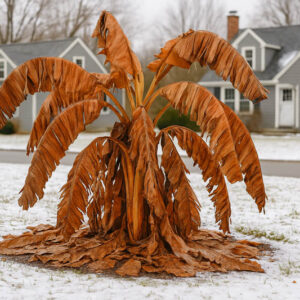
Leaves collapse at frost. In zones 9–11 the clump usually sails through winter; in warm 8 it can be root-hardy with deep mulch, resprouting in spring. In very sheltered 7b, some gardeners report rhizomes returning with heavy mulch—treat this as experimental.
From fresh seed and warm conditions, expect 12–24+ months to first flowers depending on vigor, heat, and feeding. Division of pups is much faster
Yes—give the brightest window, consistent moisture, regular feeding in warmth, and boosted humidity (45–60%+). It’s happiest outdoors in summer.
It clumps politely and is easy to manage by removing extra pups. In frost-free climates it may self-sow—deadhead fruit if you prefer tidy borders.
Updated: September 23, 2025 • Reviewed by Gardenia Editors
| Hardiness |
7 - 11 |
|---|---|
| Climate Zones | 23, 24, H2 |
| Plant Type | Perennials |
| Plant Family | Musaceae |
| Genus | Musa |
| Common names | Banana |
| Exposure | Full Sun |
| Season of Interest | Spring (Early, Mid, Late), Summer (Early, Mid, Late), Fall, Winter |
| Height | 4' - 8' (120cm - 240cm) |
| Spread | 3' - 5' (90cm - 150cm) |
| Spacing | 60" (150cm) |
| Maintenance | Average |
| Water Needs | Average |
| Soil Type | Chalk, Clay, Loam, Sand |
| Soil pH | Acid, Alkaline, Neutral |
| Soil Drainage | Moist but Well-Drained, Well-Drained |
| Characteristics | Plant of Merit, Showy, Evergreen, Fruit & Berries |
| Garden Uses | Patio And Containers |
| Garden Styles | Mediterranean Garden |
| Toxic to Humans | No known toxicity |
| Toxic to Cats | No known toxicity |
| Toxic to Dogs | No known toxicity |
| Toxic to Horses | No known toxicity |


| Hardiness |
7 - 11 |
|---|---|
| Climate Zones | 23, 24, H2 |
| Plant Type | Perennials |
| Plant Family | Musaceae |
| Genus | Musa |
| Common names | Banana |
| Exposure | Full Sun |
| Season of Interest | Spring (Early, Mid, Late), Summer (Early, Mid, Late), Fall, Winter |
| Height | 4' - 8' (120cm - 240cm) |
| Spread | 3' - 5' (90cm - 150cm) |
| Spacing | 60" (150cm) |
| Maintenance | Average |
| Water Needs | Average |
| Soil Type | Chalk, Clay, Loam, Sand |
| Soil pH | Acid, Alkaline, Neutral |
| Soil Drainage | Moist but Well-Drained, Well-Drained |
| Characteristics | Plant of Merit, Showy, Evergreen, Fruit & Berries |
| Garden Uses | Patio And Containers |
| Garden Styles | Mediterranean Garden |
| Toxic to Humans | No known toxicity |
| Toxic to Cats | No known toxicity |
| Toxic to Dogs | No known toxicity |
| Toxic to Horses | No known toxicity |
How many Musa velutina (Pink Banana) do I need for my garden?
| Plant | Quantity | |
|---|---|---|
| Musa velutina (Pink Banana) | N/A | Buy Plants |
Create a membership account to save your garden designs and to view them on any device.
Becoming a contributing member of Gardenia is easy and can be done in just a few minutes. If you provide us with your name, email address and the payment of a modest $25 annual membership fee, you will become a full member, enabling you to design and save up to 25 of your garden design ideas.
Join now and start creating your dream garden!
Create a membership account to save your garden designs and to view them on any device.
Becoming a contributing member of Gardenia is easy and can be done in just a few minutes. If you provide us with your name, email address and the payment of a modest $25 annual membership fee, you will become a full member, enabling you to design and save up to 25 of your garden design ideas.
Join now and start creating your dream garden!