Banana, Banana Plant, Dessert Banana, Edible Banana, Plantain, Cavendish banana, Dwarf banana, Apala, Guiteng, Banano, Banane, Bananier du paradis.


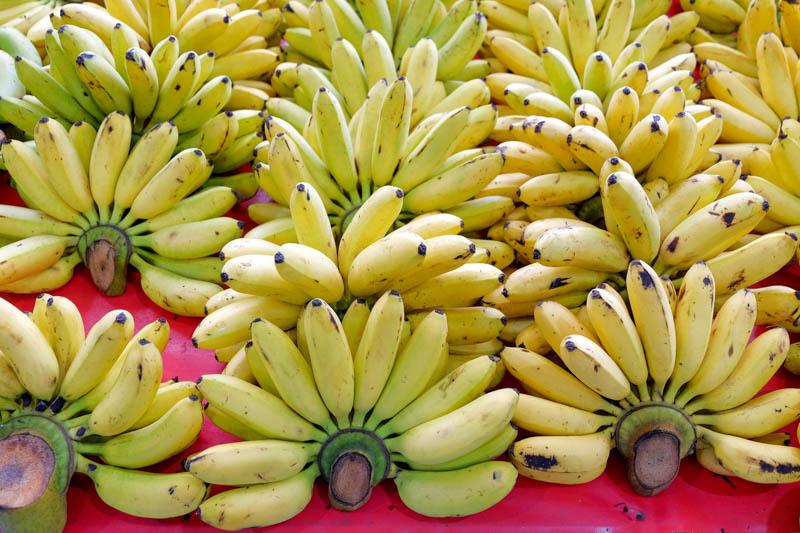
Summary: A beloved tropical staple that does triple duty as edible landscape, shade-maker, and pantry hero. From lunchbox snacks to weekend baking, bananas show up everywhere—and for good reason.
Taste: Creamy-sweet with subtle floral notes when ripe; starchy and mild when green.
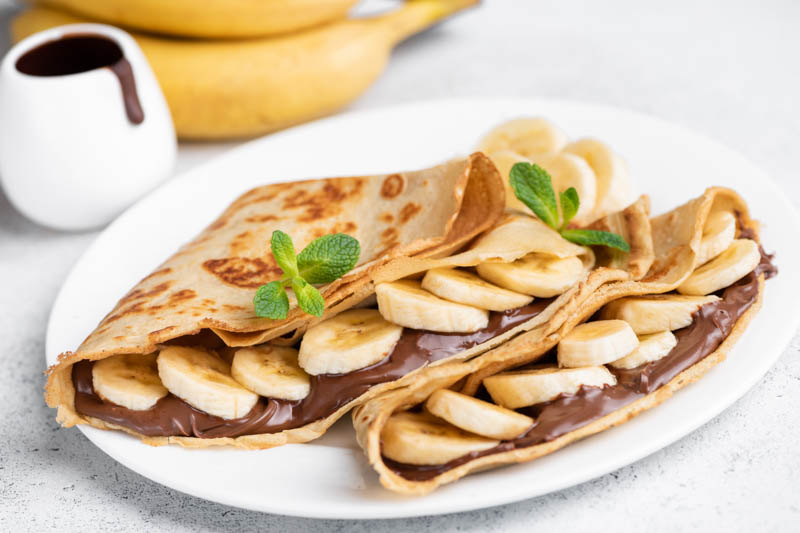
Use: Fresh eating, smoothies, grilling, baking, freezing into “nice cream,” leaf-wrapped steaming, and more.
Growing Note: Not a woody tree but a giant herb; thrives in warmth, moisture, and rich soil. Dwarf types are patio-friendly.
| Botanical Name | Musa acuminata (primary dessert species) |
|---|---|
| Family | Musaceae |
| Common Names | Banana, Dessert Banana, Cavendish banana, Lady Finger |
| Plant Type & Habit | Herbaceous perennial with pseudostem; clumping habit via underground rhizome (“mat”) |
| Hardiness (USDA) | Fruits reliably in warm frost-free regions (Zones ~10-11). |
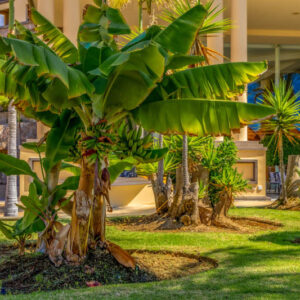
| Size | Dwarf 5–8 ft; common garden types 8–12 ft; vigorous selections 12–20+ ft |
| Sun & Exposure | Full sun (6–8+ hrs). Light afternoon shade helps in very hot, dry climates. |
| Soil | Rich, well-drained, moisture-retentive loam; pH ~5.5–7.0. Heavy feeders—love organic matter. |
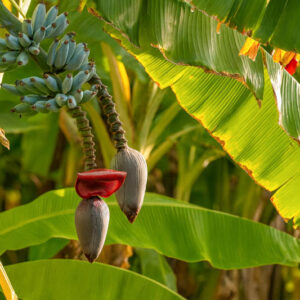
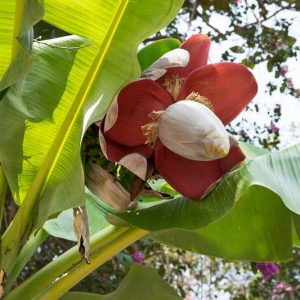
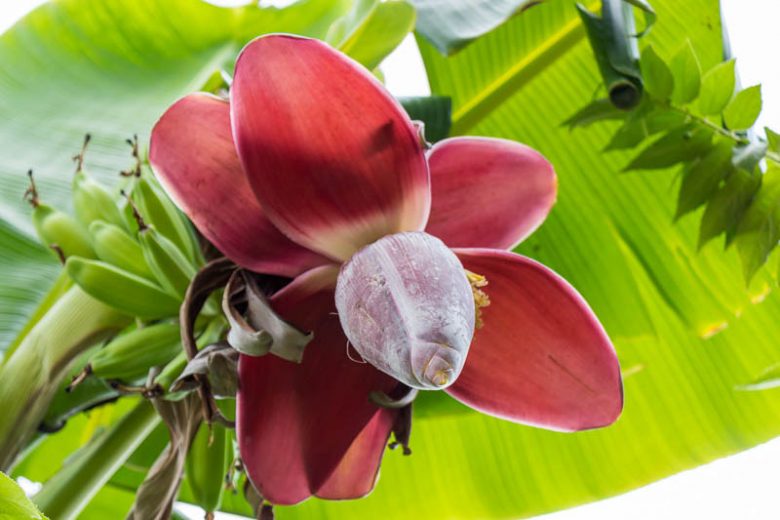
| Bloom & Fruit | Showy purple bracts (the edible banana blossom) reveal hands of fruit; many dessert types set seedless fruit without pollination. |
| Pruning | Remove tattered leaves; after fruiting, cut the spent pseudostem to soil level and select new suckers (“pups”). |
| Primary Uses | Fresh fruit, smoothies, baking, leaf wrapping/serving, shade and tropical effect in landscapes |
If you’ve ever peeled one on a hike and thought, “this is exactly what I needed,” you already understand the everyday magic of bananas. They’re portable sweetness with built-in packaging, equally at home in a kid’s lunch, a baker’s mixing bowl, or a tropical garden that begs for drama. The plant itself is a conversation starter: towering leaves that fan out like green sails, purple bracts that unfurl to reveal baby fruit, and a rhythm of growth that feels both fast and generous.
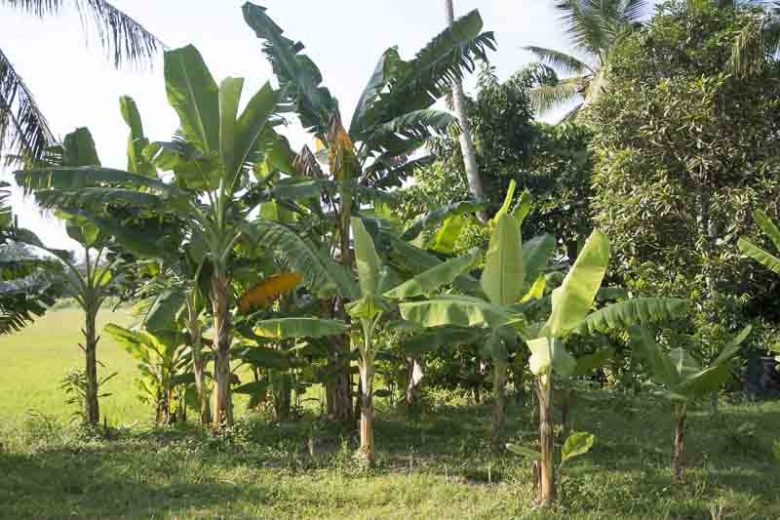
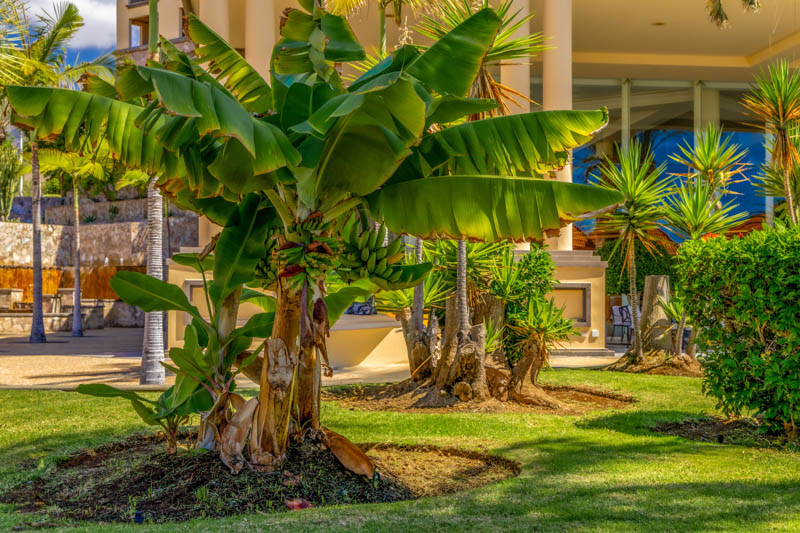
An unmistakable tropical standby, the banana plant is a giant herb, not a woody tree. What looks like a trunk is actually a tightly layered sheath of leaf bases called a pseudostem. Inside, the true stem rises like an elevator and eventually emerges at the top as a long flower spike carrying the spectacular banana blossom. As bracts lift, they reveal rows of hands that mature into the fruit we know so well. Most banana dessert types are naturally seedless and develop without pollination, which is why your morning bananas don’t have hard seeds.
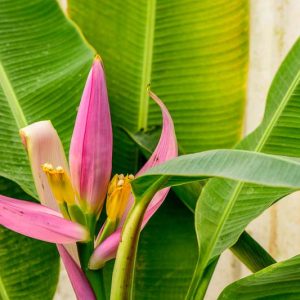
Bananas belong to the genus Musa in the family Musaceae. Most sweet “dessert” bananas trace primarily to Musa acuminata (A genome), most commonly as AAA triploid or AA diploid clones. Plantains and many starchier cooking types carry Musa balbisiana (B genome) ancestry; their triploid hybrids are historically grouped under Musa × paradisiaca (AAB/ABB). Several other species are important for ornament, local use, or breeding—among them M. basjoo (cold-hardy Japanese fiber banana; chiefly ornamental), M. ornata (showy flowering ornamental), M. velutina (pink banana; ornamental), M. coccinea (scarlet banana; ornamental), and regionally significant wild relatives such as M. sikkimensis, M. itinerans, and M. schizocarpa.
The species traces back to Southeast Asia and the western Pacific, where early cultivators selected naturally edible, low-seed forms and spread them by dividing clumps. Over centuries, the banana sailed with people and trade to the tropics worldwide, eventually becoming one of the most consumed fruits on the planet.
A single pseudostem grows rapidly, often reaching full height in a single warm season. Depending on variety, that can mean a compact 5–8 feet (1.5-2.4 m) for dwarf types or 12–20+ feet (3.6-6 m) for vigorous selections. After a pseudostem fruits once, its job is done; you cut it down, and selected pups take center stage.
Given warmth, moisture, and nutrition, growth is head-turning. In prime conditions a plant can push a new leaf every week. Many garden types can present an inflorescence in 9–15 months from a strong pup, then require a few more months to size up fruit.
While each pseudostem is one-and-done after fruiting, the clump (mat) persists for years. With good management—regular feeding, mulching, and thinning of suckers—one initial plant can provide a steady stream of fruiting stems season after season.
The purple, teardrop-shaped banana blossom (also called a banana heart) is edible. In Southeast Asian kitchens it’s shredded into salads, simmered in curries, and fried as fritters. If your goal is fruit, you’ll usually leave the emerging hands intact and sometimes remove the male tip once the last hand has formed to concentrate energy on sizing the bunch.
Musa acuminata doesn’t flower by day length; it flowers when a pseudostem is old and large enough. In good heat and moisture, expect the first “flag leaf” (a short, upright leaf that precedes bloom) about 9–15 months after planting a vigorous pup or tissue-cultured start. The inflorescence soon follows, revealing hands of future fruit.
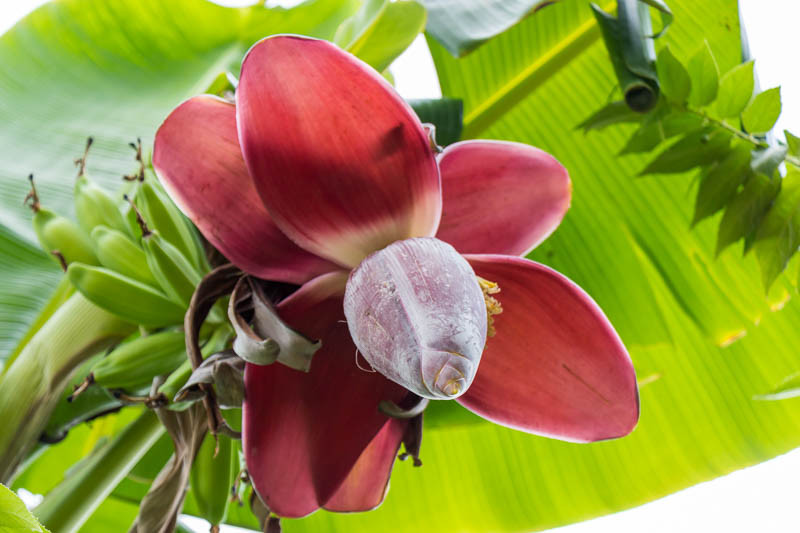
After bloom, fingers enlarge and fill. Harvest timing hinges on temperature: warmth speeds development; cool nights slow it. Most home growers cut bunches mature-green and finish ripening off the plant.
| Flower → harvest (warm climates) | ~3–5 months (fastest in consistently hot, humid weather) |
| Flower → harvest (cool nights / marginal) | ~5–7+ months (may not finish before frost in unprotected 9b) |
| First harvest after planting | ~12–20 months for the first pseudostem; thereafter, staggered stems can yield nearly year-round in USDA 10–11 |
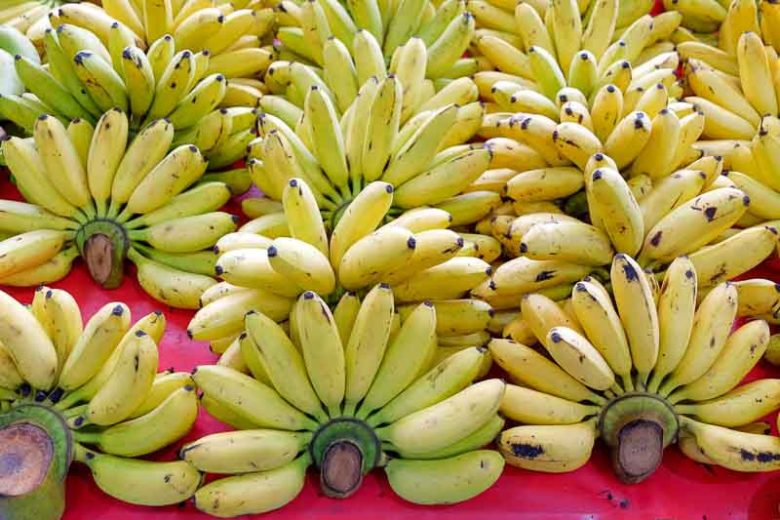
| Typical fruit size | About 6–9 inches (15-22 cm) for common dessert types; mini “Lady Finger” types are shorter and slender; cooking types are often thicker and longer. |
| When fruit ripens | Usually off the plant after cutting the bunch mature-green. Ripening takes days to weeks depending on temperature and ethylene exposure. |
| Average yield per bunch | A home-grown bunch often holds 30–80 bananas depending on variety, plant vigor, and care. |
Cutting cues: fingers look full and rounded (angles have “smoothed”), last hand has sized, and the male tip beyond the last hand has finished. Cut the bunch, support its weight, and hang in a cool, airy spot to finish ripening.
| Example type | Typical height | Best use | Climate notes | Highlights |
|---|---|---|---|---|
| Cavendish group (e.g., Dwarf Cavendish, Grand Nain) — AAA | Dwarf 6–8 ft; standard 10–12 ft | Dessert, smoothies, baking | Needs a long, warm season; sheltered, sunny spot | Reliable household favorite; compact dwarfs suit containers |
| Lady Finger / Sucrier (‘Pisang Mas’) — AA | 8–12 ft | Fresh eating, kids’ lunches | Thrives in heat and humidity; wind protection helps | Small, very sweet fruit; thin peel |
| Gros Michel — AAA | 10–15 ft | Dessert, baking | Warm, frost-free; sturdy stems benefit from staking when fruiting | Rich flavor and aroma; classic pre-Cavendish taste |
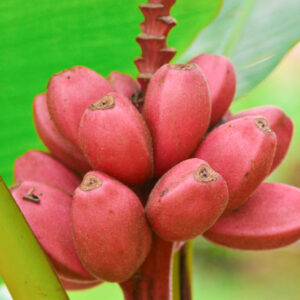
| Red Dacca / Red banana — AAA | 10–15 ft | Dessert, display | Heat-loving; needs a long, warm season to color and sweeten fully | Reddish peel; aromatic flesh; striking landscape accent |
| Lakatan (Philippines) — AAA | 8–12 ft | Dessert | Warm, humid conditions; protect from strong winds | Full, sweet flavor; firm texture when just ripe |
| East African Highland bananas (AAA cooking types) | 10–15 ft | Cooking (steamed/mashed dishes) | Best in reliably warm, frost-free climates | All-acuminata cooking bananas; stout pseudostems |
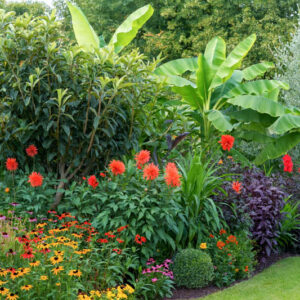
Leaves are enormous—often 2–9 feet (0.6-2.7 m) long—casting dappled shade that cools patios and garden beds. Banana leaf is one of nature’s most versatile kitchen tools. It’s used as a fragrant, disposable platter, for lining steamers, and for wrapping fish, rice, and sweets. In the garden, leaves flutter and shred gracefully in wind—normal, not a problem. A quick trim of ragged edges keeps things tidy.
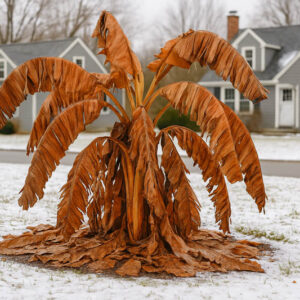
Musa acuminata fruits reliably outdoors in warm, frost-free climates in USDA hardiness Zones 10-11.
The nectar in opening bracts draws curious pollinators where they are present; birds may investigate the maturing bunches. In many regions, fruit development is parthenocarpic (no pollination needed), which makes the process surprisingly low-drama in a backyard setting.
Fruits and leaves are widely used around the world. As with any plant latex, a small subset of people with latex-fruit syndrome may experience sensitivity. Always introduce new foods gradually and pay attention to your body.
Bananas expand by forming pups from the rhizome. They’re easy to manage: keep just one or two strong suckers per clump and spade out extras for friends or new plantings.
Grower Story A single gallon-size start became a backyard oasis in two summers. The trick? Thick mulch, a weekly deep soak, and steady, light feeding. We cut our first bunch just before a cool spell, hung it in the garage, and watched breakfast ripen row by row. Takeaway Bananas love generosity—water, warmth, and organic matter pay you back.
Call it the everyday fuel bar that grows on plants. Curious about banana calories and macro-balance? Here’s the gist for a typical ripe dessert type.
| Nutrient | Amount (approx.) |
|---|---|
| Calories | ~89 |
| Carbohydrates | ~23 g (mostly natural sugars + starch) |
| Fiber | ~2.6–3.1 g |
| Protein | ~1.1 g |
| Fat | Trace |
| Potassium | ~350–400 mg |
| Vitamin B6 | ~0.4 mg |
| Vitamin C | ~9 mg |
Portion note A medium fruit is roughly 118–120 g edible portion and lands in the neighborhood of 100–105 calories. If you track banana nutrition, this makes it a simple, satisfying pre-workout choice.
From road-trip fuel to dinner-party dessert, there’s a use for every stage of ripeness.
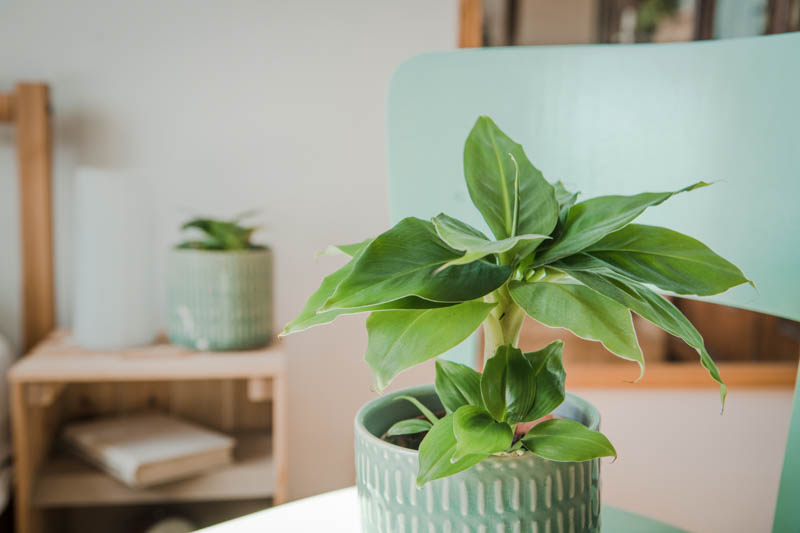
Dwarf selections are shockingly happy in large pots on sunny balconies and patios.
| Task | Notes |
|---|---|
| Pick a wind-sheltered, full-sun spot with rich, well-drained soil. | Full sun = 6–8+ hrs; avoid low cold pockets; protect from strong prevailing winds. |
| Amend generously with compost; create a broad mound in heavy clay. | Improves drainage and fertility; mounding keeps the crown above soggy soil. |
| Plant with the crown at soil level; water deeply to settle. | Do not bury the crown; deep watering removes air pockets around roots. |
| Mulch wide and thick; start a steady, light feeding routine. | Apply 3–4 in (7–10 cm) organic mulch; feed little-and-often during warm growth. |
| Limit each clump to 1 fruiting stem plus 1–2 pups. | Thin extra suckers to direct energy to the current bunch and next crop. |
| Stake heavy bunches and remove the spent stem after harvest. | Prevent topple; cutting the spent pseudostem recycles energy to the next pup. |
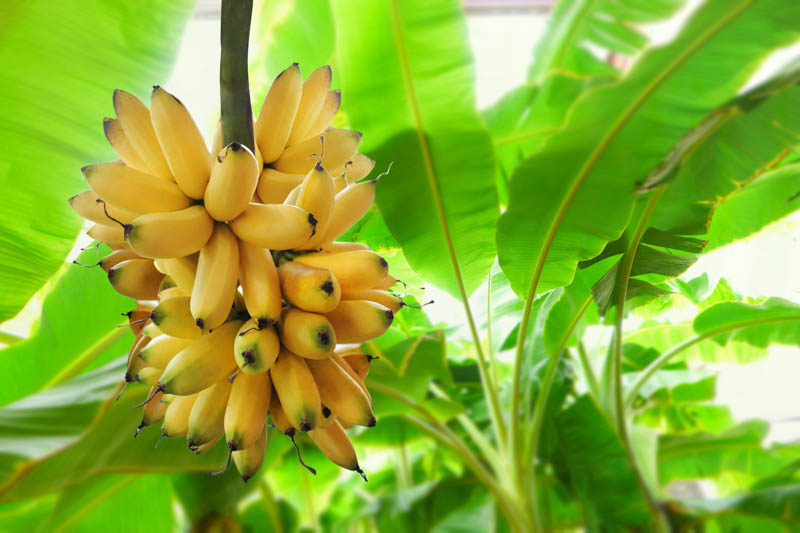
Flavor is a dance between maturity and ripeness.
Home growers divide pups from a healthy clump. Choose vigorous suckers with some independent roots, slice away with a clean spade, and replant immediately into a warm, moist, well-prepared bed or pot. Commercial growers also use tissue-cultured starts for uniform, disease-free plants.
Most backyard clumps sail along with good hygiene and airflow, but it’s smart to know the usual suspects.
In the tropics, plantings can roll from bloom to bunch nearly year-round. Subtropical gardeners often time harvests for late summer into fall. If you live far from commercial groves, watch for farmers-market bunches in warm regions and taste the difference between just-mature fruit that ripened locally and fruit that traveled.
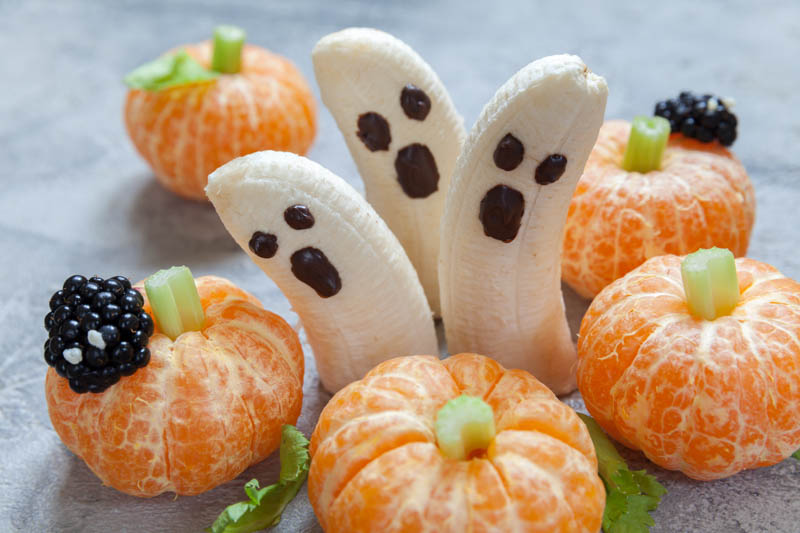
Turn a simple evening into something memorable with these ideas:
Per 100 g: ~358 mg
Per medium banana (about 118 g, 7–8″): ~420–430 mg
Per 100 g: ~23 g carbs
Per medium banana: ~27 g carbs (about 14 g natural sugars, remainder starch/fiber)
Per 100 g: ~2.6 g fiber
Per medium banana: ~3 g fiber
Yes—botanically, the fruit of the banana plant is a berry. Cultivated bananas are typically seedless due to parthenocarpy, but the fruit structure still fits the berry definition.
Yes—in small amounts. Tips:
Offer peeled, bite-size slices; the peel isn’t toxic but is hard to digest.
Follow the “treats ≤10% of daily calories” rule (bananas are sugary).
Sensible portions: a few thin slices for small dogs; up to ~¼ banana for medium; up to ~½ banana for large, not daily.
Skip if your dog has diabetes, obesity, GI sensitivity, or kidney issues unless your vet says it’s okay.
Watch for tummy upset the first time.
About 100–105 for a medium fruit (roughly 118–120 g edible portion). If you’re tracking banana nutrition, also note the roughly 23 g carbs, ~3 g fiber, and meaningful potassium.
Yes—choose a dwarf in a bright window or sunroom. Expect lush leaves and the occasional indoor mess when older leaves shed. Fruiting indoors is possible but not guaranteed without high light, warmth, and time.
A nickname for Blue Java, a dessert type with a pale bluish peel when immature and a creamy texture many describe as custardy. It’s great for smoothies and no-churn banana ice cream.
Red-skinned types like Red Dacca are still dessert bananas but bring a striking color and a gently perfumed flavor. They appreciate extra warmth and a long season to shine.
Plantains are starchier and meant for cooking—frying, roasting, simmering—while dessert types are eaten fresh when sweet and ripe.
Keep them at room temperature in a paper bag with an apple to boost ethylene. Separate fingers to spread ripeness over a few days. Cooler rooms slow everything down.
It’s the purple flower at the end of the fruiting stem. Peel and shred the tender inner bracts for salads, curries, and fritters. It brings a delicate, slightly artichoke-like character.
Only by nickname. Banana peppers are a mild type of Capsicum annuum with a long, curved shape. They’re fantastic pickled and have nothing to do with the banana plant botanically.
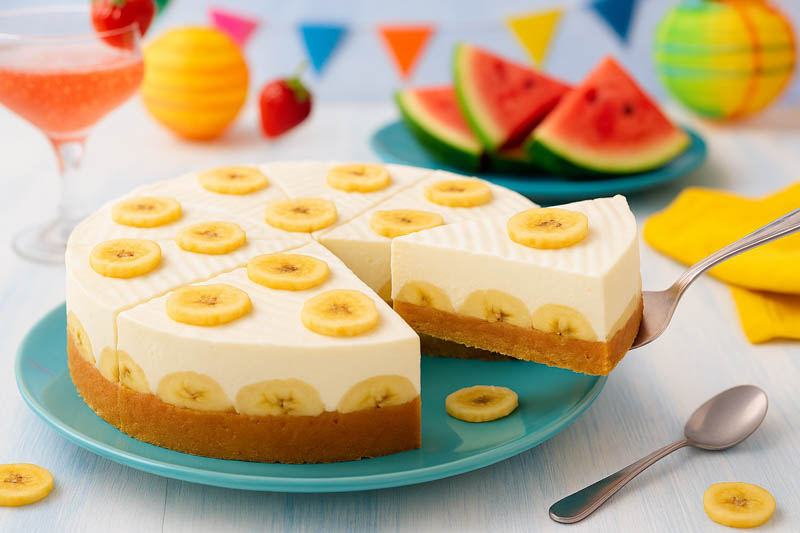
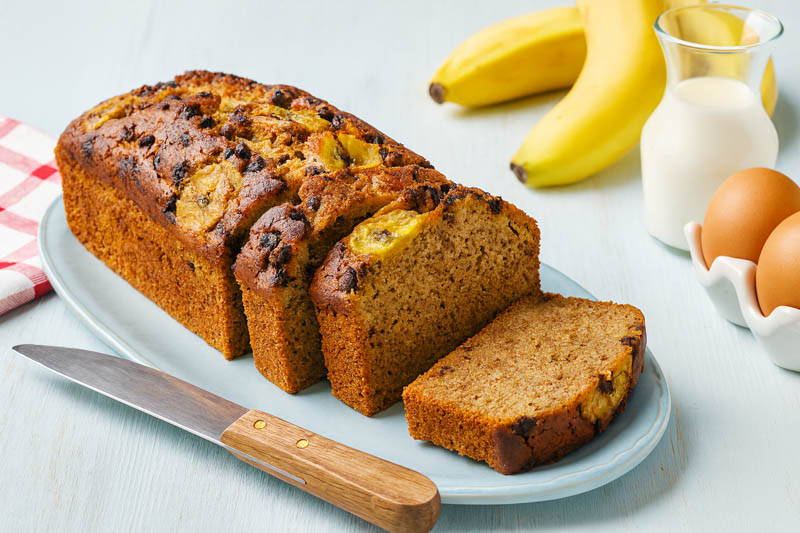
Freeze chunks for smoothies and banana ice cream; mash for banana bread, banana muffin, banana cookies, or pancakes; or whisk into custards for banana pudding and banana cream pie.
Updated: September 18, 2025 • Reviewed by Gardenia Editors
| Hardiness |
10 - 11 |
|---|---|
| Climate Zones | 8, 9, 14, 15, 16, 17, 18, 19, 20, 21, 22, 23, 24, H1, H2 |
| Plant Type | Fruits, Perennials |
| Plant Family | Musaceae |
| Genus | Musa |
| Common names | Banana |
| Exposure | Full Sun |
| Season of Interest | Spring (Early, Mid, Late), Summer (Early, Mid, Late), Fall, Winter |
| Height | 12' - 20' (3.7m - 6.1m) |
| Spread | 6' - 10' (180cm - 3m) |
| Spacing | 72" - 120" (180cm - 3m) |
| Maintenance | Average |
| Water Needs | Average |
| Soil Type | Chalk, Clay, Loam, Sand |
| Soil pH | Acid, Alkaline, Neutral |
| Soil Drainage | Moist but Well-Drained, Well-Drained |
| Characteristics | Showy, Evergreen, Fruit & Berries |
| Garden Uses | Patio And Containers |
| Garden Styles | Mediterranean Garden |
| Toxic to Humans | No known toxicity |
| Toxic to Cats | Not toxic |
| Toxic to Dogs | Not toxic |
| Toxic to Horses | Not toxic |


| Hardiness |
10 - 11 |
|---|---|
| Climate Zones | 8, 9, 14, 15, 16, 17, 18, 19, 20, 21, 22, 23, 24, H1, H2 |
| Plant Type | Fruits, Perennials |
| Plant Family | Musaceae |
| Genus | Musa |
| Common names | Banana |
| Exposure | Full Sun |
| Season of Interest | Spring (Early, Mid, Late), Summer (Early, Mid, Late), Fall, Winter |
| Height | 12' - 20' (3.7m - 6.1m) |
| Spread | 6' - 10' (180cm - 3m) |
| Spacing | 72" - 120" (180cm - 3m) |
| Maintenance | Average |
| Water Needs | Average |
| Soil Type | Chalk, Clay, Loam, Sand |
| Soil pH | Acid, Alkaline, Neutral |
| Soil Drainage | Moist but Well-Drained, Well-Drained |
| Characteristics | Showy, Evergreen, Fruit & Berries |
| Garden Uses | Patio And Containers |
| Garden Styles | Mediterranean Garden |
| Toxic to Humans | No known toxicity |
| Toxic to Cats | Not toxic |
| Toxic to Dogs | Not toxic |
| Toxic to Horses | Not toxic |
How many Musa acuminata (Dessert Banana) do I need for my garden?
| Plant | Quantity | |
|---|---|---|
| Musa acuminata (Dessert Banana) | N/A | Buy Plants |
Create a membership account to save your garden designs and to view them on any device.
Becoming a contributing member of Gardenia is easy and can be done in just a few minutes. If you provide us with your name, email address and the payment of a modest $25 annual membership fee, you will become a full member, enabling you to design and save up to 25 of your garden design ideas.
Join now and start creating your dream garden!
Create a membership account to save your garden designs and to view them on any device.
Becoming a contributing member of Gardenia is easy and can be done in just a few minutes. If you provide us with your name, email address and the payment of a modest $25 annual membership fee, you will become a full member, enabling you to design and save up to 25 of your garden design ideas.
Join now and start creating your dream garden!