Japanese banana, Hardy banana, Japanese fiber banana, Hardy fiber banana, Basjoo banana, Musa japonica, Basho, Sichuan hardy banana

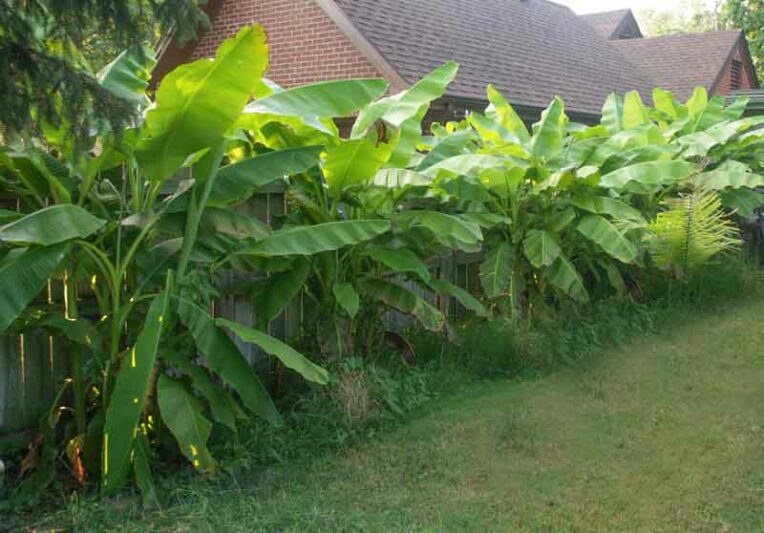
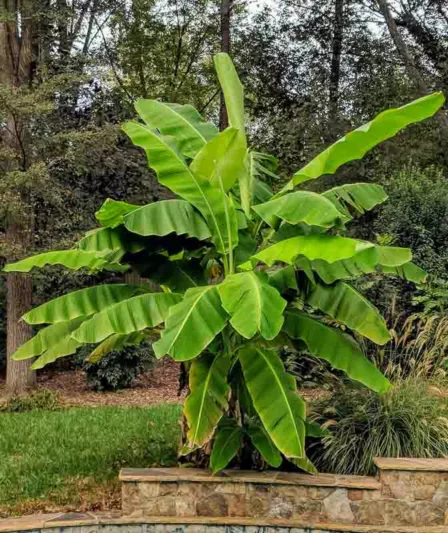


Summary: The legendary “hardy banana” that gives instant jungle vibes far from the tropics. Big leaves, rapid growth, and remarkable cold resilience make Musa basjoo a hero for temperate gardens.
Edibility: Fruit is typically small, seedy, and not considered edible; grown for foliage and fiber history.
Use: Tropical-look perennial, fast summer screen, bold container feature; leaves for steaming/serving crafts.
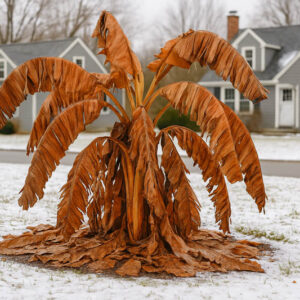
Growing Note: Not a woody tree—an herb with a pseudostem. Leaves die with frost; the rhizome can overwinter with protection in cold zones.
| Botanical Name | Musa basjoo (syn. historically Musa japonica) |
|---|---|
| Family | Musaceae |
| Common Names | Japanese Banana, Japanese Fiber Banana, Hardy Banana, Bashō (芭蕉) |
| Plant Type & Habit | Herbaceous perennial with a pseudostem; clumping via underground rhizome (“mat”) |
| Hardiness (USDA) | Zones 5–10 overall (crown/rhizome hardiness). Leaves collapse near 28–30°F; pseudostems may overwinter in mild/wrapped sites; rhizomes reliably hardy to Zone 6 with dry mulch, sometimes Zone 5 in sheltered microclimates. |
| Size | 6–15 ft (1.8–4.5 m) tall and wide |
| Sun & Exposure | Full sun to bright, open shade; shelter from strong winds to limit leaf tatter |
| Soil | Deep, rich, moisture-retentive but well-drained; pH ~5.5–7.5. Heavy feeders—love organic matter. |
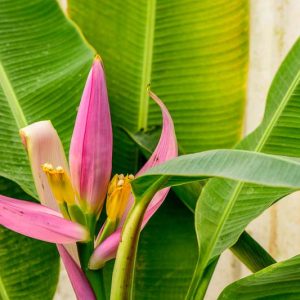
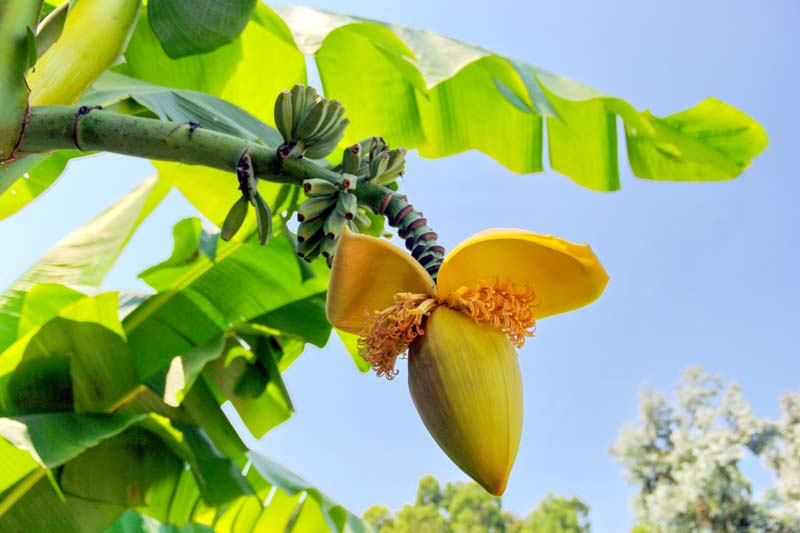
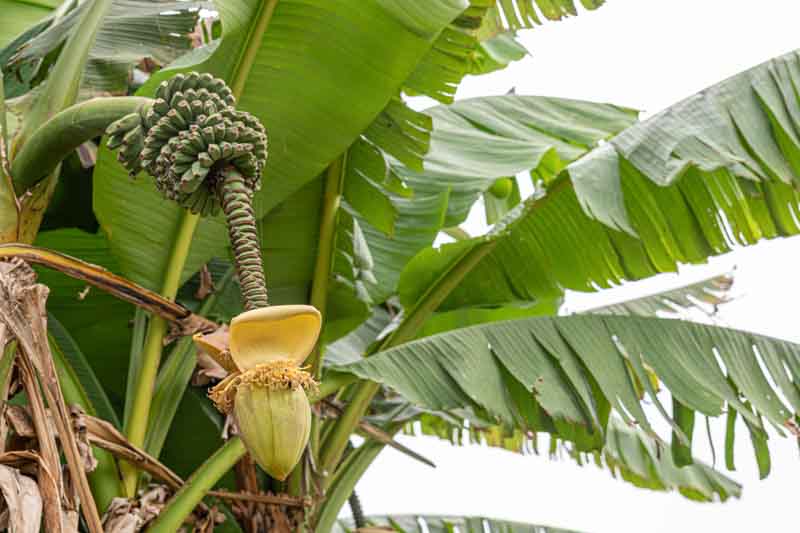
| Bloom & Fruit | Creamy-yellow inflorescence with showy bracts; small, seedy fruits typically inedible in temperate gardens |
| Pruning | Remove ragged leaves; after freeze, cut back damaged pseudostems in spring; thin pups to 1–3 stems |
| Primary Uses | Tropical foliage, screening, backdrop for borders, bold container specimen, fiber heritage |
You want summer drama—the “are we on vacation?” energy—without living in the tropics. Enter Musa basjoo, the Japanese banana. It rockets upward in one season, unfurling glossy green paddles that clap in the breeze. Frost will lay the leaves down, sure, but protect the base and it rises again next spring like nothing happened. That’s the secret: a hardy, determined rhizome powering an exceptionally fast grower.
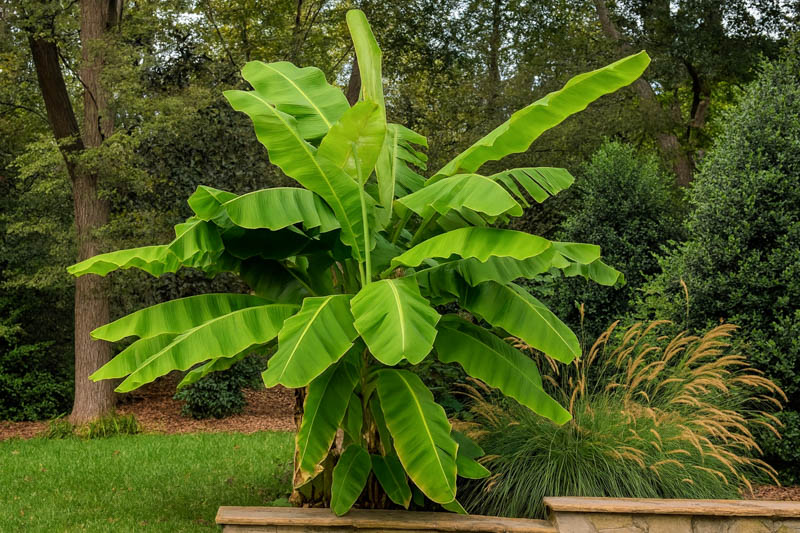
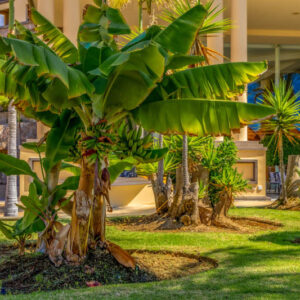
Think of Musa basjoo as your cold-tolerant gateway to the banana look. It isn’t a woody tree; it’s an herbaceous perennial. The “trunk” you see is a pseudostem—a tight stack of leaf bases. The plant’s true stem rises inside that column and eventually produces a floral spike. The effect in the landscape is pure tropical theatre: enormous, arching leaves; bold midribs; and an architectural presence that turns patios and borders into resorts.
Musa basjoo is recipient of the prestigious Award of Garden Merit of the Royal Horticultural Society.
Bananas belong to the genus Musa in the family Musaceae. Most sweet “dessert” bananas trace primarily to Musa acuminata (A genome), most commonly as AAA triploid or AA diploid clones. Plantains and many starchier cooking types carry Musa balbisiana (B genome) ancestry; their triploid hybrids are historically grouped under Musa × paradisiaca (AAB/ABB). Several other species are important for ornament, local use, or breeding — among them M. basjoo (cold-hardy Japanese fiber banana; chiefly ornamental), M. ornata (showy flowering ornamental), M. velutina (pink banana; ornamental), M. coccinea (scarlet banana; ornamental), and regionally significant wild relatives such as M. sikkimensis, M. itinerans, and M. schizocarpa.
Native to parts of China (e.g., Sichuan/Yunnan) and long cultivated in Japan (Ryukyu/Okinawa for bashōfu fiber). In gardens worldwide it’s prized as the hardiest banana.
Each pseudostem surges upward in a single season. In long, warm summers, expect 6–15 ft (1.8-4.5 m) of height, sometimes more in prime microclimates. Clumps expand via underground rhizomes, sending up pups around the mother stem. Managed with a light touch—keeping one to three strong stems—you’ll get a handsome, full, but not unruly planting about 6–15 ft (1.8-4.5 m) wide over time.
Given warmth, water, and nutrition, M. basjoo is a blur. A new leaf every week in midsummer isn’t unusual. Gardeners in cool climates often grow it as a “tender perennial”: massive summer show, then cut back/insulate for winter and repeat.
Each pseudostem is monocarpic—it flowers once, then retires. The clump persists for years by replacing older stems with new pups. After a stem flowers (rare in short-season climates), keep younger stems to carry the torch next year.
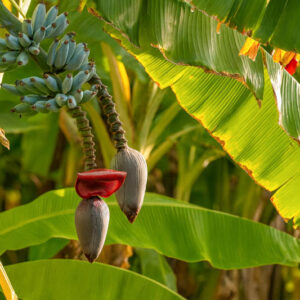
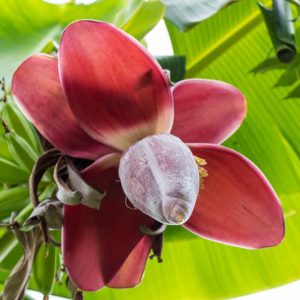
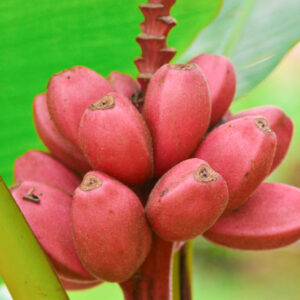
The inflorescence emerges from the top of a mature pseudostem as a stout, drooping spike with pale bracts, revealing rows of flowers. Fruits follow, but in most temperate gardens they remain small, thick-skinned, and packed with seeds—best admired, not eaten. The real reason you grow basjoo is for its enormous, tropical foliage and exuberant scale.
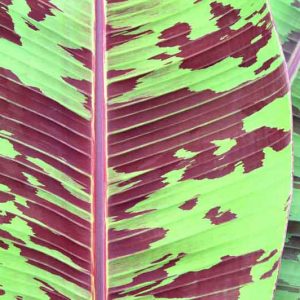
Musa basjoo wears oversized, paddle-shaped leaves that scream “tropical”—even in temperate gardens. In a good season, individual leaves commonly reach up to ~6 ft (1.8 m) long and ~2 ft (60 cm) wide, unfurling from a tight central roll. Expect some wind tatter (totally normal and mostly cosmetic). In cold climates the foliage is usually cut to the ground by the first hard freeze, but new leaves rocket back from the rhizome once warmth returns.
While M. basjoo is grown chiefly for its foliage, the summer inflorescences (pale, pendant bracts) can draw in pollinating insects where present. In cooler regions fruit rarely develops or ripens; in warmer spots the small green bananas are typically full of hard seeds and are not used as dessert fruit. The dense clump and huge leaves also create shelter and perching structure for backyard birds in blustery weather.
As an ornamental banana, Musa basjoo is not known to be toxic to people or pets. (Many horticultural authorities list bananas with no reported toxicity.) As with any plant latex, a small subset of individuals with latex–fruit sensitivity may experience irritation when handling sap—wear gloves if you’re prone to sensitivities.
M. basjoo spreads gradually by short rhizomes, forming a manageable clump (“mat”). It is not generally considered invasive in temperate gardens. To control spread, simply spade out excess pups in spring or install an edging/root barrier in formal beds. Container culture keeps it perfectly in-bounds on patios and terraces.
Here’s the practical breakdown many gardeners use:
| Leaves | Damaged at freezing; usually collapse below ~28–30°F (-2 to -1°C) |
| Pseudostem | May survive light freezes if wrapped and kept dry; often cut back in cold winters |
| Rhizome (crown) | With deep, dry mulch and a sheltered spot, many gardeners overwinter it reliably in USDA 6—and with extra effort, even 5 |
Translation: if you’re in Zones 8–10 and protect from windy sites, you can keep foliage and height from year to year. In Zones 6–7, expect a dieback-and-rebound cycle—still spectacular by midsummer. In Zone 5, treat it like a cherished project: pick a protected microclimate, mulch generously, and enjoy the thrill when it pops back in spring.
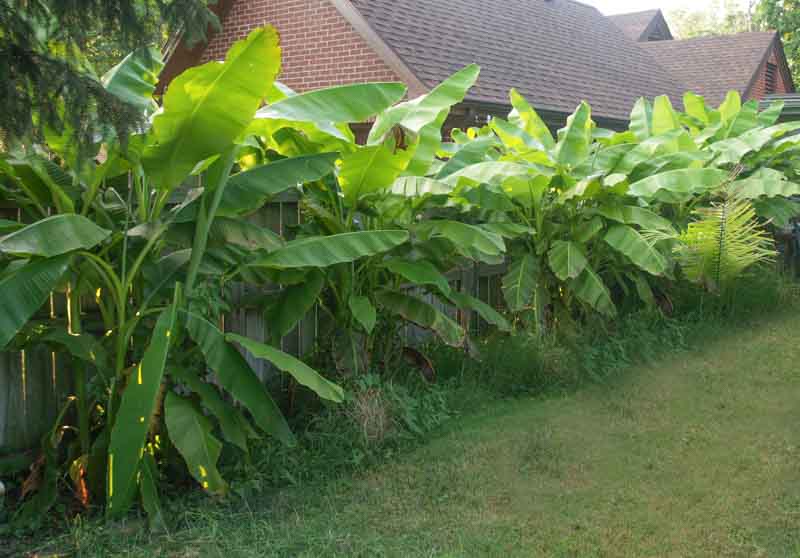
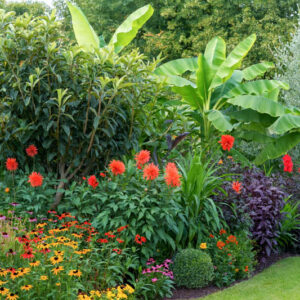
A great choice for wall-side borders, containers, or Mediterranean-style gardens where it will proudly stand out. Give Musa basjoo a warm, sheltered microclimate—south- or west-facing walls, sun-trapped courtyards, or patios that store daytime heat. It also shines in lush “jungle” borders with bold-leaf companions and beside water features (in well-drained soil; bananas dislike sitting soggy in winter). In colder regions, grow it in large containers you can wheel under cover, or mulch crowns deeply to overwinter in the ground.
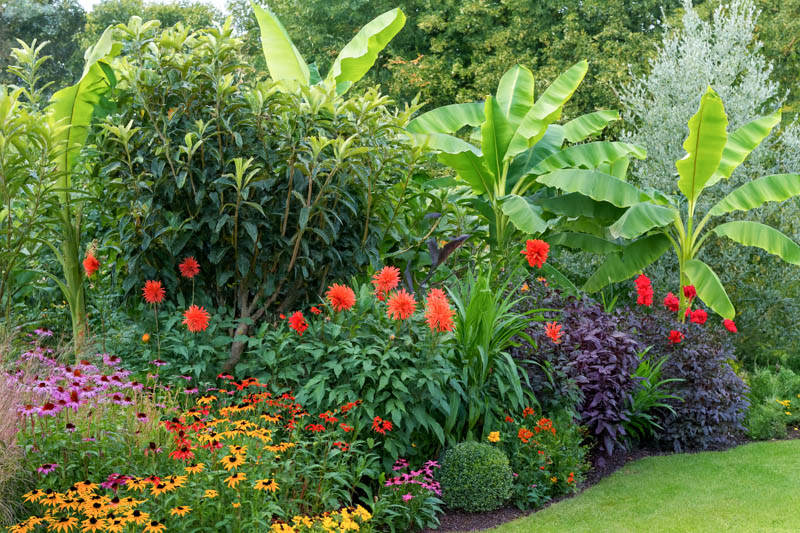
Pick the strategy that fits your winter:
Goal: keep the rhizome cold but not soaked. Winter wet + deep cold is the real enemy.
Musa basjoo is fantastic in big pots on balconies and patios.
| Task | Notes |
|---|---|
| Choose a warm, wind-sheltered spot with sun. | South or west wall steals extra heat; fences tame tatter. |
| Amend deeply with compost; mound in clay. | Drainage matters in winter more than summer. |
| Plant crown at soil level; water to settle. | Avoid burying the crown/leaf bases. |
| Mulch wide and thick. | 3–4 in organic mulch keeps roots cool and moist. |
| Adopt a “little-and-often” feeding rhythm. | Light, regular nutrition beats heavy single doses. |
| Limit each mat to 1–3 stems. | Thin extra pups to direct energy and manage width. |
The simplest method is to divide pups. Choose vigorous suckers with their own roots, slice away with a clean spade, and plant immediately into warm, moist, prepared soil or a roomy pot. Seed is possible but slow and variable; most gardeners stick with divisions or tissue-cultured plants for uniformity and clean health status.
In temperate gardens, Musa basjoo is generally easygoing. Most issues trace back to winter wet (rot) or summer drought (crispy edges). Still, it’s smart to know the usual suspects:
Banana leaves are nature’s non-stick platter: line steamer baskets, wrap fish or sticky rice parcels, or serve as aromatic, biodegradable plates. Historically, Musa basjoo was grown for its fiber—stripped and processed into threads woven as bashōfu textiles in Okinawa. While you won’t be making kimono fabric in the backyard, the craft history adds depth and charm to this plant’s story.
Not really. Flowers and small fruits can form in long seasons, but they’re typically seedy and inedible. Grow it for the foliage and wow factor.
Ground is easiest for size and moisture, but big containers (20–30+ gal) shine on patios and make winter protection simpler—just roll into shelter.
After frost, cut leaves, build a wire “leaf cage” around the clump, fill with dry leaves/straw, and cap loosely. In very cold/wet regions, cut stems low and heap 12–18 in of dry mulch over the crown.
No. It expands by pups near the base. Keep 1–3 stems and spade out extras to share or replant.
Normal! It’s cosmetic. If you prefer pristine leaves, tuck the plant behind a screen or hedge or accept the “windswept jungle” aesthetic.
Yes—for lining steamers and wrapping parcels for grilling/steaming. They impart a gentle, green aroma and make beautiful serving platters.
Updated: September 18, 2025 • Cultivar & species focus by Gardenia Editors
| Hardiness |
5 - 10 |
|---|---|
| Heat Zones |
8 - 11 |
| Climate Zones | 4, 5, 6, 7, 8, 9, 14, 15, 16, 17, 18, 19, 20, 21, 22, 23, 24, H1, H2 |
| Plant Type | Fruits, Perennials |
| Plant Family | Musaceae |
| Genus | Musa |
| Common names | Banana |
| Exposure | Full Sun, Partial Sun |
| Season of Interest | Spring (Early, Mid, Late), Summer (Early, Mid, Late), Fall, Winter |
| Height | 6' - 15' (180cm - 4.6m) |
| Spread | 6' - 15' (180cm - 4.6m) |
| Spacing | 72" - 120" (180cm - 3m) |
| Maintenance | Average |
| Water Needs | Average |
| Soil Type | Chalk, Loam, Sand |
| Soil pH | Acid, Alkaline, Neutral |
| Soil Drainage | Well-Drained |
| Characteristics | Plant of Merit, Showy, Evergreen, Fruit & Berries |
| Tolerances | Heat |
| Garden Uses | Beds And Borders, Patio And Containers, Wall-Side Borders |
| Garden Styles | Mediterranean Garden |
| Toxic to Humans | No known toxicity |
| Toxic to Cats | No known toxicity |
| Toxic to Dogs | No known toxicity |
| Toxic to Horses | No known toxicity |


| Hardiness |
5 - 10 |
|---|---|
| Heat Zones |
8 - 11 |
| Climate Zones | 4, 5, 6, 7, 8, 9, 14, 15, 16, 17, 18, 19, 20, 21, 22, 23, 24, H1, H2 |
| Plant Type | Fruits, Perennials |
| Plant Family | Musaceae |
| Genus | Musa |
| Common names | Banana |
| Exposure | Full Sun, Partial Sun |
| Season of Interest | Spring (Early, Mid, Late), Summer (Early, Mid, Late), Fall, Winter |
| Height | 6' - 15' (180cm - 4.6m) |
| Spread | 6' - 15' (180cm - 4.6m) |
| Spacing | 72" - 120" (180cm - 3m) |
| Maintenance | Average |
| Water Needs | Average |
| Soil Type | Chalk, Loam, Sand |
| Soil pH | Acid, Alkaline, Neutral |
| Soil Drainage | Well-Drained |
| Characteristics | Plant of Merit, Showy, Evergreen, Fruit & Berries |
| Tolerances | Heat |
| Garden Uses | Beds And Borders, Patio And Containers, Wall-Side Borders |
| Garden Styles | Mediterranean Garden |
| Toxic to Humans | No known toxicity |
| Toxic to Cats | No known toxicity |
| Toxic to Dogs | No known toxicity |
| Toxic to Horses | No known toxicity |
How many Musa basjoo (Japanese Banana) do I need for my garden?
| Plant | Quantity | |
|---|---|---|
| Musa basjoo (Japanese Banana) | N/A | Buy Plants |
Create a membership account to save your garden designs and to view them on any device.
Becoming a contributing member of Gardenia is easy and can be done in just a few minutes. If you provide us with your name, email address and the payment of a modest $25 annual membership fee, you will become a full member, enabling you to design and save up to 25 of your garden design ideas.
Join now and start creating your dream garden!
Create a membership account to save your garden designs and to view them on any device.
Becoming a contributing member of Gardenia is easy and can be done in just a few minutes. If you provide us with your name, email address and the payment of a modest $25 annual membership fee, you will become a full member, enabling you to design and save up to 25 of your garden design ideas.
Join now and start creating your dream garden!