Explore Oregon planting zones with the updated 2023 USDA map. Learn your frost dates, decode coastal, valley, and high-desert microclimates, and discover the best vegetables, fruits, flowers, shrubs, trees, and native plants to build a resilient, productive, water-wise Pacific Northwest garden in every corner of the Beaver State.


Gardening in Oregon might mean a misty coastal garden in Astoria, a raised-bed veggie patch in Portland, a berry-filled backyard in Eugene, a sunny Rogue Valley homestead near Medford, a high-desert lot in Bend, or a breeze-swept yard on the Columbia Plateau near Pendleton. Oregon planting zones stretch from cool, wet coastal pockets to hot, dry interior valleys and chilly high-desert plateaus – each with its own gardening personality.
This guide will help you understand your Oregon growing zone using the updated 2023 USDA Plant Hardiness Zone Map, plan around frost dates, and choose the best plants for your corner of the Beaver State.
On the 2023 USDA Plant Hardiness Zone Map, Oregon runs roughly from zone 5a to zone 10a, based on 30-year averages of the coldest winter temperatures (1991–2020). Colder zones cover the higher Cascades, Central Oregon’s elevated plateaus, and parts of Eastern Oregon. The warmest zones hug the southern coast and select low-elevation valleys. Most home gardens fall between zones 6b and 9a.
The updated 2023 USDA Plant Hardiness Zone Map uses 30-year climate normals (1991–2020) and higher-resolution terrain and elevation data than earlier versions. In Oregon, the map shows colder blues and purples across the Cascades, Blue and Wallowa Mountains, and high Central Oregon plateaus, with warmer greens, yellows, and oranges along the Willamette Valley, Rogue Valley, and especially the south coast near Brookings and Gold Beach.
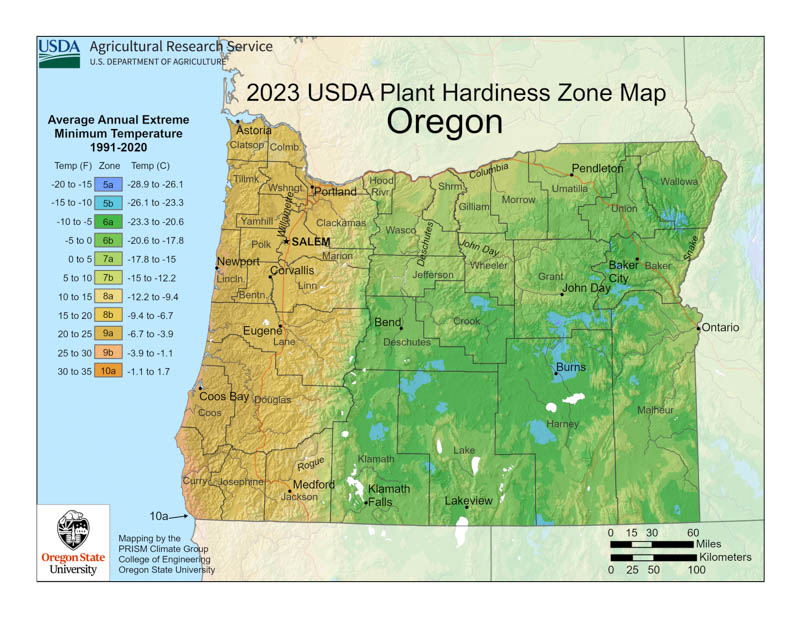
A simplified Oregon planting zone map based on the 2023 USDA Plant Hardiness Zone Map (1991–2020 climate data).
Use the map alongside your ZIP code to pinpoint your Oregon garden zone. Look up your Oregon planting zone by ZIP code using the USDA tool, then come back here or visit our Plant Finder for plants tailored to your zone, elevation, and site conditions.
Like most of the Pacific Northwest, Oregon’s climate is shaped by mountains, ocean, river valleys, and elevation. Coastal fog, marine layers, Gorge winds, rain shadows, cold-air drainage, urban heat islands, and reflected heat from pavement and buildings can nudge your yard a half-zone – or more – warmer or colder than the official map. Zone boundaries can shift quickly over short distances (for example, a low pocket outside Bend may be much colder than a nearby hillside garden).
This region includes Astoria, Seaside, Cannon Beach, Tillamook, Lincoln City, Newport, Florence, Coos Bay, Bandon, Gold Beach, and Brookings.
This region includes Portland, Gresham, Hillsboro, Beaverton, Tigard, Salem, Albany, Corvallis, and Eugene.
Roseburg, Grants Pass, Medford, Jacksonville, Ashland, and nearby valleys share warm summers and comparatively mild winters for the Pacific Northwest.
Bend, Redmond, Sisters, La Pine, Prineville, and Madras sit on the east side of the Cascades in a dry, high-elevation climate.
This region includes Pendleton, Hermiston, La Grande, Baker City, John Day, Burns, Ontario, and smaller farming and ranching communities.
In Oregon, frost is all about elevation, distance from the ocean, and which side of the Cascades you call home. A Portland courtyard or south-coast patio may go frost-free most years, while Central Oregon or high valleys in Eastern Oregon can experience freezing temperatures from fall through late spring. Your average last and first frosts determine when to plant tomatoes, protect peppers and dahlias, and tuck cool-season crops into fall beds.
Across Oregon, last spring frosts range from March in the mildest low-elevation west-side gardens to June in colder Central and high-elevation interior locations. First fall frosts may hit Central and Eastern Oregon gardens in September, while parts of the coast and urban cores may not see a killing frost until late November or even December. Statewide, many gardeners see roughly 100–260 frost-free days, depending heavily on region and elevation.
| Region / City | Average Last Spring Frost | Average First Fall Frost | Approx. Frost-Free Days |
|---|---|---|---|
| Portland (Lower Willamette Valley) | Late March (around Mar 21) | Early December (around Dec 5) | ~250–260 days |
| Eugene (Southern Willamette Valley) | Late April (around Apr 25) | Late October (around Oct 26) | ~180–190 days |
| Medford (Rogue Valley) | Mid April (around Apr 18) | Late October (around Oct 26) | ~185–195 days |
| Bend (Central Oregon High Desert) | Mid June (around Jun 14) | Mid September (around Sep 16) | ~90–100 days |
| Pendleton (Columbia Plateau / NE Oregon) | Late April (around Apr 30) | Mid October (around Oct 16) | ~165–175 days |
Dates summarized from regional climate data and frost-date tools (NOAA, PRISM); always check a local forecast and ZIP-code–based lookup for the most precise information for your garden.
Use these frost dates as flexible guidelines – your own yard may be warmer or cooler depending on elevation, slope, cold-air drainage, wind exposure, coastal fog or marine influence, reflected heat from walls and pavement, irrigation, and urban heat effects. They’re averages, not guarantees, so watch the forecast in spring and fall and protect tender plants when temperatures dip toward freezing.
Once you know your Oregon planting zone – and whether you garden in a cool coastal pocket, a mild Willamette Valley backyard, a warm Rogue Valley slope, or a frosty high-desert plateau – you can work with your climate instead of against it. Focus on plants that tolerate cool, wet winters, summer drought, acidic or clay soils in many regions, and wide day–night temperature swings. Choose perennials rated for zones 5–10, and time annual plantings around your frost dates and summer heat.
Pacific Northwest and Oregon native plants are adapted to local soils, rainfall patterns, and seasonal drought – and they feed pollinators, birds, and beneficial insects. Mix native wildflowers, shrubs, trees, and grasses for a resilient, habitat-rich landscape that feels authentically Oregon.
Tap a month to see what to plant in Oregon by zone. Use this as a starting point, then adjust for your exact frost dates, elevation, and whether you garden on the coast, in the Willamette or Rogue Valley, in Central Oregon, or in Eastern Oregon’s plateaus and mountains.
Oregon gardeners juggle cool, wet winters; summer drought; coastal fog and marine layers; strong Gorge winds; high-desert cold; and a wide spread of hardiness zones and microclimates. These tips help plants thrive from zones 5a to 10a:
While USDA hardiness zones (roughly 5a–10a in Oregon on the 2023 map) tell you how cold it gets in winter, they don’t capture summer heat, marine fog, east winds, or the length and timing of your growing season. For Western gardeners, the Sunset Western Garden climate zones are often more precise, factoring in elevation, humidity, and seasonal rainfall. Oregon spans several Sunset zones (1-3, 3-7, 17), from cool coastal and valley climates to hot, dry interior plateaus and high-desert regions. Using both USDA and Sunset maps gives the clearest picture of what will thrive in your yard.
Now that you understand your Oregon planting zone, frost dates, and regional climate, you’re ready to choose plants that match your conditions and build a thriving coastal, valley, foothill, or high-desert garden. Blend edible crops, flowering perennials, and native plants for a landscape that feeds both your household and local wildlife. Curious how Oregon compares to other regions? Visit our national USDA planting zone guide to explore growing zones across the United States.
The 2023 USDA Plant Hardiness Zone Map places Oregon in zones 5a through 10a. The coldest zones occur in higher elevations of the Cascades, Central Oregon, and Eastern Oregon, while the warmest zones appear along the southern coast and select low-elevation valleys with very mild winter lows.
n the 2023 USDA map, most of Portland falls in zone 8b–9a, reflecting relatively mild winter lows and urban heat. Sheltered courtyards and south-facing walls can behave even warmer, while outlying hills and river bottoms may be slightly colder. Checking your specific ZIP code gives the most accurate zone.
Bend, on the east side of the Cascades at higher elevation, falls roughly into zones 5a–6b on the 2023 USDA map. The climate is high desert, with long, snowy winters, short frost-free summers, and large day–night temperature swings. Gardeners treat it as a short-season, frost-prone mountain garden.
Medford, in the Rogue Valley of southern Oregon, is generally classified around zones 8a–9a. Winters are relatively mild compared with Central and Eastern Oregon, while summers are hot and dry. This combination makes Medford excellent for grapes, pears, peaches, and many heat-loving vegetables when irrigated properly.
Based on long-term climate averages, the typical last spring frost in Portland occurs around late March. Some years may see a frost earlier or later, so gardeners often wait until mid to late April before planting frost-tender crops like tomatoes and basil in unprotected beds, watching local forecasts closely.
In Bend, the average last spring frost often isn’t until mid June, and light frosts can occur even outside those dates. Many gardeners delay planting tender crops in open beds until after mid June and use tools like low tunnels, row covers, and cold frames to add precious frost-free days to the season.
Oregon’s frost-free season varies widely. Coastal and lower Willamette Valley gardens may enjoy 200–260 frost-free days. Rogue Valley and Eastern Oregon valleys typically see around 150–190 frost-free days. Central Oregon and higher-elevation areas sometimes have as few as 90–120 frost-free days, making careful variety selection and timing crucial.
Cool-season crops perform well nearly everywhere in Oregon, including lettuce, spinach, kale, broccoli, peas, carrots, beets, potatoes, and onions. In warmer valleys and sheltered west-side locations, warm-season vegetables such as tomatoes, peppers, squash, corn, and melons also thrive when planted after the last frost and given full sun and consistent water.
Citrus is challenging outdoors in most of Oregon but possible in the very warmest microclimates, usually in zones 9b–10a along the south coast or in sheltered urban courtyards. Even there, gardeners choose hardier types such as certain lemons, mandarins, or yuzu and often add winter protection. Many Oregonians grow citrus in containers and move them indoors during cold spells.
Oregon is well suited to apples, pears, cherries, plums, and grapes, especially in the Willamette Valley, Rogue Valley, and some Eastern Oregon valleys. In warmer spots, peaches, nectarines, hardy figs, and certain apricots can also succeed. Matching varieties to local chill hours, disease pressure, and frost risk is critical for consistent yields.
Because much of Oregon has dry summers, efficient watering is essential. Drip irrigation or soaker hoses, deep but infrequent watering, and a 2–4 inch layer of organic mulch help conserve moisture and keep roots cool. Water early in the morning, focus on plant root zones, and prioritize long-lived trees, shrubs, and food crops during drought.
Use the USDA Plant Hardiness Zone Map tool and enter your ZIP code to determine your official zone. Then pair it with a frost-date calculator based on NOAA or similar climate data to estimate your average last and first frost dates. Over a few seasons, compare those estimates with your own observations to fine-tune planting and protection strategies for your microclimate.
Data sources: 2023 USDA Plant Hardiness Zone Map (1991–2020 normals), NOAA frost-date climatology, Sunset climate zone coverage for California and the wider West..
Updated: December 2025 • Reviewed by Gardenia Editors
| Hardiness |
5 - 10 |
|---|---|
| Climate Zones | 1, 1A, 1B, 2, 2A, 2B, 3, 3A, 3B, 4, 5, 6, 7, 17 |
| Native Plants | United States, Pacific Northwest, Oregon |
| Toxic to Humans | No known toxicity |
| Toxic to Cats | No known toxicity |
| Toxic to Dogs | No known toxicity |
| Toxic to Horses | No known toxicity |
| Hardiness |
5 - 10 |
|---|---|
| Climate Zones | 1, 1A, 1B, 2, 2A, 2B, 3, 3A, 3B, 4, 5, 6, 7, 17 |
| Native Plants | United States, Pacific Northwest, Oregon |
| Toxic to Humans | No known toxicity |
| Toxic to Cats | No known toxicity |
| Toxic to Dogs | No known toxicity |
| Toxic to Horses | No known toxicity |
Create a membership account to save your garden designs and to view them on any device.
Becoming a contributing member of Gardenia is easy and can be done in just a few minutes. If you provide us with your name, email address and the payment of a modest $25 annual membership fee, you will become a full member, enabling you to design and save up to 25 of your garden design ideas.
Join now and start creating your dream garden!
Create a membership account to save your garden designs and to view them on any device.
Becoming a contributing member of Gardenia is easy and can be done in just a few minutes. If you provide us with your name, email address and the payment of a modest $25 annual membership fee, you will become a full member, enabling you to design and save up to 25 of your garden design ideas.
Join now and start creating your dream garden!