Unsure what to plant where you live? This USDA planting zone guide makes it easy. Explore an updated U.S. zone map, a state-by-state chart, frost-date basics, and hand-picked plant ideas for every climate. Find your zone by ZIP code and start planning a garden that actually thrives.


Curious what planting zone you’re in or which plants will thrive in your climate? This friendly, comprehensive guide walks you through the USDA hardiness zones, explains how planting zones in the United States work, and helps you quickly find your growing zone by state and ZIP code.
USDA planting zones—also called USDA hardiness zones or garden zones—are a simple way to describe the average minimum winter temperature in an area. Each zone tells you how cold it typically gets in winter, which helps you choose plants that can survive your climate.
When you see a plant tag that says something like “Hardy in zones 5–9,” it’s referring to these USDA planting zones. If your home garden falls inside those zones, there’s a good chance that plant will come back year after year.
The USDA map was most recently updated in 2023, reflecting slightly warmer average winter lows in many regions. Keep in mind that hardiness zones are a guide, not a guarantee—factors like wind, soil, rainfall, elevation, and local microclimates (urban heat islands, sheltered courtyards, hillsides) can all nudge your garden a bit warmer or cooler than the map suggests.
The official USDA Plant Hardiness Zone Map divides the United States into zones based on 10°F increments of average annual minimum winter temperature. Zones are numbered from 1 (coldest) to 13 (warmest), with “a” and “b” sub-zones indicating slightly colder or warmer ranges.
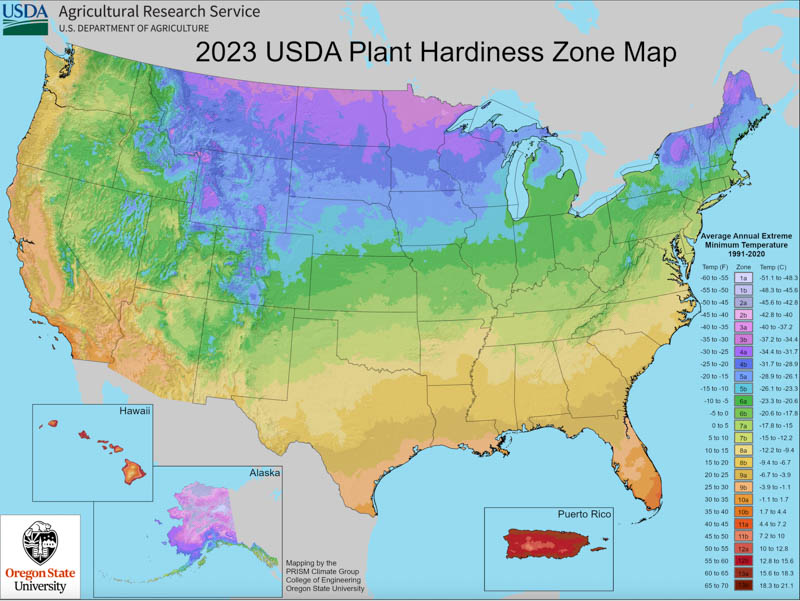
A visual overview of USDA planting zones across the United States
Use the map plus your ZIP code to pinpoint your exact garden zone.
To find your exact planting zone, you can:
Here’s a quick reference for common USDA growing zones. Use this chart alongside the map and your ZIP code to match your garden with the right flowers, shrubs, trees, and vegetables.
This is a simplified overview of zones 3–13. For full a/b sub-zone details, refer to the official USDA map.
| Zone | Average Min Temp (°F) | Average Min Temp (°C) | General Notes |
|---|---|---|---|
| Zone 3 | -40 to -30 | -40 to -34 | Very cold winters; short growing season; hardy perennials only. |
| Zone 4 | -30 to -20 | -34 to -29 | Cold climate gardens; focus on cold-tolerant trees, shrubs, and veggies. |
| Zone 5 | -20 to -10 | -29 to -23 | Four-season climate; popular for a wide range of perennials and fruit trees. |
| Zone 6 | -10 to 0 | -23 to -18 | Moderate winters; long list of ornamental and edible plants thrive. |
| Zone 7 | 0 to 10 | -18 to -12 | Mild winters; great for extended growing seasons and diverse plantings. |
| Zone 8 | 10 to 20 | -12 to -7 | Warm climate; many evergreen shrubs, Mediterranean and subtropical plants. |
| Zone 9 | 20 to 30 | -7 to -1 | Very mild winters; citrus and many tender perennials thrive. |
| Zone 10 | 30 to 40 | -1 to 4 | Subtropical; ideal for many tender ornamentals and fruit trees. |
| Zone 11 | 40 to 50 | 4 to 10 | Tropical winters; frost is rare, year-round gardening possible. |
| Zone 12 | 50 to 60 | 10 to 16 | Hot, frost-free climates; many tropical ornamentals and edibles. |
| Zone 13 | 60 and above | 16 and above | Extremely warm areas (parts of Hawaii and Puerto Rico); tropical species only. |
Every state stretches across one or more USDA hardiness zones. Use this quick list to see the general planting zones for each state.
| State | USDA Planting Zones |
|---|---|
| Alabama | Zones 7b–9b |
| Alaska | Zones 1a–8b |
| Arizona | Zones 5b–10a |
| Arkansas | Zones 7a–8b |
| California | Zones 5a–11a |
| Colorado | Zones 3b–7b |
| Connecticut | Zones 6a–7b |
| Delaware | Zones 7a–8a |
| Florida | Zones 8b–11b |
| Georgia | Zones 7a–9b |
| Hawaii | Zones 8b–13a |
| Idaho | Zones 3b–7b |
| Illinois | Zones 5a–7b |
| Indiana | Zones 5b–7a |
| Iowa | Zones 4b–6a |
| Kansas | Zones 5b–7a |
| Kentucky | Zones 6b–7b |
| Louisiana | Zones 8b–10b |
| Maine | Zones 3b–7a |
| Maryland | Zones 5b–8a |
| Massachusetts | Zones 5a–7b |
| Michigan | Zones 4a–6b |
| Minnesota | Zones 3a–5a |
| Mississippi | Zones 7b–9b |
| Missouri | Zones 5b–8a |
| Montana | Zones 3a–6b |
| Nebraska | Zones 4b–6a |
| Nevada | Zones 4a–10a |
| New Hampshire | Zones 3b–6b |
| New Jersey | Zones 6b–8a |
| New Mexico | Zones 5a–8b |
| New York | Zones 4a–7b |
| North Carolina | Zones 6a–9a |
| North Dakota | Zones 3a–4b |
| Ohio | Zones 5b–7a |
| Oklahoma | Zones 6b–8a |
| Oregon | Zones 5a–10a |
| Pennsylvania | Zones 5b–8a |
| Rhode Island | Zones 6a–7b |
| South Carolina | Zones 7b–9b |
| South Dakota | Zones 4a–5b |
| Tennessee | Zones 6a–8a |
| Texas | Zones 6b–10b |
| Utah | Zones 4a–9a |
| Vermont | Zones 4a–6a |
| Virginia | Zones 5b–8b |
| Washington | Zones 4a–9b |
| West Virginia | Zones 5b–7a |
| Wisconsin | Zones 3b–6a |
| Wyoming | Zones 3b–6a |
For more detailed information, including frost dates, planting calendars, and recommended plants, open the full planting zone guide for your state.
Beyond planting zones, average frost dates are key for planning when to sow seeds and transplant seedlings. Your last spring frost date tells you when it’s typically safe to plant frost-tender crops; your first fall frost date tells you when the growing season usually ends.
In general:
Once you know your USDA hardiness zone, choosing plants becomes much easier. Look for plant tags, catalogs, and online listings that include recommended zones. Alternatively, use our Plant Finder to find the right plants for your garden.
Ready to dive deeper into planting zones by state? Choose your state below to see detailed growing zones, frost dates, recommended plants, and a month-by-month garden planting calendar.
USDA planting zones, also called hardiness zones or garden zones, are based on the average annual extreme minimum winter temperature at a location over a 30-year period. The United States is divided into 13 zones, each covering a 10°F range, and each zone is split into “a” and “b” half-zones that differ by 5°F. These zones help gardeners predict whether a perennial plant is likely to survive winter in their climate.
The most accurate way to find your zone is to use the official USDA Plant Hardiness Zone Map and enter your ZIP code in the search box. The interactive map will zoom to your location and display the zone (including the a/b half-zone). You can also view downloadable state maps, or approximate your zone by comparing your location to nearby cities on the map.
The USDA map is updated occasionally when enough new climate data has accumulated. Major updates were released in 1990, 2012, and 2023. The 2023 version is based on 1991–2020 weather data and shows that about half of the United States has shifted at least a half-zone warmer compared with previous editions, reflecting a trend toward milder winter lows in many regions.
Your planting zone is about how cold it gets in winter and whether a perennial can survive those minimum temperatures. Frost dates and growing season describe when freezing temperatures start and end each year and how many frost-free days you get. Zones tell you what can live through winter; frost dates and season length tell you when to plant seeds and transplants. You need both pieces of information for smart garden planning
Sometimes, yes—but it usually takes more work. A plant that’s rated for warmer zones than yours may be grown as an annual, in a container you move indoors, or with extra winter protection like mulching and covers. Conversely, cold-hardy plants from lower zones can often handle warmer climates, but may dislike intense summer heat or lack of winter chill. The further you “stretch” beyond your zone, the more risk, care, and experimentation are involved.
USDA zones are most important for perennials, trees, and shrubs that must survive your coldest winter temperatures year after year. Annual vegetables and flowers only grow for one season, so they’re usually killed by frost regardless of zone. For annuals, frost dates, heat, and season length matter more than hardiness zone, though zone still hints at overall climate patterns.
A microclimate is a small area—like a sheltered courtyard, south-facing wall, raised bed, or low-lying frost pocket—where conditions are noticeably warmer or colder than the surrounding landscape. Microclimates can effectively make your garden behave about a half-zone warmer or cooler than the map suggests. That’s why two gardens in the same ZIP code can have different results with the exact same plant.
USDA planting zones measure cold tolerance based on the average annual minimum winter temperature. Heat zones, such as the American Horticultural Society (AHS) Heat Zone Map, measure how many days per year are hotter than 86°F (30°C), which affects heat stress in plants. “Climate zones” in building codes or other systems may use completely different criteria. For a full picture of what will thrive, gardeners often consult both hardiness zones (cold) and heat zones (heat).
No. A warmer zone on the new map doesn’t mean your existing plants are suddenly unsuitable. It reflects an updated average of past winter lows, not a guarantee that future winters will always be mild. If your current plants have been thriving, they’ll likely continue to do so. The new zone mainly gives you more options to consider when choosing new plants, especially marginally hardy ones.
Use your zone as a screening tool, not a rigid rule. When reading plant tags or catalogs, check that the plant is hardy to at least your zone number or a lower one (for example, hardy to Zones 4–8 if you’re in Zone 6). Then factor in sun, soil, moisture, heat, and frost dates. If you’re pushing the limits (trying something just outside your zone), start small, use protected spots, and be ready to experiment.
The USDA hardiness zone system is widely referenced in North America and sometimes adapted elsewhere, but many countries have their own maps and rating systems. Canada has a national plant hardiness map, the UK’s Royal Horticultural Society uses its own H1–H7 ratings, and other regions may publish local guidance. If you garden outside the U.S., it’s best to consult both USDA-equivalent zones and any local hardiness or climate resources.
Updated: December 2025 • Reviewed by Gardenia Editors
| Hardiness |
2 - 13 |
|---|---|
| Native Plants | California, United States, Northeast, Pennsylvania, Rhode Island, Vermont, Connecticut, Delaware, Maine, Massachusetts, Maryland, New Hampshire, New Jersey, New York, Illinois, Indiana, Iowa, Kansas, Michigan, Midwest, Minnesota, Missouri, Nebraska, North Dakota, Ohio, South Dakota, Wisconsin, Idaho, Oregon, Pacific Northwest, Washington, Southeast, Louisiana, Mississippi, North Carolina, South Carolina, Tennessee, Virginia, West Virginia, Alabama, Arkansas, Florida, Georgia, Kentucky, Southwest, Texas, Arizona, Nevada, New Mexico, Oklahoma, Colorado, Montana, Rocky Mountains, Utah, Wyoming, Alaska |
| Toxic to Humans | No known toxicity |
| Toxic to Cats | No known toxicity |
| Toxic to Dogs | No known toxicity |
| Toxic to Horses | No known toxicity |
Photo: 123rf
| Hardiness |
2 - 13 |
|---|---|
| Native Plants | California, United States, Northeast, Pennsylvania, Rhode Island, Vermont, Connecticut, Delaware, Maine, Massachusetts, Maryland, New Hampshire, New Jersey, New York, Illinois, Indiana, Iowa, Kansas, Michigan, Midwest, Minnesota, Missouri, Nebraska, North Dakota, Ohio, South Dakota, Wisconsin, Idaho, Oregon, Pacific Northwest, Washington, Southeast, Louisiana, Mississippi, North Carolina, South Carolina, Tennessee, Virginia, West Virginia, Alabama, Arkansas, Florida, Georgia, Kentucky, Southwest, Texas, Arizona, Nevada, New Mexico, Oklahoma, Colorado, Montana, Rocky Mountains, Utah, Wyoming, Alaska |
| Toxic to Humans | No known toxicity |
| Toxic to Cats | No known toxicity |
| Toxic to Dogs | No known toxicity |
| Toxic to Horses | No known toxicity |
Create a membership account to save your garden designs and to view them on any device.
Becoming a contributing member of Gardenia is easy and can be done in just a few minutes. If you provide us with your name, email address and the payment of a modest $25 annual membership fee, you will become a full member, enabling you to design and save up to 25 of your garden design ideas.
Join now and start creating your dream garden!
Create a membership account to save your garden designs and to view them on any device.
Becoming a contributing member of Gardenia is easy and can be done in just a few minutes. If you provide us with your name, email address and the payment of a modest $25 annual membership fee, you will become a full member, enabling you to design and save up to 25 of your garden design ideas.
Join now and start creating your dream garden!