Design a serene woodland border with beautyberry, sweetspire, ferns, river oats, and woodland phlox for shade, wildlife, and 3-season color.
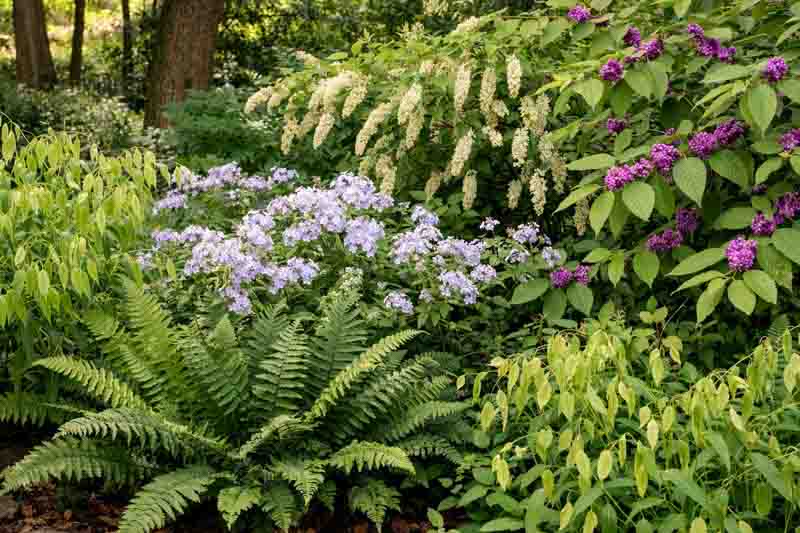


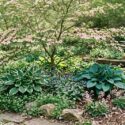
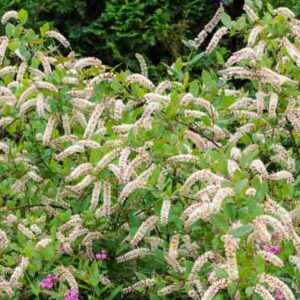
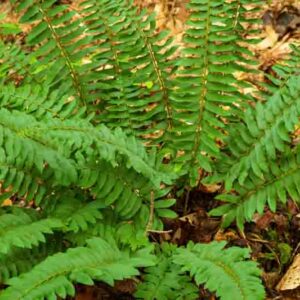
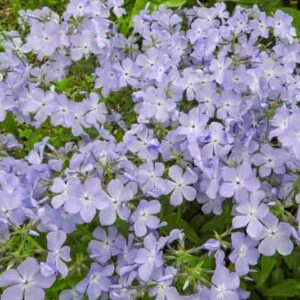
This woodland planting relies on foliage as much as flowers. Broad drifts of Polystichum acrostichoides fill the foreground with arching evergreen fronds, while pale blue Phlox divaricata flowers through the middle of the bed. Behind them, Itea virginica carries slender white flower clusters, and Callicarpa americana forms a substantial leafy shrub on the right.
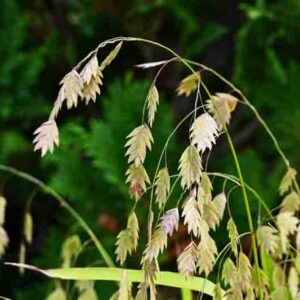
Chasmanthium latifolium threads through the lower planting with fresh green, bamboo-like leaves. Its distinctive flattened seedheads appear later in the season, so at this stage it contributes mainly foliage and texture rather than the dangling oats for which the plant is best known.
Main plants used: Polystichum acrostichoides, Itea virginica, Phlox divaricata, Chasmanthium latifolium, and Callicarpa americana
The photograph shows a border that is dense but not uniform. Christmas Fern provides the darkest and most consistent foliage, while Woodland Phlox rises just above it with loose clusters of pale flowers. Sweetspire adds a completely different shape with arching white racemes, and Beautyberry contributes larger leaves and longer branches.
River Oats helps connect those layers. Its foliage is finer than the shrubs but broader than the fern fronds, and mature plants eventually send up flat, hanging seedheads that become especially attractive from late summer into fall.
The plants also suit the informal character of a woodland edge. Nothing is clipped or arranged in a straight row. Ferns overlap neighboring plants, Phlox spreads into loose colonies, and the shrubs extend naturally over the perennials below.
Polystichum acrostichoides, or Christmas Fern, provides much of the year-round foliage. Its leathery dark green fronds form substantial clumps in shade and partial shade and work especially well beneath deciduous trees. Established plants tolerate some dry shade, although they perform best where the soil does not remain excessively dry.
Itea virginica, or Virginia Sweetspire, produces fragrant white flower racemes in late spring to early summer. It grows well in moist soil and tolerates considerably wetter conditions than many woodland shrubs. In fall, the foliage can turn shades of red, orange, and burgundy.
Phlox divaricata brings the clearest spring color. Its pale blue to lavender flowers appear above spreading stems and are particularly effective in loose colonies. It prefers humus-rich, reasonably moist, well-drained soil and partial shade, especially in warmer climates.
Chasmanthium latifolium, or River Oats, is a warm-season native grass that tolerates more shade than many ornamental grasses. Flat seedheads appear later in summer, gradually changing from green to tan or coppery tones. The plant can reseed freely, so remove unwanted seedlings if it begins spreading beyond its allotted area.
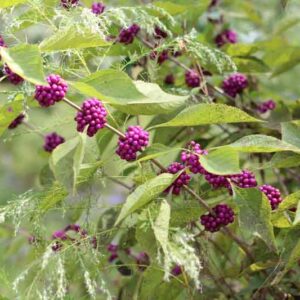
Callicarpa americana, or American Beautyberry, forms an arching deciduous shrub. Small summer flowers are followed by clusters of vivid purple berries in late summer and fall. It fruits best with adequate light, although it also grows well along woodland edges and in partial shade.
Create a layered woodland border where evergreen fern foliage supports successive waves of spring flowers, summer texture, fall color, and berries.
These percentages describe the balance of the five featured plants rather than equal numbers. Sweetspire and Beautyberry will eventually occupy considerably more space than individual ferns or Phlox plants.
Position Beautyberry and Virginia Sweetspire first, allowing for their mature spread. Use them toward the back and sides rather than creating a continuous shrub wall.
Repeat Christmas Fern in broad clumps through the foreground and middle. Plant Woodland Phlox between those groups so it can gradually form loose flowering colonies.
Thread River Oats through selected gaps where its arching foliage and later seedheads can be seen, but avoid allowing it to dominate the entire ground layer.
This is not a uniformly wet-shade planting. Virginia Sweetspire tolerates wet soil particularly well, while Christmas Fern and Woodland Phlox are better suited to moist but drained woodland ground. Avoid assuming that every plant should sit in permanently saturated soil.
Tree roots can also make woodland borders surprisingly dry in summer. Even shade-tolerant plants may need supplemental water during prolonged hot weather, particularly while establishing.
River Oats can spread by seed, and both Sweetspire and Beautyberry can broaden considerably with age. Allow some movement and natural expansion, but thin plants when necessary to preserve the layered structure visible in the photograph.
| Hardiness |
6 - 8 |
|---|---|
| Climate Zones | 3, 3A, 3B, 4, 5, 6, 15, 16, 17 |
| Exposure | Partial Sun |
| Season of Interest | Spring (Mid, Late), Summer (Early, Mid, Late), Fall |
| Maintenance | Low |
| Water Needs | Average |
| Soil Type | Clay, Loam |
| Soil pH | Acid |
| Soil Drainage | Moist but Well-Drained |
| Characteristics | Showy, Fruit & Berries |
| Native Plants | United States, Southeast, Louisiana, Mississippi, North Carolina, South Carolina, Tennessee, Virginia, Alabama, Arkansas, Georgia, Kentucky, Southwest, Texas, Oklahoma |
| Attracts | Bees, Butterflies, Hummingbirds, Birds |
| Landscaping Ideas | Beds And Borders |
| Garden Styles | Butterfly Garden, Informal and Cottage, Pollinator Garden, Woodland Garden |

| Hardiness |
6 - 8 |
|---|---|
| Climate Zones | 3, 3A, 3B, 4, 5, 6, 15, 16, 17 |
| Exposure | Partial Sun |
| Season of Interest | Spring (Mid, Late), Summer (Early, Mid, Late), Fall |
| Maintenance | Low |
| Water Needs | Average |
| Soil Type | Clay, Loam |
| Soil pH | Acid |
| Soil Drainage | Moist but Well-Drained |
| Characteristics | Showy, Fruit & Berries |
| Native Plants | United States, Southeast, Louisiana, Mississippi, North Carolina, South Carolina, Tennessee, Virginia, Alabama, Arkansas, Georgia, Kentucky, Southwest, Texas, Oklahoma |
| Attracts | Bees, Butterflies, Hummingbirds, Birds |
| Landscaping Ideas | Beds And Borders |
| Garden Styles | Butterfly Garden, Informal and Cottage, Pollinator Garden, Woodland Garden |
Recreate this garden. Specify the percentages you would like to have of each plant and input the dimensions of your garden space.We'll give you a shopping list so you know how many plants you need.
| Plant | Quantity | |
|---|---|---|
| Callicarpa americana (American Beautyberry) | N/A | Buy Plants |
| Itea virginica (Virginia Sweetspire) | N/A | Buy Plants |
| Polystichum acrostichoides (Christmas Fern) | N/A | Buy Plants |
| Phlox divaricata (Woodland Phlox) | N/A | Buy Plants |
| Chasmanthium latifolium (Northern Sea Oats) | N/A | Buy Plants |
Create a membership account to save your garden designs and to view them on any device.
Becoming a contributing member of Gardenia is easy and can be done in just a few minutes. If you provide us with your name, email address and the payment of a modest $25 annual membership fee, you will become a full member, enabling you to design and save up to 25 of your garden design ideas.
Join now and start creating your dream garden!