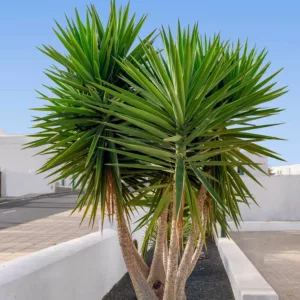
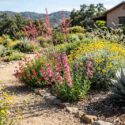
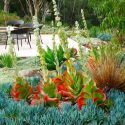
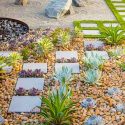
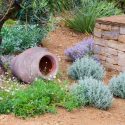
A full sun, low-water gravel garden built with architectural succulents and ornamental grass. Yucca rostrata brings sculptural height, Agave parryi repeats crisp rosettes, Muhlenbergia capillaris blooms with pink plumes in late summer to fall, and Lantana montevidensis flowers through warm months.
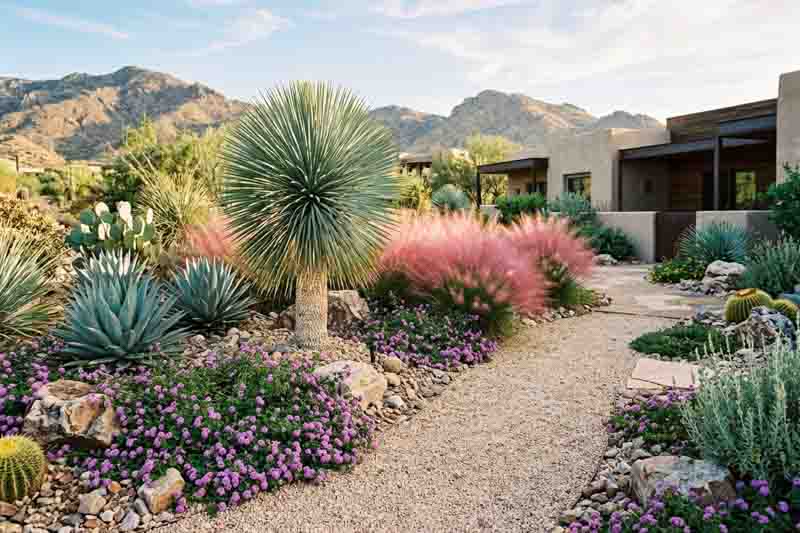


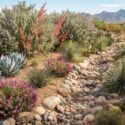
This Southwestern garden combines strong architectural plants with grasses, flowering groundcovers, cacti, and gravel. A mature Yucca rostrata provides height near the center of the planting, while blue-gray agaves repeat at lower levels. Behind them, Muhlenbergia capillaris adds a broad sweep of pink in late summer and fall, and Lantana montevidensis spreads between rocks and larger plants with small purple flowers.
The garden is more varied than a simple four-plant scheme. Prickly pears, barrel cacti, other succulents, rocks, and low-growing plants contribute to the dry-land character, while the gravel path leads toward the house. The mountain backdrop and simple architecture reinforce the Southwestern setting.
What keeps the planting from becoming visually crowded is the amount of open gravel between the larger plants. Each yucca, agave, cactus, and grass has enough room for its natural shape to remain visible.
Main plants used: Yucca rostrata, Agave parryi, Muhlenbergia capillaris (Pink Muhly Grass), and Lantana montevidensis (Trailing Lantana)
The strongest contrast is between the rigid forms of the yuccas, agaves, and cacti and the much softer muhly grass. The spiky plants give the garden structure throughout the year, while the grass changes with the season and moves in the wind.
Color is restrained. Blue-gray foliage appears repeatedly through the planting, the gravel and rocks provide warm neutral tones, and the pink muhly and purple lantana introduce seasonal color without overwhelming the garden.
The open ground is just as important as the plants. Gravel creates separation between large forms, makes individual silhouettes easier to appreciate, and suits the dry character of the landscape.
Yucca rostrata provides the principal height and one of the clearest silhouettes in the garden. Give it plenty of space around the crown and position it where it can be seen from the path, house, or another important viewpoint.
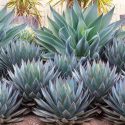
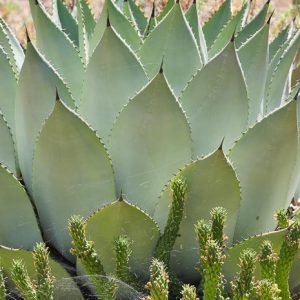
Agave parryi repeats the blue-gray color at ground level. Several rosettes placed at irregular intervals work better than an evenly spaced row. Keep mature size in mind so neighboring plants do not eventually crowd the leaves.
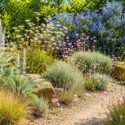
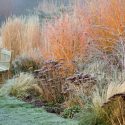
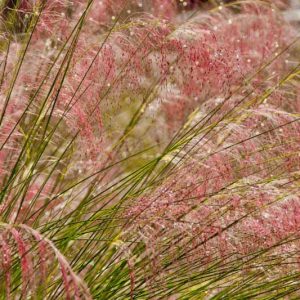
Muhlenbergia capillaris is most effective in groups. Its fine green foliage remains relatively quiet for much of the year, then develops airy pink flower plumes in late summer and fall. In this garden, the larger grouping behind the succulents provides a welcome contrast to their rigid forms.
Lantana montevidensis occupies the lowest layer. Its spreading habit allows it to move around rocks and between larger plants, introducing both foliage and small purple flowers without hiding the gravel completely.
Create a low-water garden with strong architectural plants, enough open gravel to show their form, and softer grasses and flowering groundcovers to keep the landscape from feeling severe.
Use these proportions as a guide for the featured plants. Cacti and other compatible xeric plants can be added in smaller numbers, as they are in this garden.
Place the yucca first, giving it enough room to develop into a strong specimen.
Repeat agaves nearby and farther through the garden rather than arranging them at equal intervals.
Use muhly grass in larger groups behind or between the architectural plants, where its softer shape can be seen clearly.
Allow lantana to occupy some of the lower gaps, but keep areas of gravel exposed. Add cacti and rocks sparingly rather than trying to fill every open space.
This type of garden depends on choosing plants suited to both the climate and the drainage. Low-water does not mean no water, particularly during establishment or prolonged periods of extreme heat.
It also benefits from restraint. One well-placed yucca, several clearly spaced agaves, a generous sweep of grass, and a few groups of cacti usually make a stronger composition than filling the entire area with small specimens.
As the garden matures, allow some plants to spread and soften the gravel while preserving enough open ground for the larger architectural forms to remain visible.
| Hardiness |
8 - 9 |
|---|---|
| Heat Zones |
9 - 11 |
| Climate Zones | 8, 9, 10, 12, 13, 14, 15, 16, 17, 18, 19, 20, 21, 22, 23, 24 |
| Exposure | Full Sun |
| Season of Interest | Spring (Early, Mid, Late), Summer (Early, Mid, Late), Fall, Winter |
| Maintenance | Low |
| Water Needs | Low |
| Soil Type | Loam, Sand |
| Soil pH | Acid, Neutral |
| Soil Drainage | Well-Drained |
| Characteristics | Showy |
| Tolerances | Drought, Deer |
| Attracts | Bees, Butterflies |
| Landscaping Ideas | Beds And Borders |
| Garden Styles | Butterfly Garden, Gravel and Rock Garden, Pollinator Garden |



| Hardiness |
8 - 9 |
|---|---|
| Heat Zones |
9 - 11 |
| Climate Zones | 8, 9, 10, 12, 13, 14, 15, 16, 17, 18, 19, 20, 21, 22, 23, 24 |
| Exposure | Full Sun |
| Season of Interest | Spring (Early, Mid, Late), Summer (Early, Mid, Late), Fall, Winter |
| Maintenance | Low |
| Water Needs | Low |
| Soil Type | Loam, Sand |
| Soil pH | Acid, Neutral |
| Soil Drainage | Well-Drained |
| Characteristics | Showy |
| Tolerances | Drought, Deer |
| Attracts | Bees, Butterflies |
| Landscaping Ideas | Beds And Borders |
| Garden Styles | Butterfly Garden, Gravel and Rock Garden, Pollinator Garden |
Recreate this garden. Specify the percentages you would like to have of each plant and input the dimensions of your garden space.We'll give you a shopping list so you know how many plants you need.
| Plant | Quantity | |
|---|---|---|
| Yucca rostrata (Beaked Yucca) | N/A | Buy Plants |
| Agave parryi (Artichoke Agave) | N/A | Buy Plants |
| Muhlenbergia capillaris (Pink Muhly Grass) | N/A | Buy Plants |
| Lantana montevidensis (Trailing Lantana) | N/A | Buy Plants |
Create a membership account to save your garden designs and to view them on any device.
Becoming a contributing member of Gardenia is easy and can be done in just a few minutes. If you provide us with your name, email address and the payment of a modest $25 annual membership fee, you will become a full member, enabling you to design and save up to 25 of your garden design ideas.
Join now and start creating your dream garden!