Leavenworth’s Sedge, Lawn Sedge
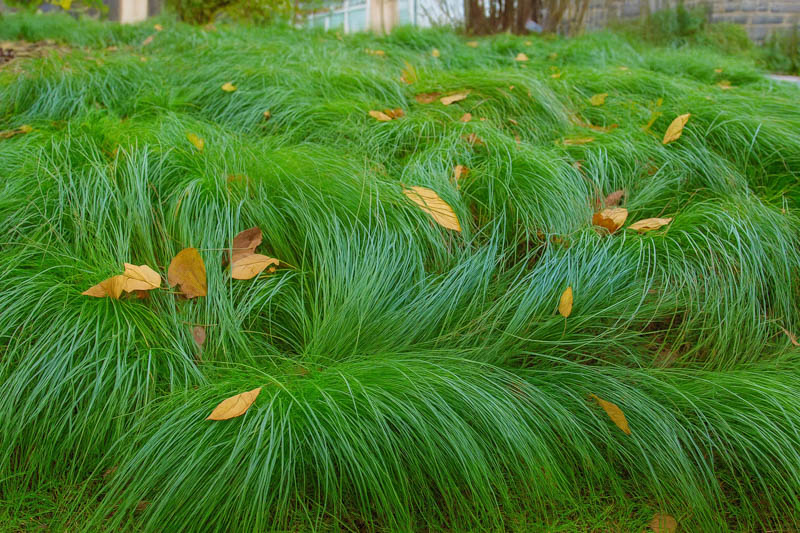


Wish your dry shade or tricky woodland edge would just behave and look green without constant pampering? Meet Carex leavenworthii, usually called Leavenworth’s sedge, lawn sedge, or Leavenworth sedge. This small, native perennial sedge forms dense clumps of very narrow, deep green leaves that read like a soft turf.
Carex leavenworthii care is easy: plant it in full sun to part shade or bright dry shade, give it average to dry soil, water it well the first season, and let it knit into a resilient, low mow green carpet. It is a standout choice for woodland lawns, shady lawn alternatives, dry shade groundcovers, naturalistic borders, slopes, and low input meadows across much of the central and eastern United States.
Summary: Petite, fine textured native sedge forming tight clumps of dark to medium green leaves that can be massed as a lawn alternative in sun or dry shade.
Use: Woodland lawns, shady lawn replacement, dry shade groundcover, slopes, naturalistic borders, restoration plantings, and low input meadows.
Highlight: Thrives in average to dry, well drained soil, handles heat and short drought after establishment, and keeps a surprisingly lush look in tough dry shade.
Note: Deer resistant, drought tolerant, and low maintenance. Clump forming but self sows into open soil, gradually creating a green, mow optional matrix.
| Botanical Name | Carex leavenworthii Dewey |
|---|---|
| Family | Cyperaceae (sedge family) |
| Common Names | Leavenworth’s sedge, lawn sedge, Leavenworth sedge |
| Native Range | Native to eastern and central North America, from Ontario and New York and the Great Lakes region south to the Florida Panhandle and Texas, and west to Nebraska, Kansas, and Oklahoma, in dry forests, woodland edges, grasslands, roadsides, and lawns. |
| Plant Type and Habit | Cool season perennial sedge, tightly clump forming with fibrous roots; narrow, grass like foliage forming low, tufted mounds. |
| Hardiness (USDA) | Zones 6 to 9 in most horticultural references, with some reports into Zone 5 in protected sites. |
| Size | Typically 6 to 12 inches tall and about 6 to 12 inches wide, forming small, dense clumps that gradually knit together when massed. |
| Sun and Exposure | Full sun to full shade. Best in part sun or bright dry shade; in full sun it prefers at least occasional watering, and in deep shade it remains surprisingly lush if soil is not bone dry. |
| Soil | Thrives in average, dry to medium, well drained soils. Tolerates sandy, clay, rocky, and even seasonally flooded sites once established. Ideal for dry woods, woodland edges, and tough urban soils. |
| Seasonal Interest | Evergreen to semi evergreen foliage in many climates; tight, green flower and seed heads in late spring that age to tan, adding fine texture into summer and fall. |
| Primary Uses | Woodland groundcover, lawn alternative in sun or dry shade, shady path edging, slopes, erosion control, naturalistic plantings, and Carex leavenworthii meadow lawns that can be mown once to a few times a year. |
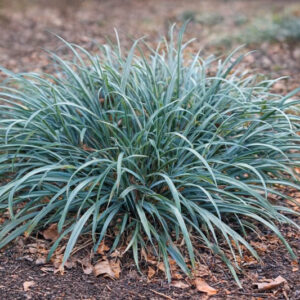
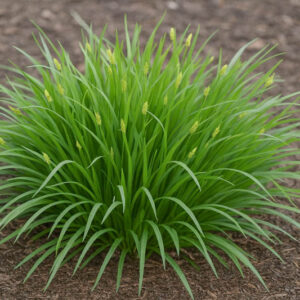
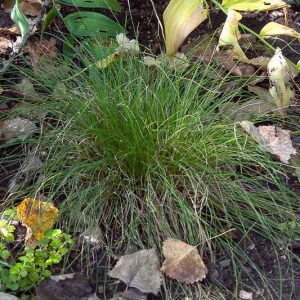
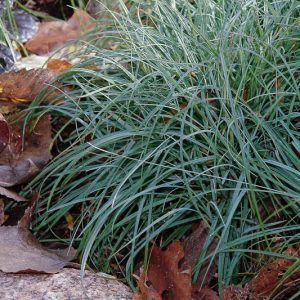
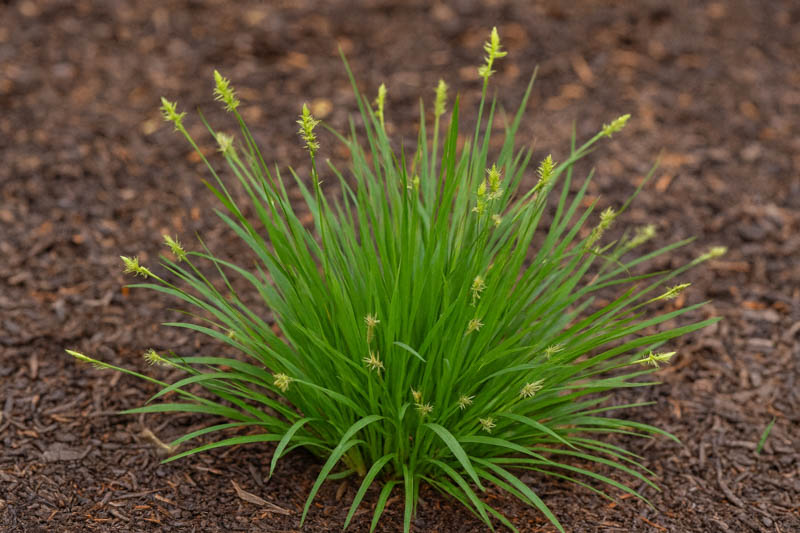
Carex leavenworthii is a small, clump forming woodland and grassland sedge with very narrow, dark green leaves and a fine, hair like texture. Each clump forms a small fountain of grass like foliage, about half a foot to a foot tall, that looks like a miniature ornamental grass. Leaves are typically around one eighth of an inch wide, giving the whole plant a soft, tufted look that works beautifully as a groundcover or lawn substitute.
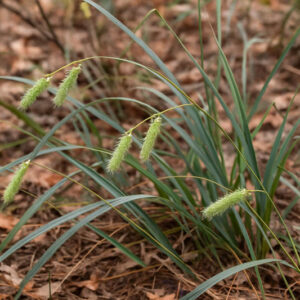
In late spring, slender stems rise just above the foliage and carry tight, rounded heads of greenish flower spikes. Those little heads mature into tan, conical clusters of seeds that sit above the foliage and add subtle texture without screaming for attention. From a distance, the overall effect is a calm, even, fine textured green surface that reads like a more relaxed, natural version of turf.
Leavenworth’s sedge is native to a wide swath of eastern and central North America. Its natural distribution stretches from Ontario and New York and the Northeast through much of the Midwest and Ohio Valley, south to the Florida Panhandle and Gulf Coast, and west into states like Nebraska, Kansas, Oklahoma, and Texas.
In the wild, you are likely to find Carex leavenworthii in habitats such as:
This natural range explains why Carex leavenworthii thrives in dry shade and average soils, and why it tolerates heat and short periods of drought once established. Best Shade Plants for Texas Yards (That Actually Thrive, Not Sulk)
Carex leavenworthii is a densely tufted sedge that grows without obvious rhizomes. Each plant forms a small, tight clump of foliage about 6 to 12 inches tall and wide. In good conditions, the clumps expand gradually, and seedlings appear here and there in open soil, especially if you allow seed heads to ripen and shatter.
This combination of clumping habit and modest self seeding makes Leavenworth’s sedge ideal for use as a lawn sedge. It does not run aggressively like some turf grasses. Instead, it slowly thickens and fills in bare patches, especially if planted on a grid and given time to knit together.
Flowering typically occurs in late spring, often from May into early June depending on climate. Slender stems rise just above the foliage, each carrying a dense, head like cluster of several small spikes. The flowers themselves are not showy in the traditional sense. They are greenish to pale, blending subtly with the foliage.
As the season progresses, these heads ripen into tight clusters of small, round seeds enclosed by light green to tan sacs. Mature seed clusters are attractive at close range and provide seed for birds and small wildlife in naturalistic plantings. If you are using Carex leavenworthii as a lawn, you can choose to mow before or after seed set depending on whether you want more self sowing.
The foliage is the main ornamental feature of Carex leavenworthii. Leaves are:
In mass, the foliage reads as a soft, green carpet that is far more forgiving than turf, especially under trees. It pairs nicely with bolder foliage such as hostas, ferns, heucheras, and low shrubs, bringing a smooth, grassy texture that ties diverse plantings together.
Most nursery sources list Carex leavenworthii as hardy in roughly USDA Zones 6 to 9, with some gardeners reporting success in Zone 5 where snow cover or protection is reliable. It performs well in climates with hot summers as long as soil is not overly wet and drainage is good. In cooler zones, foliage may thin in winter but fresh growth returns early in spring, as this is a cool season grower.
Thanks to its small size, drought tolerance, and fine texture, Leavenworth’s sedge is one of the most useful native sedges for lawn replacement in shade or part sun. You can use Carex leavenworthii in many ways:
Sedges are essential for many native insects and birds, and Carex leavenworthii is no exception. Its value in a wildlife friendly landscape includes:
Because a Carex leavenworthii lawn generally needs little irrigation, fertilizer, or chemicals compared to standard turf, it helps create safer, more stable habitat in residential and public landscapes.
Leavenworth’s sedge is widely described as deer resistant and unpalatable to many herbivores. The fine, fibrous leaves are not high on the menu compared to broad leaf perennials or tender annuals. Browsing, if it happens, is usually light and cosmetic, making this sedge a smart choice for high deer pressure gardens.
One of the standout features of Carex leavenworthii is its drought and heat tolerance once established. In trials and garden reports, foliage stayed green through summer dry spells when other sedges began to look stressed. In average to dry soils, it usually needs supplemental water only in prolonged drought, especially in full sun.
This species is not commonly listed as toxic to people or pets in major native plant references. As with most ornamental sedges and grasses, it is best treated as non edible. Normal gardening contact is fine, but pets and children should not be encouraged to chew on the foliage or seed heads.
Within its native and adapted range, Carex leavenworthii is generally considered well behaved. It forms clumps and self seeds into open, suitable soil, but does not spread aggressively by long rhizomes. In a lawn or meadow context, that gentle self seeding is an advantage, helping to fill in bare spots over time. Unwanted seedlings are easy to thin or transplant.
Overall, Carex leavenworthii care comes down to three simple things: reasonable drainage, average to dry soil, and not overwatering once it settles in.
Plant Carex leavenworthii where it gets:
Leavenworth’s sedge is surprisingly adaptable:
Water needs are moderate and decrease as plants mature.
Carex leavenworthii is adapted to natural woodland and grassland soils and does not need heavy feeding.
Mulch is helpful at planting time but becomes less necessary as the sedge thickens.
Carex leavenworthii maintenance is refreshingly low compared to conventional turf.
Leavenworth’s sedge spreads slowly, but it is easy to propagate if you want more plants.
In appropriate conditions, Carex leavenworthii is typically a trouble free, low maintenance native sedge.
Updated: November 2025
Key sources for horticultural details include native plant trials and profiles from Mt. Cuba Center, New Moon Nursery, North Creek Nurseries, USDA PLANTS, state flora atlases, and native plant societies across the species range.
| Hardiness |
6 - 9 |
|---|---|
| Plant Type | Ornamental Grasses |
| Plant Family | Cyperaceae |
| Genus | Carex |
| Common names | Sedge |
| Exposure | Full Sun, Partial Sun, Shade |
| Season of Interest | Spring (Early, Mid, Late), Summer (Early, Mid, Late), Fall, Winter |
| Height | 6" - 1' (15cm - 30cm) |
| Spread | 6" - 1' (15cm - 30cm) |
| Spacing | 8" - 12" (20cm - 30cm) |
| Maintenance | Low |
| Water Needs | Average |
| Soil Type | Clay, Loam, Sand |
| Soil pH | Acid, Neutral, Alkaline |
| Soil Drainage | Moist but Well-Drained |
| Characteristics | Showy, Evergreen, Semi-Evergreen |
| Native Plants | United States, Northeast, Pennsylvania, Maryland, New Jersey, New York, Illinois, Indiana, Iowa, Kansas, Michigan, Midwest, Missouri, Nebraska, Ohio, Southeast, Louisiana, Mississippi, North Carolina, South Carolina, Tennessee, Virginia, West Virginia, Alabama, Arkansas, Florida, Georgia, Kentucky, Southwest, Texas, Oklahoma |
| Tolerances | Deer, Drought, Dry Soil, Fire |
| Attracts | Butterflies, Birds |
| Garden Uses | Banks And Slopes, Ground Covers |
| Garden Styles | Informal and Cottage, Prairie and Meadow |
| Toxic to Humans | No known toxicity |
| Toxic to Cats | No known toxicity |
| Toxic to Dogs | No known toxicity |
| Toxic to Horses | No known toxicity |


| Hardiness |
6 - 9 |
|---|---|
| Plant Type | Ornamental Grasses |
| Plant Family | Cyperaceae |
| Genus | Carex |
| Common names | Sedge |
| Exposure | Full Sun, Partial Sun, Shade |
| Season of Interest | Spring (Early, Mid, Late), Summer (Early, Mid, Late), Fall, Winter |
| Height | 6" - 1' (15cm - 30cm) |
| Spread | 6" - 1' (15cm - 30cm) |
| Spacing | 8" - 12" (20cm - 30cm) |
| Maintenance | Low |
| Water Needs | Average |
| Soil Type | Clay, Loam, Sand |
| Soil pH | Acid, Neutral, Alkaline |
| Soil Drainage | Moist but Well-Drained |
| Characteristics | Showy, Evergreen, Semi-Evergreen |
| Native Plants | United States, Northeast, Pennsylvania, Maryland, New Jersey, New York, Illinois, Indiana, Iowa, Kansas, Michigan, Midwest, Missouri, Nebraska, Ohio, Southeast, Louisiana, Mississippi, North Carolina, South Carolina, Tennessee, Virginia, West Virginia, Alabama, Arkansas, Florida, Georgia, Kentucky, Southwest, Texas, Oklahoma |
| Tolerances | Deer, Drought, Dry Soil, Fire |
| Attracts | Butterflies, Birds |
| Garden Uses | Banks And Slopes, Ground Covers |
| Garden Styles | Informal and Cottage, Prairie and Meadow |
| Toxic to Humans | No known toxicity |
| Toxic to Cats | No known toxicity |
| Toxic to Dogs | No known toxicity |
| Toxic to Horses | No known toxicity |
How many Carex leavenworthii (Leavenworth’s Sedge) do I need for my garden?
| Plant | Quantity | |
|---|---|---|
| Carex leavenworthii (Leavenworth’s Sedge) | N/A | Buy Plants |
Create a membership account to save your garden designs and to view them on any device.
Becoming a contributing member of Gardenia is easy and can be done in just a few minutes. If you provide us with your name, email address and the payment of a modest $25 annual membership fee, you will become a full member, enabling you to design and save up to 25 of your garden design ideas.
Join now and start creating your dream garden!
Create a membership account to save your garden designs and to view them on any device.
Becoming a contributing member of Gardenia is easy and can be done in just a few minutes. If you provide us with your name, email address and the payment of a modest $25 annual membership fee, you will become a full member, enabling you to design and save up to 25 of your garden design ideas.
Join now and start creating your dream garden!