What should you plant with lilacs? Discover companions that do more than look pretty beside spring flowers. From bulbs, peonies, and catmint to roses, daylilies, asters, and grasses, learn how to soften bare stems, extend bloom from spring to fall, add texture, and build a better-balanced lilac border.


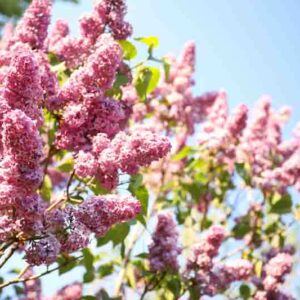
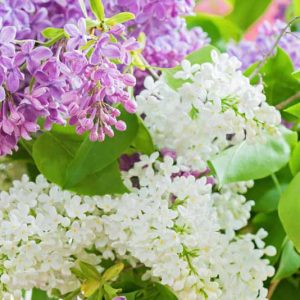
Lilacs hardly need help when they are in full bloom. For a few unforgettable weeks, their fragrant flower clusters dominate the spring garden in shades of purple, lavender, pink, white, and blue-violet.
The harder design question comes afterward.
Once the flowers fade, a mature lilac (Syringa) becomes a large mass of green foliage and woody stems. What should grow nearby so the planting still looks intentional in June, July, September, and even winter? What can soften a bare lower framework without crowding the shrub? Which plants will continue flowering after lilac season? And which combinations look beautiful on paper but struggle because their growing requirements do not actually match?
The best lilac companion plants are therefore not simply flowers that look pretty next to purple blooms. A useful companion should perform a job: extend the flowering season, soften the base of the shrub, introduce contrasting foliage or flower shapes, add summer or fall color, provide winter structure, or increase wildlife value.
Before choosing anything to plant with a lilac, work through five questions:
| Step | What to Ask | Why It Matters |
|---|---|---|
| Match the Site | Do both plants suit similar sun, drainage, soil moisture, and climate? | Visual compatibility is useless if one plant continually struggles. |
| Solve the Season | Does the planting need flowers before, during, or after lilac bloom? | Companions should extend interest rather than all peaking at once. |
| Cover the Weak Spot | Do you need to soften bare stems or an empty foreground? | Low companions can improve the composition without hiding the flowers. |
| Contrast the Form | Would spikes, globes, grasses, mounds, or broad foliage improve the planting? | Contrast prevents the border from becoming one shapeless mass of foliage. |
| Check the Competition | Will the companion have enough light, root space, and water as the lilac matures? | Plants positioned too close to an established shrub may struggle despite being otherwise compatible. |
Gardenia’s guiding principle: Choose a lilac companion by the job it needs to perform after checking that the two plants can actually share the site.
How to use the plant cards: The Gardenia plant cards placed throughout this guide can show specific examples for each design job. They are starting points, not fixed recipes. Open the individual profiles to compare hardiness, height, spread, bloom season, sun, soil, moisture requirements, and other characteristics before planting.
Want to test combinations before committing them to the garden? Use Gardenia’s Garden Design Tool to organize plants by size and season and build a planting palette around your lilac.
Most traditional lilacs flower best in full sun and well-drained soil. Common lilac generally favors neutral to alkaline conditions, although soil preferences vary somewhat across the genus. Lilacs dislike chronically waterlogged ground and flower less freely in substantial shade.
That immediately rules out the idea that any beautiful perennial automatically makes a good lilac companion.
Sun-loving perennials such as peonies, ornamental alliums, many irises, catmint, salvia, daylilies, coneflowers, asters, and upright sedums are often much easier partners than moisture-loving woodland plants in a bright, exposed lilac border.
Conditions may change immediately beneath a mature shrub, however. The north side of an established lilac can be noticeably shadier and drier than the open border several feet away. Companion placement therefore matters almost as much as plant selection.
Site first: Do not choose a companion because a photograph looks beautiful. First ask whether the exact planting position around your lilac is sunny, partly shaded, moist, dry, open, or heavily occupied by established roots.
One of the easiest ways to improve a lilac planting is to give the foreground an earlier spring season.
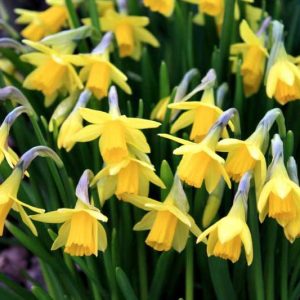
Daffodils are especially useful because their yellow, white, cream, peach, and orange flowers appear before or around early lilac season. Their upright leaves also occupy relatively little ground space between established shrubs and perennials.
Tulips can create dramatic color combinations with lilacs, particularly purple tulips beneath white lilacs or soft pink and cream tulips beside violet-flowered cultivars.
Ornamental alliums are even more useful because many flower during or just after the main lilac display. Their spherical heads introduce a completely different geometry beneath the billowing panicles of a lilac.
Bulbs are best planted in loose drifts rather than isolated single plants. Place them where emerging perennial foliage can gradually make ripening bulb leaves less conspicuous.
| Plant Type | Shrubs |
|---|---|
| Genus | Syringa |
| Exposure | Full Sun |
| Season of Interest | Spring (Mid, Late), Summer (Early) |
| Soil Type | Chalk, Clay, Loam, Sand |
| Soil pH | Alkaline, Neutral |
| Soil Drainage | Moist but Well-Drained, Well-Drained |
| Characteristics | Cut Flowers, Fragrant, Showy |
| Tolerances | Deer |
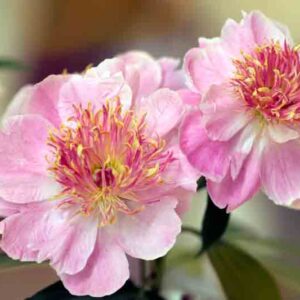
Peonies (Paeonia) and lilacs are classic companions for good reason. Both are associated with the lush, fragrant late-spring garden, and their large flowers complement one another without looking identical.
Peonies also solve a structural problem. Their rounded mounds of divided foliage can soften the lower foreground of a mature lilac and remain attractive after their own flowering season ends.
But do not interpret “plant peonies beneath a lilac” too literally. Herbaceous peonies perform best with abundant sun and do not appreciate strong root competition. Position them toward the sunny outer edge of the lilac planting rather than squeezing their crowns against the shrub’s woody base.
Pink lilacs with white peonies create a soft romantic palette. Purple lilacs with coral or pale pink peonies are richer and more dramatic. White lilacs allow almost any peony color to work.
Placement matters: Peonies and lilacs can share similar sunny, well-drained conditions, but give the peony its own light and root space. Companion planting should create visual overlap, not underground congestion.
Irises provide something a lilac planting often needs: crisp vertical foliage and clearly defined flower shapes.
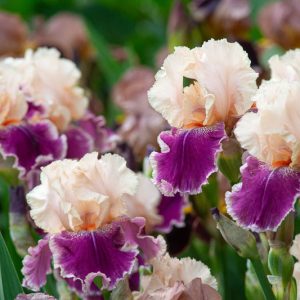
Bearded irises perform particularly well in sunny, well-drained sites and often flower around the same general period as lilacs. Purple-on-purple combinations can be surprisingly sophisticated when the tones differ, while blue, cream, yellow, and white irises create stronger contrast.
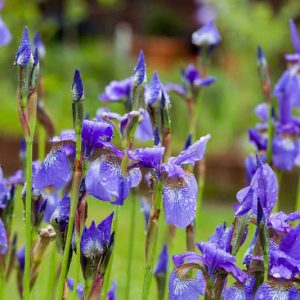
Siberian irises offer narrower leaves and a lighter, more graceful effect. Their moisture preference is somewhat greater than that of a classic dry lilac border, so use them where the soil remains reasonably fresh but still drains well.
Position irises outside the densest shrub root zone where their rhizomes or crowns receive good light.
A mature lilac can become visually heavy at the top and sparse near the ground, especially when older stems are exposed. Low, mounding perennials help connect the woody shrub to the rest of the border.
Catmint (Nepeta) is particularly effective in sunny, well-drained conditions. Its loose gray-green foliage and violet-blue flowers soften the lower edge of a lilac without competing visually with the large flower clusters above.
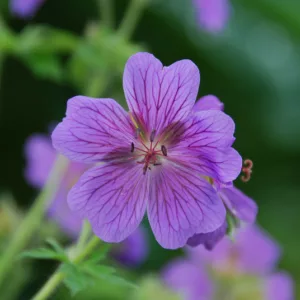
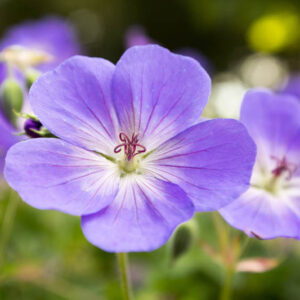
Hardy geraniums can provide a similar role. Choose sun-tolerant cultivars for open lilac borders and allow them to spread in the foreground rather than directly over the shrub’s base.
Both work especially well when the goal is to make an established lilac look integrated into a perennial border instead of appearing as a shrub with an empty ring of soil around it.
Once lilac flowers fade, the border needs plants that are just getting started.
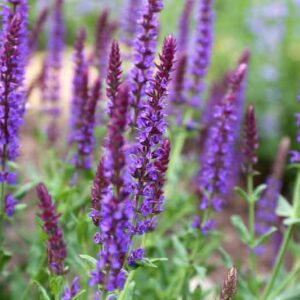
Perennial Salvia is excellent for this transition. Upright flower spikes create strong vertical punctuation against rounded lilac foliage, and shades of blue, violet, purple, pink, and white work easily with most lilac colors.
Many salvias favor full sun and good drainage, making them useful companions toward the sunny front and sides of a lilac planting.
The visual handoff is particularly effective: lilac panicles begin fading just as salvia spikes become prominent, so the border never seems to lose all its flowers at once.
Design for handoff: The best companion does not necessarily flower at the exact same moment as the lilac. Plants that begin as lilacs fade often contribute more to the garden as a whole.
Daylilies (Hemerocallis) are useful when the main design problem is the long green period after lilacs flower.
Their arching foliage forms substantial clumps at the base and foreground of a shrub planting, while their flowers arrive in summer in an enormous range of colors.
Daylilies are adaptable, but they flower most freely with adequate sun. Use them along the sunny edge of a lilac group rather than in deep shade beneath a dense mature canopy.
Blue-purple lilacs pair especially well with yellow, cream, apricot, and soft orange daylilies. Pink lilacs can be continued with rose, peach, or burgundy cultivars for a warmer palette.
Coneflowers (Echinacea), Rudbeckia, and other summer daisy-shaped perennials provide a striking contrast to lilac’s dense spring panicles.
They are most useful not because their flowers overlap with lilacs, but because they take over later. By midsummer, when the lilac is functioning primarily as a green background shrub, upright coneflower stems and daisy-shaped blooms bring the foreground back to life.
The combination also works particularly well in pollinator-focused gardens because it creates a longer sequence of flowering resources rather than concentrating bloom into spring alone.
Leave enough space between large perennial clumps and the lilac’s central framework so routine pruning and sucker management remain possible.
Lilacs and roses belong to different seasons of the romantic garden. That is precisely why they work well together.
Lilacs provide the major spring fragrance display. Roses then begin taking over as the lilac flowers disappear, extending color through summer and, with repeat-flowering roses, often much longer.
Do not crowd a rose directly into the base of an old lilac. Roses need strong light, good air circulation, and adequate root space. Position them nearby as part of the same composition rather than expecting both shrubs to occupy the same footprint.
For a harmonious palette, combine lavender lilacs with blush, cream, apricot, or deep pink roses. White lilacs can precede almost any rose color.
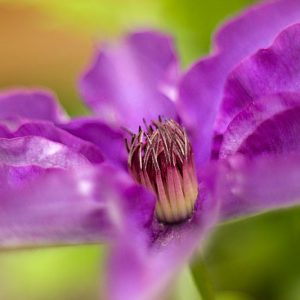
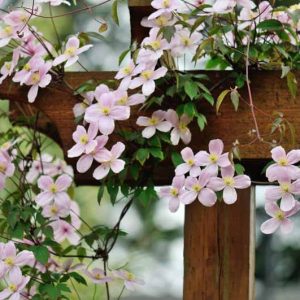
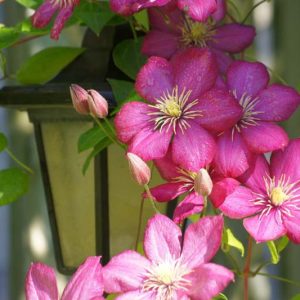
Clematis can be an effective way to add flowers around a lilac after the shrub’s own display is finished.
A summer-flowering clematis grown beside a mature lilac, or lightly guided through part of its outer framework, can add a second flowering season without overwhelming the shrub.
However, the combination should be deliberate. A vigorous vine can make pruning the lilac difficult, and both plants need adequate root space. Plant the clematis away from the central trunk area and guide it initially rather than simply allowing a vigorous vine to engulf the shrub.
Later-flowering clematis, including many Clematis viticella types, are especially useful because their display follows lilac bloom rather than competing with it.
Do not turn the lilac into a permanent trellis: A clematis should add flowers without smothering the shrub or preventing access for pruning and renewal. Very vigorous vines are better given their own support nearby.
A companion planting should not stop working in July.
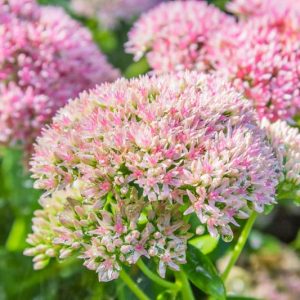
Upright sedums bring substantial foliage through summer and broad flower heads in late summer and fall. Their solid form contrasts well with the coarser canopy of a mature lilac.
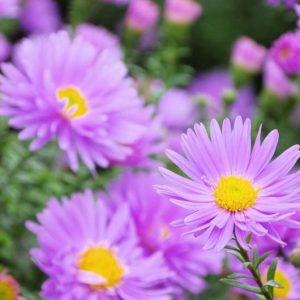
Asters take the seasonal sequence even later, covering themselves with daisy-shaped flowers when many summer perennials are finishing.
These plants are particularly valuable because the lilac itself often contributes relatively little flower color in autumn. Instead, its foliage becomes a neutral background for the late-season display.
Purple asters beneath a white lilac create a particularly elegant echo of spring color, while pink or blue-purple asters can continue a cooler palette beneath lavender-flowered lilacs.
Few plants contrast more strongly with broad lilac leaves than fine-textured ornamental grasses.
Smaller grasses can sit toward the front or sides of a lilac border, while larger grasses belong farther back or in neighboring groups where they will not crowd the shrub.
The main advantage appears after summer. Many grasses develop attractive seedheads and warm straw, gold, or copper tones in fall, then continue providing structure into winter after the lilac has lost its leaves.
Choose grass species according to climate, moisture, and mature size. A grass that becomes 6 ft wide is not a sensible filler beside a compact dwarf lilac.
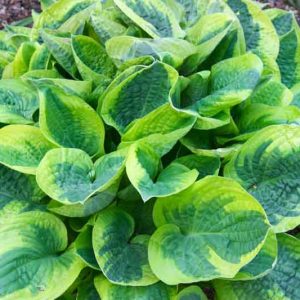
The old advice to plant hostas beneath lilacs needs qualification.
Hostas provide broad, handsome leaves that can look excellent against lilac stems, but their preferred site is usually shadier and more consistently moist than the open, full-sun position that produces the best lilac flowering.
The pairing can work on the north or east side of a mature lilac, where the canopy creates partial shade and the soil does not become excessively dry. It is much less convincing at the sunny outer edge of a hot, exposed lilac border.
This is a good example of why companion plants should be chosen for the actual microclimate around the shrub, not simply because two plants look attractive in photographs.
The old companion list included flowering crabapples, dogwoods, cherries, magnolias, and conifers. They can indeed create beautiful larger landscape compositions with lilacs, but they should be treated as neighboring structural plants, not close underplanting companions.
Flowering crabapples can precede or overlap lilac bloom and later contribute colorful fruit.
Flowering cherries and magnolias can establish an earlier spring canopy of flowers before lilacs take over.
Dogwoods add flowers, branching structure, fruit, and fall interest where climate and site conditions suit both plants.
Conifers contribute something lilacs cannot: evergreen structure. A dark green conifer in the middle or background can make pale lilac flowers appear even more luminous in spring and prevent the winter garden from feeling empty.
Allow enough distance that mature trees and conifers do not eventually shade the lilac or dominate its root zone.
At the base: use low plants that soften exposed stems without covering the shrub’s crown.
At the edge: use sun-loving perennials with enough room to develop independently.
In the wider landscape: use trees, roses, large shrubs, and conifers as neighboring layers rather than forcing multiple woody plants into the same root space.
The strongest lilac planting is designed as a sequence rather than a single spring event.
Use daffodils and tulips to bring color into the border before lilac flowering reaches its peak.
Let ornamental alliums, iris, and peonies overlap or immediately follow the main lilac display.
Bring in catmint, salvia, hardy geraniums, roses, daylilies, and clematis so the border does not collapse into plain green foliage.
Use coneflowers and other summer perennials to carry the foreground after the spring and early-summer plants have finished.
Let sedum, asters, ornamental grasses, fruiting shrubs, and foliage color take over.
Rely on the woody structure of the lilac, nearby evergreens, grasses, bark, and seedheads rather than expecting flowers to do all the work.
This seasonal layering is particularly valuable because lilacs themselves have such a concentrated flowering peak. Gardenia’s When Do Lilacs Bloom? explains how lilac species and cultivars move from early to peak, late, and repeat flowering.
There is no universal spacing number because a 3-ft dwarf lilac and a 12-ft common lilac create completely different root zones and canopies.
Use mature spread as the starting point. Avoid burying the lilac’s base under dense groundcover, and leave enough access to remove suckers, prune old stems, inspect the crown, and water when necessary.
Perennials should visually overlap with the shrub without becoming packed against its central stems. Large woody companions should sit farther away so both plants have independent root space and sufficient light at maturity.
When planting near an old established lilac, avoid unnecessarily cutting major roots to install new companions. Smaller plants or bulbs are usually easier to establish than digging large holes for mature container plants within the shrub’s root system.
A small garden needs the same seasonal sequence as a large landscape, but every plant should work harder.
Choose companions that solve more than one problem. Catmint can provide long bloom, soft foliage, and ground coverage. Hardy geraniums can soften the shrub base and flower for an extended period. Compact salvia supplies vertical form and summer flowers. Smaller grasses add texture, fall color, and winter structure.
Do not automatically use the smallest plant. Mature spread still matters. A 12-in.-tall groundcover that spreads aggressively may occupy more valuable garden space than a narrow 3-ft perennial.
If the lilac itself needs to fit a restricted site, see Gardenia’s Best Lilacs for Small Gardens before building the surrounding planting.
Gardenia’s Small-Border Rule: In a tight garden, each companion should ideally solve at least two jobs – spring bloom plus summer foliage, ground coverage plus long bloom, or summer flowers plus fall structure.
Before adding a plant, ask what it contributes when the lilac is not flowering. If the answer is little more than another brief spring flower, a different companion may provide greater value across the season.
Excellent lilac companions include daffodils, tulips, ornamental alliums, peonies, irises, catmint, hardy geraniums, salvia, daylilies, coneflowers, roses, clematis, sedum, asters, and ornamental grasses. The best choice depends on the site’s sunlight, drainage, available root space, and the season you want to improve.
Choose plants according to the light and moisture beneath the shrub. Low catmint or hardy geraniums can work near the sunny outer edge, while hostas may suit the cooler, partly shaded side of a mature lilac. Avoid densely covering the shrub’s crown or damaging major roots during planting.
Yes. Peonies and lilacs share a classic late-spring character and generally prefer sunny, well-drained sites. Position peonies toward the outer, sunny edge of the lilac planting rather than directly against the shrub’s base, where root competition and shade may become excessive.
They can be, but only in the right position. Hostas generally prefer more shade and moisture than lilacs. They can work on the north or east side of a mature lilac where partial shade develops, provided the soil does not become excessively dry and root competition is manageable.
Yes, a suitably sized summer-flowering clematis can add flowers after lilac bloom. Plant it away from the central stems and guide it through the shrub without allowing it to engulf the canopy. Very vigorous vines are better given a separate support nearby.
Peonies, salvia, catmint, hardy geraniums, roses, daylilies, clematis, coneflowers, summer phlox, and other perennials can continue the display after lilacs fade. Sedum and asters extend color into late summer and fall.
Daffodils, tulips, and ornamental alliums are useful companions. Daffodils and tulips bring early spring color, while many alliums overlap with or immediately follow lilac bloom and add contrasting spherical flower heads.
Low or medium-height perennials such as catmint, hardy geraniums, salvia, daylilies, and peonies can visually soften bare lower stems. Position them around the foreground rather than packing plants directly against the lilac’s crown.
Yes, provided both shrubs receive adequate sun, air circulation, water, and root space. Roses work particularly well as neighboring shrubs because their summer flowering begins as the lilac’s spring display is finishing.
Asters, upright sedums, and ornamental grasses are especially useful. They add flowers, foliage, seedheads, and texture at a time when lilacs mainly provide a green background before losing their leaves.
There is no universal distance. Allow for the mature spread of both plants, avoid burying or crowding the lilac’s base, and leave access for pruning and sucker removal. When planting around an established lilac, minimize damage to major roots.
No. Some overlap creates a beautiful spring display, but the strongest planting includes companions that flower before and after the lilac. Seasonal succession keeps the border attractive for far longer than concentrating every bloom into the same few weeks.
A lilac already gives you a spectacular fragrant spring display. The surrounding plants do not need to duplicate that achievement.
Instead, identify what the planting lacks. If early spring feels empty, add bulbs. If the base looks bare, use low mounding perennials. If the border turns green after May, add salvia, roses, daylilies, or coneflowers. If autumn lacks color, bring in sedum and asters. If winter feels empty, introduce grasses or evergreen structure.
Gardenia’s Lilac Companion Test: Match the Site → Solve the Season → Cover the Weak Spot → Contrast the Form → Check the Competition.
That shift from selecting plants because they happen to look attractive beside lilac flowers to selecting them according to function is what turns a brief spring display into a border that works across the growing season.
Use the Gardenia plant cards throughout this guide to compare actual companion plants, then open the individual profiles to check hardiness, mature height and spread, bloom season, sunlight, soil, moisture, and other characteristics. You can also use Gardenia’s Plant Finder and Garden Design Tool to build combinations that suit your own garden rather than copying a generic planting recipe.
Updated: September 2026 • Reviewed by Gardenia Editors
123rf
| Plant Type | Shrubs |
|---|---|
| Genus | Syringa |
| Exposure | Full Sun |
| Season of Interest | Spring (Mid, Late), Summer (Early) |
| Soil Type | Chalk, Clay, Loam, Sand |
| Soil pH | Alkaline, Neutral |
| Soil Drainage | Moist but Well-Drained, Well-Drained |
| Characteristics | Cut Flowers, Fragrant, Showy |
| Tolerances | Deer |
Create a membership account to save your garden designs and to view them on any device.
Becoming a contributing member of Gardenia is easy and can be done in just a few minutes. If you provide us with your name, email address and the payment of a modest $25 annual membership fee, you will become a full member, enabling you to design and save up to 25 of your garden design ideas.
Join now and start creating your dream garden!