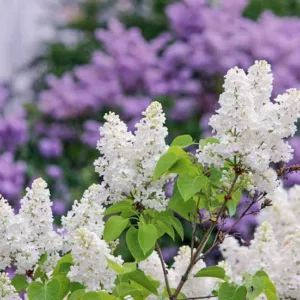
Love lilacs but short on space? Discover compact and dwarf lilacs that truly fit small gardens, borders, patios, and containers. Compare mature height and spread, fragrance, reblooming varieties, climate needs, and landscape uses - and learn why choosing the right footprint matters more than simply buying a shrub labeled "dwarf."


There is something irresistible about a lilac in bloom. The fragrance drifts across the garden, the flower clusters arrive in shades of purple, pink, lavender, white, and blue-violet, and for a few weeks in spring an ordinary corner can feel completely transformed.
The problem is space. Traditional common lilacs (Syringa vulgaris) can become substantial shrubs, and a plant that looked perfectly manageable in a nursery pot may eventually overwhelm a narrow border, crowd a walkway, cover a window, or demand constant pruning.
Fortunately, gardeners no longer have to choose between lilac fragrance and a small garden. Compact lilacs now range from genuinely dwarf plants around 2-3 ft tall and wide to medium-sized shrubs that remain far easier to place than traditional common lilacs. Some rebloom later in the season. Others offer excellent mildew resistance, attractive foliage, or a naturally rounded habit that requires little shaping.
But “compact” and “dwarf” are not precise measurements. A lilac that reaches only 5 ft tall but spreads 10 ft wide may be completely wrong for a 6-ft planting bed. The best small-garden lilac is therefore not necessarily the shortest one. It is the lilac whose mature footprint, climate requirements, flowering pattern, and growth habit match the space you actually have.
Before choosing a lilac for a limited space, answer six questions:
Gardenia’s small-space rule: Choose the lilac that fits at maturity. Do not choose a large lilac and plan to manufacture a dwarf one with permanent pruning.
For practical garden design, it helps to think of compact lilacs in three rough size groups rather than treating every plant labeled “dwarf” as interchangeable.
Very compact lilacs mature around 2-3 ft tall and wide. These are the easiest choices for tight foundation beds, small urban gardens, patio borders, and larger containers. Baby Kim, for example, reaches approximately 2-3 ft tall and wide.
Compact shrubs generally occupy roughly 4-6 ft of height and width. This group includes many of the most useful small-garden lilacs because they have enough presence to function as flowering shrubs without dominating the landscape.
Moderately compact lilacs may reach 6-8 ft or more. They can still work beautifully in smaller gardens when there is enough bed depth, but they are not substitutes for true dwarf plants.
Measure the bed, not the label: If your planting area is only 4 ft deep, a lilac expected to spread 6-8 ft will eventually occupy the path, lawn, or neighboring plants unless you continually restrain it.
This is the most overlooked part of choosing lilacs for small spaces.
Gardeners naturally look at height first: Will it block the window? Will it grow above the fence? But in a narrow bed, mature spread is often the limiting measurement.
‘Palibin’ Meyer lilac, for example, typically grows about 4-5 ft tall and 5-7 ft wide. Its naturally dense, rounded habit makes it an excellent compact landscape shrub, but it still needs room to broaden.
This distinction becomes even more important with spreading lilacs. Some plants described as relatively small because of their height can become surprisingly wide. They may work in a broad mixed border but fail completely beside a narrow walkway.
Gardenia’s Footprint Rule: In a small garden, compare the lilac’s mature spread with the usable width of the planting area before comparing flower color. Width is often what determines whether the shrub truly fits.
If every foot counts, begin with genuinely dwarf lilacs rather than simply smaller-than-average shrubs.
Baby Kim is among the smallest options, growing about 2-3 ft tall and wide. Its compact rounded habit makes it particularly useful at the front of shrub borders, in courtyard gardens, beside patios, and in larger containers.
Bloomerang Dwarf Purple is similarly compact, generally reaching about 2-3 ft tall and wide. It flowers heavily in spring, pauses while new growth develops, and can rebloom later in the season. That combination of small footprint and repeat flowering is especially valuable where there is room for only one lilac.
Bloomerang Dwarf Pink offers the same small-garden appeal with fragrant pink flowers. Remaining around 2-3 ft tall and wide, it produces its main flush in spring and can flower again on new growth later in the season. Its compact habit makes it especially useful in small borders, patio gardens, and containers where a larger lilac would quickly become overwhelming.
These truly compact cultivars change how lilacs can be used. Instead of being background shrubs, they can sit inside perennial borders, flank a small terrace, anchor a sunny corner, or provide a fragrant focal point without consuming an entire bed.
| Plant Type | Shrubs |
|---|---|
| Plant Family | Oleaceae |
| Genus | Syringa |
| Exposure | Full Sun |
| Season of Interest | Spring (Late), Summer (Early) |
| Soil Type | Chalk, Clay, Loam, Sand |
| Soil pH | Alkaline, Neutral |
| Soil Drainage | Moist but Well-Drained, Well-Drained |
| Characteristics | Cut Flowers, Fragrant, Showy |
| Tolerances | Deer |
| Landscaping Ideas | Small Gardens |
Not every small garden needs the tiniest possible plant. In many landscapes, a 4-6 ft lilac creates a better proportion than a 30-in. shrub.
‘Palibin’ is a classic example. Its compact, low-spreading habit, fragrant pale lilac-pink flowers, and good resistance to powdery mildew make it particularly useful as a specimen, low flowering hedge, foundation shrub, or repeated structural plant.
Tinkerbelle generally matures around 4-6 ft tall and wide. Wine-red buds open into pink fragrant flowers, giving the shrub an attractive two-tone effect during the transition from bud to bloom.
Bloomerang Pink Perfume, around 4-5 ft tall and wide, adds the advantage of repeat flowering while remaining manageable enough for many smaller gardens.
This middle size range is particularly useful because the shrubs are large enough to provide structure throughout the growing season but still small enough to combine with perennials, ornamental grasses, roses, and spring bulbs.
‘Miss Kim’ is frequently recommended for small gardens, and with good reason. It is substantially more compact than many traditional common lilacs, has a neat rounded habit, fragrant lavender to ice-blue flowers, good powdery mildew resistance, and attractive burgundy-toned fall foliage.
But it is important to understand its mature scale. ‘Miss Kim’ can reach approximately 6-8 ft tall and wide. That makes it compact relative to a large common lilac, not truly dwarf in the same sense as Baby Kim or Bloomerang Dwarf Purple.
In a 15-ft-wide border, that may be perfect. In a 3-ft-deep foundation bed beneath a window, it is not.
Compact is relative: ‘Miss Kim’ is a very useful smaller lilac, but mature size still matters. A plant can be “compact” compared with common lilac and still be too large for a genuinely tiny garden.
In a large landscape, there may be room for early, midseason, and late lilacs. In a small garden, every shrub has to justify the space it occupies.
This is where compact reblooming lilacs become especially interesting. They produce their main flush in spring, develop new growth, and then can flower again later in summer or fall. The later display varies with cultivar, climate, summer heat, moisture, and plant vigor and may be lighter than the spring bloom.
‘Josee’ is a compact reblooming lilac, generally reaching about 4-6 ft tall and 5-6 ft wide. It produces fragrant lavender-pink flowers in spring and may flower again intermittently later in the season, with rebloom often strongest in cooler climates.
Bloomerang Purple is somewhat larger than the true dwarf Bloomerang selections but still manageable in many small gardens, typically reaching around 4-5 ft tall and wide. It flowers heavily in spring and can rebloom from summer into fall on new growth.
Bloomerang Dark Purple offers a similar repeat-flowering habit with deeper purple flowers and a compact rounded form. It is a useful choice where a gardener wants a substantial flowering shrub without the scale of a traditional common lilac.
Rebloom does not mean continuous flowering from spring through fall. There is normally a pause between the main spring display and later flowers. Still, when garden space is limited, a compact reblooming lilac can provide more seasonal interest than a similarly sized shrub that flowers only once.
Best use of limited space: If you only have room for one medium-sized lilac, a compact rebloomer can provide a strong spring display plus the possibility of additional flowers later in the season.
Plant descriptions can be misleading when height is emphasized and spread is overlooked.
‘Superba’ littleleaf lilac, for example, is sometimes described as a relatively small lilac because it generally reaches only around 5-7 ft tall. But it can spread approximately 10-15 ft.
That makes it potentially excellent for a broad mixed border or low informal flowering screen, but not an obvious choice for a narrow city bed.
The same principle applies throughout the genus. “Dwarf,” “compact,” “low-growing,” and “small” should prompt you to check the measurements, not replace the measurements.
Before buying: Check both mature height and mature spread. If the mature spread exceeds the available bed width by several feet, choose a smaller lilac rather than planning to prune away the difference every year.
A perfectly proportioned lilac is still a poor choice if it will not flower reliably in your climate.
Many traditional lilacs perform best where winters provide substantial cold. Common lilac is particularly associated with colder temperate climates. Other species, hybrids, and cultivars can extend the usable range, but no single climate recommendation applies to every lilac.
Gardeners near the warm edge of lilac-growing territory should look for cultivars with documented performance in milder-winter regions rather than selecting on size and flower color alone.
Gardenia’s regional guides can help with this decision: Lilacs for the Lower South, Lilacs for the Middle South, and Lilacs for the Upper South.
For all climates, Gardenia’s broader Lilac Comparison Tool makes it easier to compare mature size, hardiness, bloom period, and growing conditions before committing valuable small-garden space.
A smaller lilac does not require less sunlight simply because the shrub itself occupies less space.
Lilacs flower best in full sun. Aim for about six hours or more of direct sunlight when possible. Some tolerate lighter shade, but flowering generally decreases as shade becomes stronger.
This can be challenging in city gardens, where walls, fences, neighboring buildings, and mature trees create changing patterns of shade. Evaluate the site during the growing season rather than assuming that a bright-looking corner receives enough direct sun.
Good light also helps foliage dry after rain and supports a more open canopy, which can reduce conditions favorable to problems such as powdery mildew.
Yes, genuinely compact lilacs can be grown in containers, but the fact that a cultivar is dwarf does not automatically make container culture effortless.
Choose a substantial frost-resistant container with generous drainage holes and a freely draining potting mix. The pot needs enough volume to support the mature root system and enough weight to remain stable when the shrub is in leaf.
Container-grown lilacs dry more quickly than shrubs in the ground, especially in warm weather. Check moisture regularly, watering thoroughly when needed while avoiding permanently saturated compost.
Winter deserves equal attention. Roots in containers are exposed to colder temperatures than roots protected by surrounding garden soil. In cold climates, a sheltered location or additional winter protection may be necessary.
True dwarf cultivars are generally much better suited to long-term container culture than large common lilacs. Good candidates include Baby Kim, Bloomerang Dwarf Purple, and Bloomerang Dwarf Pink, all of which remain compact enough to be realistic choices for large containers.
Container rule: Choose a lilac because its mature root system and canopy fit container culture, not simply because the young plant currently fits into a pot.
Compact lilacs are much more versatile than large traditional shrubs because they can participate in the garden rather than simply forming its background.
Use one as a spring focal point. A rounded dwarf lilac beside a patio, gate, or path brings fragrance close to where people actually experience it.
Repeat compact lilacs through a border. Two or three shrubs can create rhythm without forming a solid hedge, particularly when paired with lower perennials and bulbs.
Layer by height. Place compact lilacs behind spring bulbs, hardy geraniums, catmint, peonies, or other lower perennials so the shrub supplies structure after its flowers fade.
Use fragrance strategically. Lilacs are particularly effective near an entrance, seating area, or frequently used path where the scent will not be wasted at the back of the property.
Think beyond spring. A lilac is a woody shrub for twelve months of the year, even though flowering is seasonal. Choose a habit and foliage quality you will be happy to look at long after the panicles have faded.
A well-chosen compact lilac should generally need less corrective pruning than an oversized shrub forced into a restricted space.
That does not mean it will never need attention. Remove dead, damaged, crossing, or badly placed stems as necessary. If shaping is needed, most spring-flowering lilacs are best pruned soon after bloom because the next season’s flower buds develop on the new growth produced afterward.
The important distinction is between pruning for plant health and occasional shaping versus pruning every year simply to stop the shrub from invading a walkway or window.
If constant size control is necessary, the cultivar is probably too large for the site.
For detailed pruning guidance, see Gardenia’s When and How to Prune Lilacs Without Losing Next Year’s Flowers.
If your small-garden lilac requires major size reduction every year, pruning is treating the symptom. Plant size is the real problem. A better-matched cultivar usually gives you more flowers, a more natural shape, and less work.
Compact dimensions do not change the basic planting requirements. Lilacs still need appropriate climate, sun, drainage, correct planting depth, and enough soil volume for roots to develop.
Do not squeeze a shrub against a wall simply because the nursery plant looks tiny. Allow for the mature canopy and leave enough room for air movement and access.
Spacing plants too tightly also reduces the value of selecting compact cultivars in the first place. The goal is a mature planting that fits naturally rather than one that immediately begins competing for the same space.
Gardenia’s When and How to Plant Lilacs: Step-by-Step Guide covers planting season, soil, drainage, root-ball preparation, planting depth, spacing, watering, and first-year establishment.
A small garden rarely has room for a collection of large lilacs flowering from early through late season. You can still create a longer display by choosing plants strategically.
One option is to combine an early or main-season compact lilac with a later-flowering selection if space permits. Another is to choose a reblooming dwarf that provides both a spring display and later flowers.
If fragrance is the priority, compare cultivars by scent as well as size. If summer and fall interest matter more, foliage quality or repeat flowering may deserve greater weight.
Gardenia’s When Do Lilacs Bloom? Lilac Bloom Times From Early to Late Season explains how early, peak, late, and reblooming lilacs can be combined into a longer flowering sequence.
| Your Situation | Prioritize | Likely Direction |
|---|---|---|
| Very tight bed or patio | 2-3 ft mature footprint | True dwarf lilac such as Baby Kim or dwarf Bloomerang types |
| Small border with 5-6 ft of room | Compact rounded habit | Palibin, Tinkerbelle, compact rebloomers |
| Only room for one lilac | Longer seasonal value | Consider a compact reblooming cultivar |
| Need fall foliage too | Multi-season foliage | Consider ‘Miss Kim’ if its 6-8 ft mature footprint fits |
| Narrow planting strip | Mature spread | Avoid broad-spreading cultivars even if they are relatively short |
| Large container | Very compact canopy and root system | Choose a true dwarf and plan for winter root protection where needed |
Gardenia’s selection priority: Start with the available footprint, then check climate and sun, then decide whether you want spring-only or repeat bloom. Flower color comes after the plant has passed those tests.
In a small garden, every permanent shrub matters. A difference of 2 ft in mature spread can determine whether a lilac becomes a beautifully proportioned focal point or a maintenance problem.
Instead of asking only, “What is the prettiest dwarf lilac?” ask a more useful sequence of questions: How much room do I really have? How wide does the shrub become? Will it flower in my climate? Does it receive enough sun? Do I value repeat bloom, fall foliage, or the smallest possible footprint?
Once those constraints are clear, flower color becomes the enjoyable final decision rather than the first one.
Use Gardenia’s Compare Lilacs tool to evaluate actual Syringa selections by size, bloom period, growing conditions, and other characteristics before giving one of them precious garden space.
Some modern dwarf lilacs remain around 2-3 ft tall and wide. Baby Kim and Bloomerang Dwarf Purple are examples of genuinely compact lilacs suitable for very small gardens and, with appropriate care, large containers.
There is no single best cultivar for every garden. Choose according to available mature footprint, climate, sunlight, bloom behavior, and desired landscape role. Baby Kim suits extremely tight spaces, while Palibin, Tinkerbelle, Miss Kim, and compact rebloomers fill larger small-garden niches.
It depends on the cultivar. True dwarf lilacs may stay around 2-3 ft tall and wide, while plants marketed as compact may reach 4-6 ft or considerably more. Always check both mature height and spread.
Yes. Baby Kim is one of the smallest lilacs, generally reaching about 2-3 ft tall and wide. Its compact rounded habit makes it useful in small beds, patio gardens, and larger containers.
Palibin Meyer lilac typically reaches about 4-5 ft tall and 5-7 ft wide. It is compact compared with many traditional lilacs but still needs enough room for its naturally broad, rounded habit.
Yes, where there is adequate room. Miss Kim is smaller than many common lilacs but can reach approximately 6-8 ft tall and wide. It is better suited to a modest garden border than to an extremely narrow planting strip.
Yes. True dwarf lilacs can grow in large containers with good drainage, adequate sun, regular moisture, and sufficient root space. In cold climates, container roots may need additional winter protection because they are more exposed than roots growing in the ground.
Dwarf and compact lilacs flower best in full sun. Aim for about six hours or more of direct sunlight when possible. Some tolerate lighter shade, but flowering generally decreases as shade increases.
Yes. Bloomerang Dwarf Purple is a very compact reblooming lilac. It produces a strong spring display and then can flower again on new growth later in the season after a pause.
Not continuously. Reblooming lilacs usually flower heavily in spring, pause while new growth develops, and then produce additional flowers later in summer or fall. The amount of rebloom varies with cultivar and growing conditions.
Pruning can reduce size temporarily, but repeatedly forcing a large lilac into a small space creates unnecessary maintenance and can interfere with flowering. For a restricted site, choosing a naturally compact cultivar is the better long-term solution.
Base placement on the cultivar’s mature spread. Allow enough room for the shrub to reach near its natural width without continually extending into the path. A 3-ft-wide lilac and a 7-ft-wide lilac require very different setbacks.
Updated: September 2026 • Reviewed by Gardenia Editors
123rf
| Plant Type | Shrubs |
|---|---|
| Plant Family | Oleaceae |
| Genus | Syringa |
| Exposure | Full Sun |
| Season of Interest | Spring (Late), Summer (Early) |
| Soil Type | Chalk, Clay, Loam, Sand |
| Soil pH | Alkaline, Neutral |
| Soil Drainage | Moist but Well-Drained, Well-Drained |
| Characteristics | Cut Flowers, Fragrant, Showy |
| Tolerances | Deer |
| Landscaping Ideas | Small Gardens |
Create a membership account to save your garden designs and to view them on any device.
Becoming a contributing member of Gardenia is easy and can be done in just a few minutes. If you provide us with your name, email address and the payment of a modest $25 annual membership fee, you will become a full member, enabling you to design and save up to 25 of your garden design ideas.
Join now and start creating your dream garden!