Missouri Violet, Common Blue Violet, Missouri Blue Violet, Viola missouriensis, Viola candidula, Viola illinoensis, Viola lucidifolia, Viola securigera
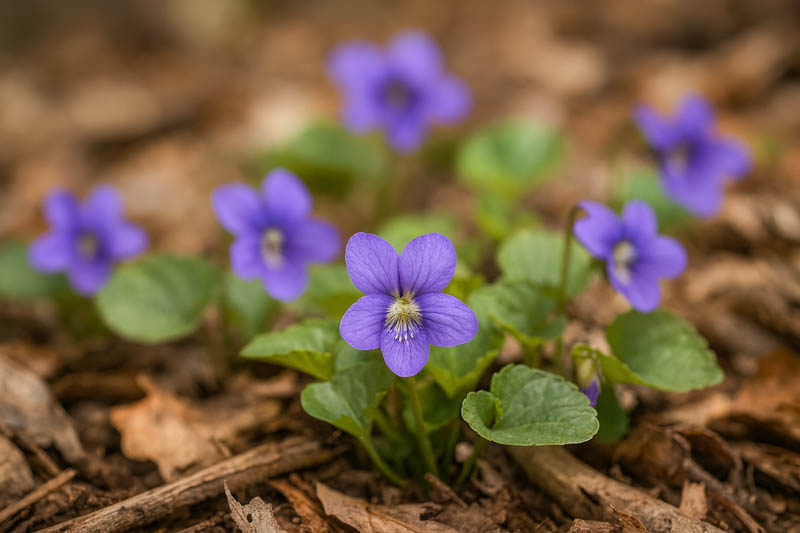


If you like the idea of a softer, more natural lawn or a spring meadow full of nectar, Viola sororia var. missouriensis deserves a closer look. Often called Missouri violet, prairie violet, or Missouri blue violet, this low native wildflower dots turf and open beds with purple, blue, or violet blooms in early spring. It is tougher than it looks, taking light foot traffic, heavy soils, and patchy moisture while quietly feeding bees and early butterflies.
Summary: Low growing native violet for informal lawns, shady edges, rain gardens, and meadows in the central and eastern United States.
Use: Lawn alternative, woodland groundcover, rain garden plant, wildflower meadows, cottage gardens, and pollinator strips.
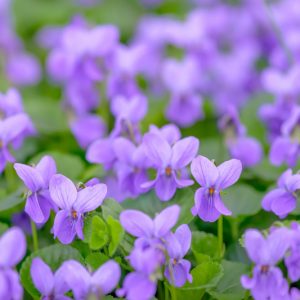
Highlight: Cheerful purple to blue spring flowers that emerge before most perennials, offering early nectar for bees and butterflies.
Note: Spreads over time by seed and short rhizomes; great for naturalistic plantings but not for highly formal, weed-free turf.
| Botanical Name | Viola sororia var. missouriensis |
|---|---|
| Family | Violaceae (violet family) |
| Common Names | Missouri violet, prairie violet, Missouri blue violet, common blue violet (Missouri form) |
| Native Range | Central and eastern North America, especially the Midwest, Ozarks, and adjacent prairies and woodlands, often in meadows, open woods, and moist lawns. |
| Plant Type and Habit | Low, clumping to slowly spreading herbaceous perennial with basal leaves and short flowering stems. |
| Hardiness (USDA) | Generally Zones 3 to 8, depending on local conditions and moisture. |
| Size | About 3 to 6 in. tall when not in bloom; flowers can reach 6 to 9 in. tall. Clumps widen slowly to 6 in. or more over time. |
| Sun and Exposure | Full sun to part shade with adequate moisture; ideal in light shade or morning sun with afternoon shade. |
| Soil | Prefers moist, fertile loam or clay loam, but tolerates a range of garden soils if not bone dry for long stretches. |
| Seasonal Interest | Showy spring flowers, fresh green heart-shaped leaves through the growing season, and self-sown seedlings that create a soft, natural carpet. |
| Primary Uses | Informal lawns, under trees, along paths, rain gardens, cottage gardens, and pollinator rich native plantings. |
Missouri violet is a low, clumping perennial violet with rounded to heart-shaped leaves held in a basal rosette. The foliage forms a simple, tidy mound that fits easily between pavers, under shrubs, or mixed into lawn grass.
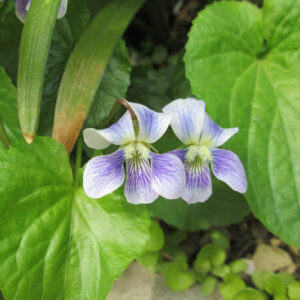
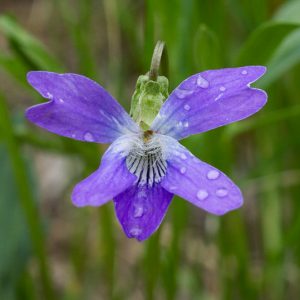
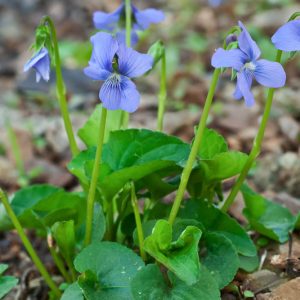
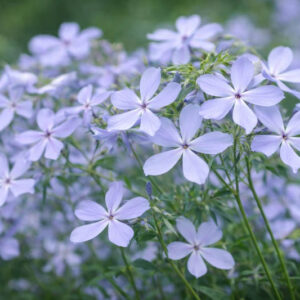
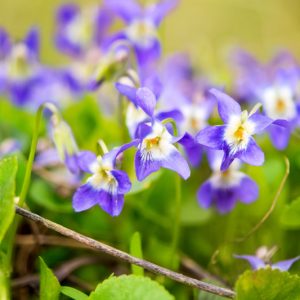
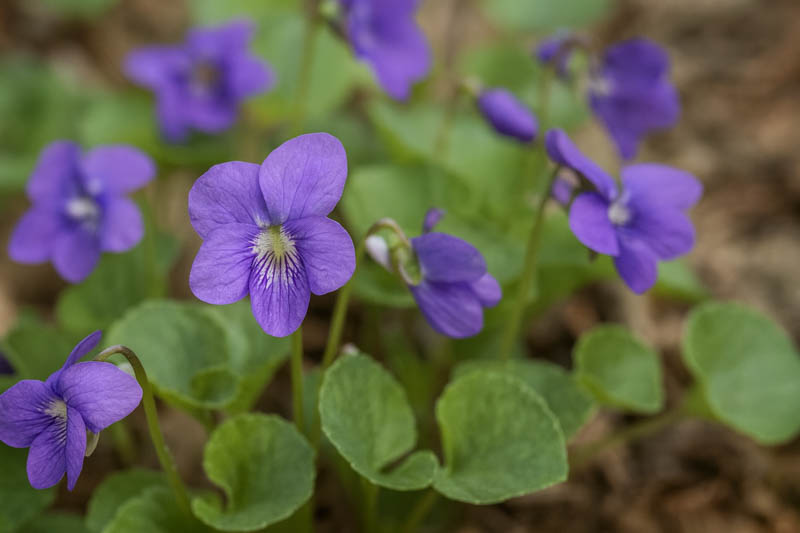
In early to mid spring, short stems rise above the leaves to carry individual violet, blue, or purple flowers. Each bloom has five petals, often with darker lines on the lower petal that act as nectar guides for pollinators. Depending on the clone or seed strain, flowers can be pale lavender, rich royal purple, or bluish with a white throat.
Viola sororia as a species is widespread in eastern and central North America. The variety missouriensis is associated with prairies, open woodlands, and moist meadows of the central U.S., especially the Midwest and Ozark regions. In the wild, you may see it:
This flexible habitat is exactly what makes Missouri violet such a good fit for informal lawns, rain gardens, and wildlife friendly yards. Best Shade Plants for Texas Yards (That Actually Thrive, Not Sulk)
Missouri violet grows from short rhizomes, forming clumps that slowly broaden. It also self-seeds, especially in open, lightly managed lawns and mulched beds. You will not get a solid mat overnight, but over several seasons, small colonies form where conditions suit it.
Plants stay low to the ground, typically under 6 in. tall once flowering is finished. Leaves may get a bit larger in rich, moist soils and smaller in leaner, drier conditions. This compact habit makes it easy to mow over at a higher mower setting if used in a lawn alternative.
Most gardeners fall in love with Missouri violet for its spring display. Flowers usually appear from early to mid spring, depending on climate, and can last several weeks. In cool weather, blooms may linger; as heat increases, flowering tapers off and foliage takes over.
After the main above-ground bloom, violets often produce cleistogamous flowers hidden among the leaves that self-pollinate and form seed. You may not notice these, but they help the plant spread subtly through your planting.
The fresh, green leaves of Missouri violet have a soft, uncomplicated look. Heart-shaped blades with slightly scalloped edges create friendly, rounded clumps. They read as a gentle, informal texture that partners well with fine grasses, ferns, and spring bulbs.
In hotter or drier climates, foliage may thin or go semi-dormant in midsummer, then revive with cooler weather and rain. In cooler, moist sites, plants can hold attractive leaves for most of the growing season.
Missouri violet is quite cold-hardy, thriving in USDA Zones 3 to 8. It enjoys regions with cool to moderate springs and some summer humidity. In hotter, drier climates, it does best with partial shade and soil that does not dry out completely for long periods.
Because it is small and adaptable, Viola sororia var. missouriensis can play several roles:
Like many native violets, Missouri violet is valuable to pollinators and butterflies:
Viola sororia var. missouriensis is generally considered moderately deer and rabbit resistant, but not deer-proof. In many gardens, browsing animals prefer tastier, more tender plants first. Light nibbling on flowers or foliage may occur, especially in spring. Protect young plants in heavy-pressure areas until clumps are established and able to rebound.
Missouri violet is not typically listed as highly toxic to people, pets, or wildlife. Many common violets have a history of mild culinary and herbal use, though individual sensitivities are possible.
Viola sororia var. missouriensis can be spreading and self-seeding, forming naturalistic carpets in suitable conditions, but it is not usually classified as an ecologically invasive species. In lawns and beds, new seedlings may appear beyond the original planting. These are generally easy to pull, thin, or transplant where a tidier look is preferred.
Missouri violet grows in a range of light levels, but you will get the best balance of flowering and foliage in light shade to morning sun with afternoon shade. It also tolerates full sun in cooler climates or consistently moist soils.
Soil flexibility is a strong point. The plant does well in:
Consistently very dry, sandy soil is the main challenge. Add compost and mulch in such sites or reserve Missouri violet for beds and lawns with better moisture-holding capacity.
Missouri violet prefers soil that is evenly moist, especially in spring. After establishment it can ride out short dry periods, but it is not a desert plant.
This violet is not a heavy feeder. Too much nitrogen encourages lush foliage at the expense of flowers and can favor competing turf grasses.
Mulch helps conserve moisture and buffer soil temperature:
In most naturalistic designs, you may not need much grooming. If you want to keep violets within bounds:
The simplest way to propagate Missouri violet is by dividing clumps:
Missouri violet also spreads readily by seed. If you want to encourage this:
Missouri violet is generally easy and trouble free in suitable conditions.
Viola sororia var. missouriensis, often called Missouri violet or prairie violet, is a low-growing native violet found in central and eastern North America. It forms small clumps of heart-shaped leaves and produces purple to blue spring flowers, making it ideal for informal lawns, woodland edges, and pollinator gardens.
Missouri violet is native to parts of central and eastern North America, especially the Midwest and Ozark regions. It typically occurs in prairies, open woods, meadows, lawns, and moist clearings with reasonably fertile soil.
Most plants stay about 3–6 inches tall when not in bloom, with flower stems reaching 6–8 inches. Clumps slowly spread to around 8–12 inches wide, and additional seedlings may appear nearby over time.
Missouri violet grows best in light shade to morning sun with afternoon shade, in moist, fertile loam or clay loam. It tolerates full sun in cooler or consistently moist regions and can adapt to average garden soil if it does not stay bone dry for long periods.
Missouri violet spreads by short rhizomes and self-seeding, but usually at a gentle pace. In relaxed lawns and naturalistic beds it can form small colonies over time. In tightly managed, highly fertilized turf it is less competitive and may remain in scattered patches.
Yes. Its early spring flowers provide nectar and pollen for native bees and other insects when few other plants are in bloom. Native violets also serve as larval host plants for several fritillary butterflies, adding extra ecological value.
You can. Many gardeners encourage violets to naturalize in a low-input “freedom lawn.” Mow high, reduce fertilizer, and allow spring flowering before the first cut. Missouri violet tolerates light foot traffic and blends well with fine grasses.
Updated: November 2025 • Reviewed by Gardenia Editors
| Hardiness |
3 - 8 |
|---|---|
| Plant Type | Perennials |
| Plant Family | Violaceae |
| Genus | Viola |
| Common names | Violet |
| Exposure | Full Sun, Partial Sun |
| Season of Interest | Spring (Early, Mid) |
| Height | 3" - 9" (8cm - 23cm) |
| Spread | 3" - 6" (8cm - 15cm) |
| Spacing | 6" (15cm) |
| Maintenance | Low |
| Water Needs | Average |
| Soil Type | Clay, Loam, Sand |
| Soil pH | Acid, Alkaline, Neutral |
| Soil Drainage | Moist but Well-Drained |
| Characteristics | Showy, Semi-Evergreen |
| Native Plants | United States, Illinois, Indiana, Iowa, Kansas, Midwest, Missouri, Nebraska, Southeast, Arkansas, Southwest, Oklahoma |
| Tolerances | Deer, Clay Soil, Black Walnut |
| Attracts | Bees, Butterflies |
| Garden Uses | Beds And Borders, Edging, Ground Covers, Patio And Containers, Rain Gardens |
| Garden Styles | Coastal Garden, Gravel and Rock Garden, Informal and Cottage, Prairie and Meadow, Traditional Garden |
| Toxic to Humans | No known toxicity |
| Toxic to Cats | No known toxicity |
| Toxic to Dogs | No known toxicity |
| Toxic to Horses | No known toxicity |


| Hardiness |
3 - 8 |
|---|---|
| Plant Type | Perennials |
| Plant Family | Violaceae |
| Genus | Viola |
| Common names | Violet |
| Exposure | Full Sun, Partial Sun |
| Season of Interest | Spring (Early, Mid) |
| Height | 3" - 9" (8cm - 23cm) |
| Spread | 3" - 6" (8cm - 15cm) |
| Spacing | 6" (15cm) |
| Maintenance | Low |
| Water Needs | Average |
| Soil Type | Clay, Loam, Sand |
| Soil pH | Acid, Alkaline, Neutral |
| Soil Drainage | Moist but Well-Drained |
| Characteristics | Showy, Semi-Evergreen |
| Native Plants | United States, Illinois, Indiana, Iowa, Kansas, Midwest, Missouri, Nebraska, Southeast, Arkansas, Southwest, Oklahoma |
| Tolerances | Deer, Clay Soil, Black Walnut |
| Attracts | Bees, Butterflies |
| Garden Uses | Beds And Borders, Edging, Ground Covers, Patio And Containers, Rain Gardens |
| Garden Styles | Coastal Garden, Gravel and Rock Garden, Informal and Cottage, Prairie and Meadow, Traditional Garden |
| Toxic to Humans | No known toxicity |
| Toxic to Cats | No known toxicity |
| Toxic to Dogs | No known toxicity |
| Toxic to Horses | No known toxicity |
How many Viola sororia var. missouriensis (Missouri Violet) do I need for my garden?
| Plant | Quantity | |
|---|---|---|
| Viola sororia var. missouriensis (Missouri Violet) | N/A | Buy Plants |
Create a membership account to save your garden designs and to view them on any device.
Becoming a contributing member of Gardenia is easy and can be done in just a few minutes. If you provide us with your name, email address and the payment of a modest $25 annual membership fee, you will become a full member, enabling you to design and save up to 25 of your garden design ideas.
Join now and start creating your dream garden!
Create a membership account to save your garden designs and to view them on any device.
Becoming a contributing member of Gardenia is easy and can be done in just a few minutes. If you provide us with your name, email address and the payment of a modest $25 annual membership fee, you will become a full member, enabling you to design and save up to 25 of your garden design ideas.
Join now and start creating your dream garden!