Explore how updated European hardiness zones, shifting climates and new winter minimums reshape plant choices. Learn which trees, shrubs and perennials will thrive in your zone, and how to design a resilient, climate-smart garden that stays beautiful despite heatwaves, droughts and sudden cold snaps across cities, coasts and mountainscapes today.


Selecting plants suited to your climate is still the single best way to create a beautiful, low-stress garden. When you know your European hardiness zone, you can instantly filter out plants that will struggle and focus on the ones that love your conditions.
Use your zone to explore:
🌱 Best plants for your climate
🌿 Inspiring garden ideas for your region
💐 Beautiful plant combinations by zone and style
Hardiness zones were first developed by the U.S. Department of Agriculture (USDA) to describe the average annual minimum winter temperature across a region. The idea was simple but powerful: if two places share similar winter lows, many of the same plants can grow there.
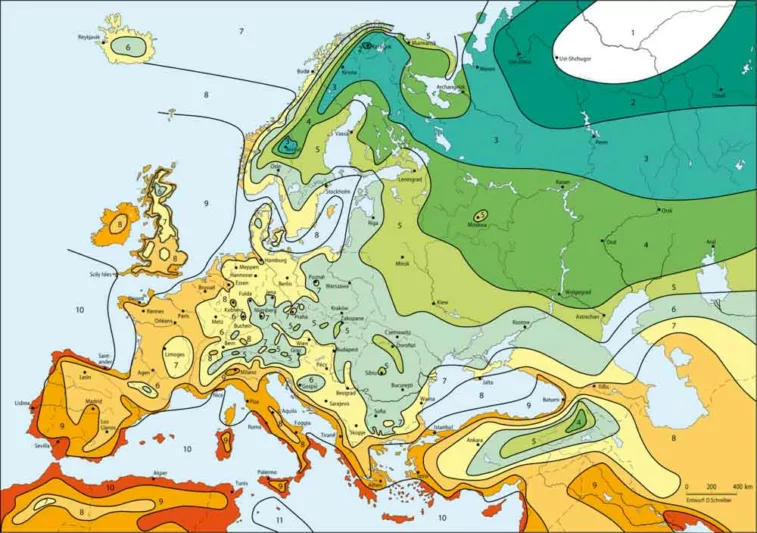
Europe adopted and adapted this concept, creating European hardiness zone maps that extend from the Arctic Circle down to the Mediterranean. These maps allow gardeners, landscape designers and nurseries to speak a common language when they say a plant is hardy to Zone 5, or perfect for Zones 8–10.
In practice, your hardiness zone tells you how cold it normally gets in winter and which plants can safely survive those lows. It is not a complete climate description, but it is an essential starting point for climate-smart gardening.
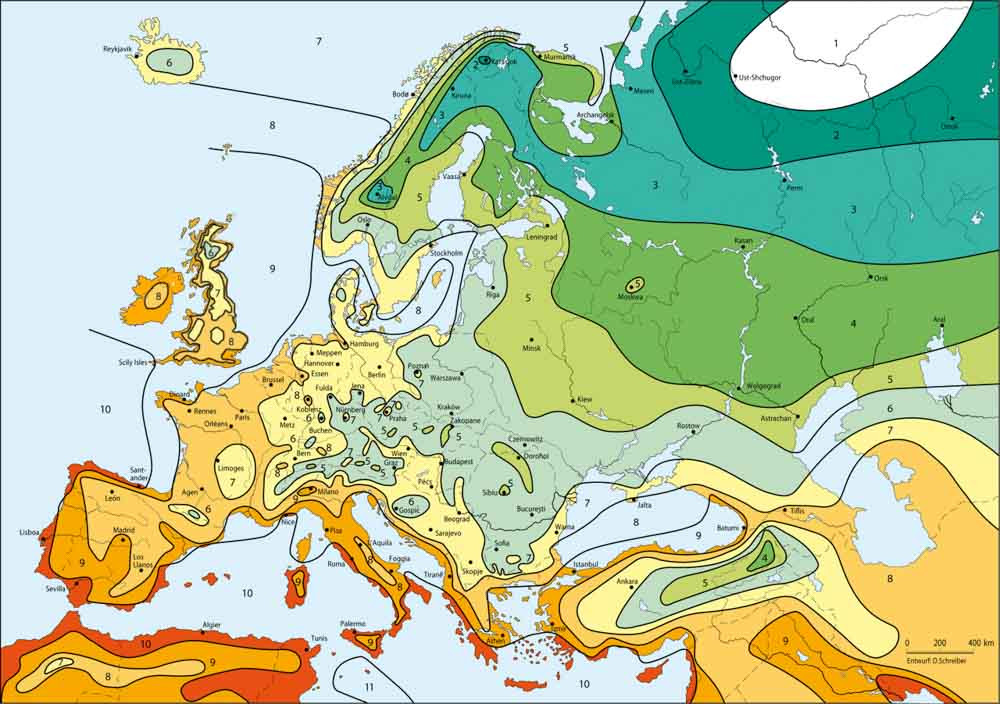
The European Hardiness Zone Map divides the continent into 11 main zones (2 to 11), based on the average annual extreme minimum winter temperature (typically calculated over a 20–30 year period). These zones range from about -51°C in the coldest areas to about +10°C in the mildest.
When you buy a shrub, perennial or tree, always check its recommended hardiness range. To make sure your new plant will survive and grow year after year, compare your zone with the plant’s minimum zone.
| Temperature Range | USDA Zone | Find Plants or Garden Ideas |
|---|---|---|
| -50ºF to -40ºF / -45ºC to -40ºC | Zone 2 | |
| -40ºF to -30ºF / -40ºC to -34ºC | Zone 3 | |
| -30ºF to -20ºF / -34ºC to -28ºC | Zone 4 | |
| -20ºF to -10ºF / -28ºC to -23ºC | Zone 5 | |
| -10ºF to 0ºF / -23ºC to -17ºC | Zone 6 | |
| 0ºF to 10ºF / -17ºC to -12ºC | Zone 7 | |
| 10ºF to 20ºF / -12ºC to -6ºC | Zone 8 | |
| 20ºF to 30ºF / -6ºC to -1ºC | Zone 9 | |
| 30ºF to 40ºF / -1ºC to +4ºC | Zone 10 | |
| 40ºF to 50ºF / +4ºC to +10ºC | Zone 11 |
Hardiness zones are easier to understand with concrete examples. Exact boundaries vary with altitude, exposure and local conditions, but broadly speaking:
| Country / Region | Approx. USDA Zones | Notes |
|---|---|---|
| United Kingdom & Ireland | 8–9 (some 6–7) | Mostly mild, maritime climates; milder coastal pockets can approach Zone 9, while Highlands and uplands are closer to Zones 6–7. |
| France | 6–10 | Northern and inland regions often Zones 6–8; Atlantic and Mediterranean coasts, especially the south, can reach Zones 8–10. |
| Spain & Portugal | 6–10 | Coastal and southern areas are often Zones 8–10, while higher inland plateaus and mountains drop to Zones 6–7. |
| Italy & Greece | 6–10 | Much of the lowland Mediterranean landscape lies in Zones 8–10, with cooler mountain areas in Zones 6–7 or lower depending on altitude. |
| Germany, Poland & Central Europe | 6–7 | Many lowland regions are Zones 6–7; colder continental interiors and uplands often fall into Zones 5–6. |
| Scandinavia (Norway, Sweden, Finland) | 2–7 | Coastal and southern zones are roughly 5–7, while northern and inland regions can range from Zones 2–5, strongly influenced by latitude and elevation. |
| Balkan & Eastern European countries | 4–8 | Lowland regions are often Zones 6–8, while mountains and more continental interiors sit in Zones 4–6. |
These ranges are approximate, but they show how a single country can host several hardiness zones.
Always combine national overviews with a detailed European hardiness map and your own garden observations.
Winter hardiness zones only describe how much cold a plant can tolerate. In a warming Europe, summer heat and drought stress are just as important. Some plants are perfectly hardy to your winter lows but struggle when temperatures soar, rain is scarce, or hot winds dry the soil.
This is where the idea of heat zones or summer stress tolerance comes in. In addition to checking winter hardiness, look for plants described as drought tolerant, heat tolerant or suitable for Mediterranean or continental summers when that matches your conditions.
Hardiness zones are a powerful tool, but they only measure winter cold. They do not reflect rainfall, humidity, wind exposure, soil type or summer heat. Two gardens in the same zone can feel completely different to plants.
On top of that, microclimates inside your own garden can shift conditions by a full zone: a south-facing wall, a sheltered courtyard or a windy, exposed corner all behave differently.
Over the last decade, many parts of Europe have experienced warmer winters and fewer extreme cold events. Newer winter hardiness maps and studies suggest that large areas now behave as if they have shifted by roughly half a zone to a full zone warmer.
That sounds like good news for tender plants, but the reality is more complex. Climate change adds:
The result? Many gardeners are shifting to resilient planting – choosing plants that handle both winter cold and summer heat, and designing gardens that can cope with erratic weather.
Once you know your hardiness zone, use it as a filter rather than a rulebook. Here is a simple step-by-step approach:
To explore climate-appropriate plants and design ideas:
Browse plants and garden ideas tailored to your hardiness zone:
Input your hardiness zone, light, water, bloom season and other filters to build a plant palette that thrives in your European climate.
A hardiness zone in Europe is a band of regions that share a similar average annual extreme minimum winter temperature. It helps gardeners predict whether a plant can survive typical winter lows in that location. Most of Europe falls between USDA-equivalent Zones 2 and 11.
Yes. Studies using recent climate normals show that many parts of Europe now experience milder winter lows than a few decades ago, effectively shifting large areas by roughly half a zone to a full zone warmer. However, more frequent extreme events—late frosts, heatwaves and droughts—still pose risks for plants.
You can locate your zone by checking a European hardiness zone map and matching your town or region to the color legend. Many national meteorological services and gardening sites provide interactive maps where you can zoom in by city. These maps are usually based on 10–30 years of winter temperature data.
No. Hardiness zones only consider minimum winter temperatures. They ignore summer heat, rainfall, humidity, wind and soil conditions. That’s why a plant can be “hardy” in your zone yet still fail if your summers are too hot, too dry or too wet. Many gardeners now combine winter zones with local heat and drought information.
Use your zone as a filter: rule out plants that are only hardy to warmer zones. Favour plants rated to your zone or colder. Then refine choices using local knowledge about summer heat, rainfall, soil and microclimates. Public gardens, neighbours’ plots and plant-finder tools are excellent reality check.
Countries such as the UK and Sweden supplement USDA-style zones with national systems that better reflect their local climate quirks, like cool summers or complex topography. For example, the Royal Horticultural Society uses its own H1–H7 scale for plant hardiness, based on absolute minimum temperatures in °C.
Updated: December 2025 • Reviewed by Gardenia Editors
| Hardiness |
2 - 11 |
|---|---|
| Toxic to Humans | No known toxicity |
| Toxic to Cats | No known toxicity |
| Toxic to Dogs | No known toxicity |
| Toxic to Horses | No known toxicity |
| Hardiness |
2 - 11 |
|---|---|
| Toxic to Humans | No known toxicity |
| Toxic to Cats | No known toxicity |
| Toxic to Dogs | No known toxicity |
| Toxic to Horses | No known toxicity |
Create a membership account to save your garden designs and to view them on any device.
Becoming a contributing member of Gardenia is easy and can be done in just a few minutes. If you provide us with your name, email address and the payment of a modest $25 annual membership fee, you will become a full member, enabling you to design and save up to 25 of your garden design ideas.
Join now and start creating your dream garden!
Create a membership account to save your garden designs and to view them on any device.
Becoming a contributing member of Gardenia is easy and can be done in just a few minutes. If you provide us with your name, email address and the payment of a modest $25 annual membership fee, you will become a full member, enabling you to design and save up to 25 of your garden design ideas.
Join now and start creating your dream garden!