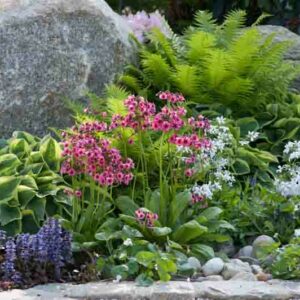
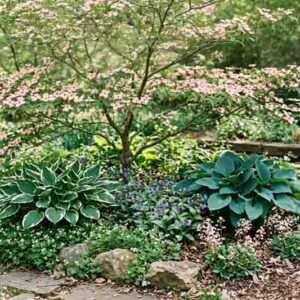
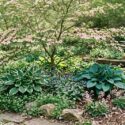
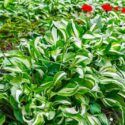
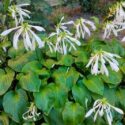
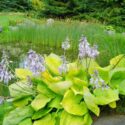
What grows best with hostas? Discover the finest hosta companion plants for moist, average, and drier shade, including ferns, Astilbe, Epimedium, Brunnera, Heuchera, and Japanese forest grass. Gardenia's companion framework shows how to combine plants by moisture, mature size, texture, color, height, and season for beautifully layered shade gardens.


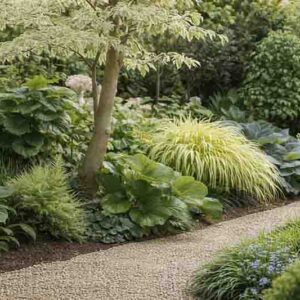
Hostas can transform a shady corner into a lush garden, but the most memorable hosta borders rarely rely on hostas alone. Their broad, substantial leaves become even more dramatic beside delicate fern fronds, arching blades of Japanese forest grass, airy Astilbe flowers, or the graceful stems of Solomon’s seal.
The secret is choosing plants that do more than look attractive together. The best hosta companion plants must also tolerate compatible levels of shade, soil moisture, and drainage, fit comfortably beside one another at maturity, and contribute something the hostas do not already provide.
Ferns, Astilbe, Heuchera, Brunnera, Japanese forest grass, Solomon’s seal, Epimedium, Tiarella, hellebores, sedges, bleeding heart, woodland phlox, and spring bulbs are among the finest plants to grow with hostas. But they are not interchangeable. An Astilbe that flourishes beside a hosta in cool, moist soil may struggle beneath a thirsty tree, while an established Epimedium may be far better suited to comparatively dry woodland conditions.
Gardenia’s Hosta Companion Rule: Match light, soil moisture, drainage, and mature size first. Once those needs align, choose companions that differ from hostas in at least two visual ways – leaf texture, growth habit, height, foliage color, or season of interest. Compatibility keeps the planting healthy; contrast makes it beautiful.
If you are still deciding which hostas to grow, start with Gardenia’s complete guide to growing hostas, then use the companion framework below to build the surrounding garden.
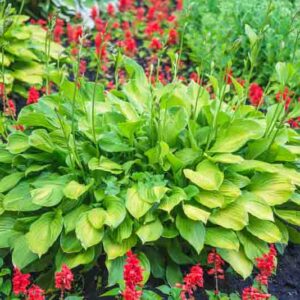
Hostas are remarkably diverse. Some form tiny clumps suited to troughs and border edges, while giant selections mature into architectural plants several feet across. Their leaves may be blue-gray, green, chartreuse, gold, cream-edged, white-centered, glossy, puckered, corrugated, or heavily textured.
Most hostas perform especially well in partial or dappled shade with fertile, humus-rich, moisture-retentive but well-drained soil. Morning sun followed by protection from intense afternoon heat suits many cultivars, but climate matters. A hosta that tolerates several hours of sun in a cool northern garden may scorch under similar exposure in a hot southern climate.
For blue hostas, light also affects appearance. Their blue coloring is created by a waxy coating over the leaf surface. Many strongly glaucous cultivars retain that blue appearance longer when protected from strong sun and excessive heat. Explore Gardenia’s blue hostas for gardens and containers for suitable choices.
Before planting a companion beside a hosta, ask five questions:
How Gardenia evaluates hosta companions: Rather than ranking shade plants by appearance alone, Gardenia compares them across five practical criteria: compatible growing conditions, mature size and vigor, foliage contrast, seasonal contribution, and their intended position in the planting. Plants that share hosta growing conditions while contributing a different form, texture, height, or season generally produce the strongest combinations.
Use this quick-reference matrix to choose companions by growing conditions and garden role rather than simply by flower color.
| Companion | Best Conditions | Main Contribution | Best Position | Gardenia Take |
|---|---|---|---|---|
| Ferns | Part to full shade; moisture varies by species | Fine texture, vertical form | Between or behind | Best all-around foliage contrast |
| Astilbe | Part shade; consistently moist soil | Summer flowers, fine foliage | Middle or back | Top flowering partner for moist shade |
| Hakonechloa | Part shade; moist, well-drained soil | Movement, narrow foliage | Front, edge, slope | Best companion for movement |
| Brunnera | Part to full shade; average to moist soil | Spring flowers, silver foliage | Front or middle | Excellent spring-to-summer companion |
| Epimedium | Part to full shade; many tolerate drier soil once established | Spring flowers, groundcover foliage | Front or between | Excellent for drier woodland shade |
| Solomon’s Seal | Part to full shade; average to moist soil | Arching height, spring flowers | Middle or back | Best arching structural contrast |
| Heuchera | Part shade; well-drained soil | Foliage color | Front or middle | Best for long-season color contrast |
| Hellebores | Part shade; well-drained soil | Winter and spring interest | Front or middle | Best seasonal bridge before hostas emerge |
Find the Right Plants for Your Shade Garden
Use Gardenia’s Plant Finder to narrow plants by sun exposure, soil, moisture, size, bloom season, foliage color, wildlife value, and other garden conditions. It is the fastest way to turn the companion principles in this guide into a shortlist suited to your own garden.
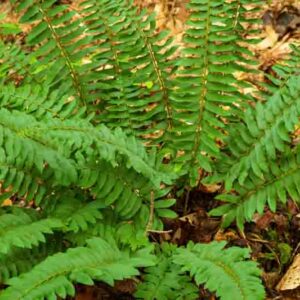
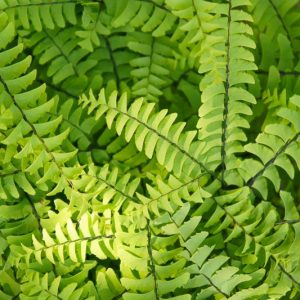
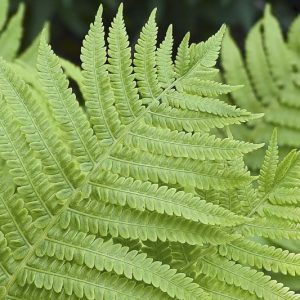
Hostas and ferns are a classic woodland combination for good reason. Hosta leaves tend to be broad, solid, and visually substantial. Fern fronds break that mass into hundreds of fine leaflets, creating immediate textural contrast without depending on flowers.
Excellent choices include:
Japanese painted fern is especially effective beside blue and blue-green hostas because its silver tones echo their cool foliage while the finely divided fronds create an entirely different silhouette. Deep green ferns, meanwhile, make gold or chartreuse hostas appear brighter.
Use taller ferns behind medium hostas, thread smaller ferns between clumps, or repeat both plants through a naturalistic woodland border.
| Hardiness |
3 - 9 |
|---|---|
| Heat Zones |
1 - 8 |
| Climate Zones | 1, 1A, 1B, 2, 2A, 2B, 3, 3A, 3B, 4, 5, 6, 7, 8, 9, 10, 14, 15, 16, 17, 18, 19, 20, 21 |
| Plant Type | Perennials |
| Plant Family | Asparagaceae |
| Genus | Hosta |
| Exposure | Partial Sun, Shade |
| Season of Interest | Spring (Mid, Late), Summer (Early, Mid, Late), Fall |
| Maintenance | Low |
| Soil Drainage | Moist but Well-Drained |
| Landscaping Ideas | Patio And Containers, Small Gardens |
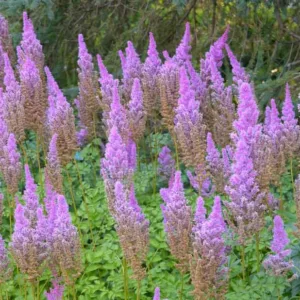
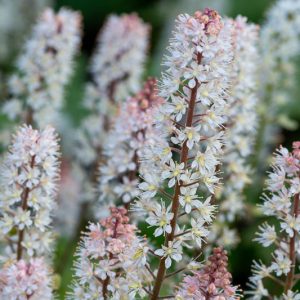
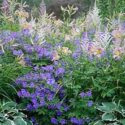
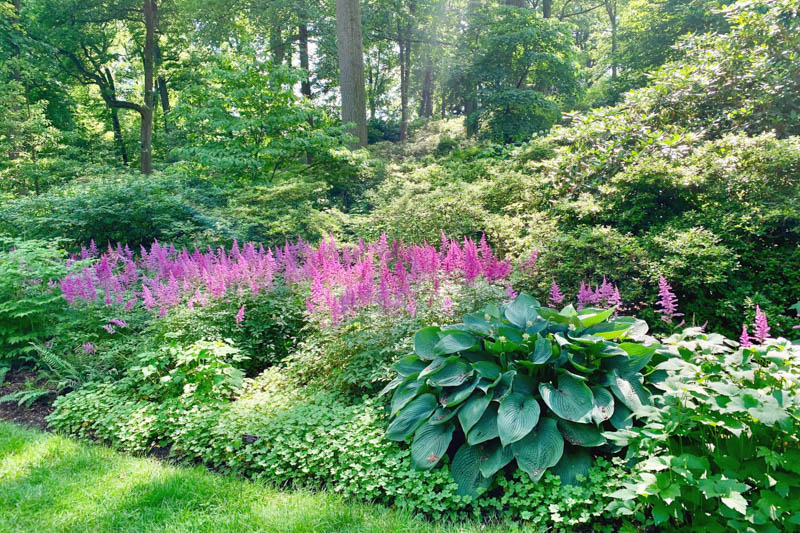
Where shade comes with reliable soil moisture, Astilbe is difficult to beat. Its feathery flower plumes rise above finely divided foliage in shades of white, cream, pink, rose, red, lavender, and purple, creating a light vertical counterpoint to rounded hosta leaves.
Astilbes work particularly well when you want to:
White Astilbes can be luminous in a dark border, while rose and pink selections pair especially well with blue-green hostas.
The important qualification is moisture. Astilbe is not a good choice for a dry, root-filled bed simply because the site is shaded. In hot or drought-prone conditions, its foliage can deteriorate if water becomes inadequate.
Browse Gardenia’s Astilbe varieties and growing guide before choosing one for your hosta border.
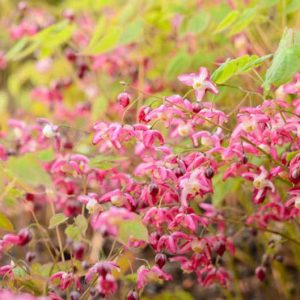
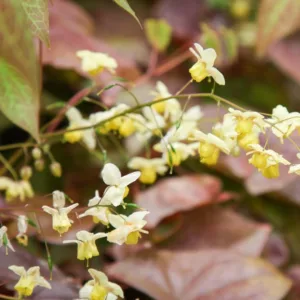
Epimedium, commonly called barrenwort, deserves a prominent place among hosta companions. Its delicate spring flowers rise on wiry stems, while the foliage often emerges bronze or reddish before becoming green. Some selections develop additional autumn color.
Its real advantage is its usefulness toward the drier end of woodland conditions. Many Epimediums prefer humus-rich, well-drained soil but, once established, tolerate periods of dryness better than moisture-demanding companions such as Astilbe.
Epimedium is particularly useful:
This does not mean hostas themselves should be allowed to become chronically dry. Epimedium simply provides a better companion option where soil moisture fluctuates.
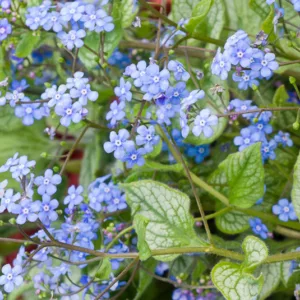
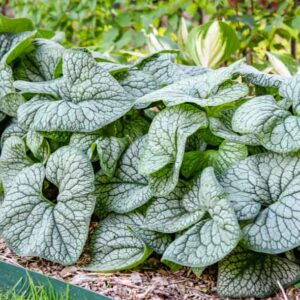
Brunnera macrophylla, or Siberian bugloss, contributes two distinct seasons of interest. Clouds of tiny blue flowers appear in spring, often while hosta leaves are still unfurling. After flowering, broad heart-shaped foliage continues the display.
Silver-leaved cultivars are particularly valuable because they catch and reflect limited woodland light. They combine beautifully with:
One design consideration is worth noting: Brunnera and many hostas both have broad, heart-shaped leaves. Where the planting begins to feel visually heavy, insert a fern, Hakonechloa, or sedge to break up the repeated leaf shape.
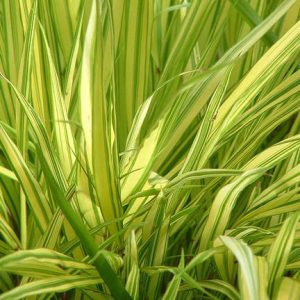
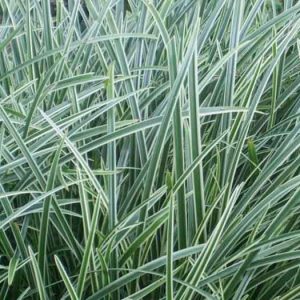
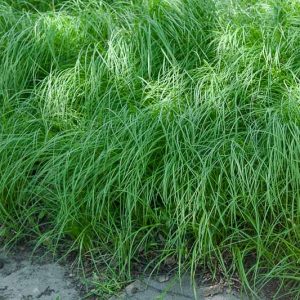
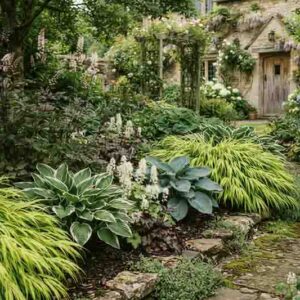
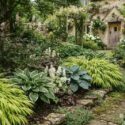
Japanese forest grass (Hakonechloa macra) adds something hostas cannot: movement. Its slender blades form flowing, cascading mounds that sway readily in a breeze, making substantial hosta foliage appear even bolder by contrast.
Green forms suit natural woodland gardens, while gold and variegated cultivars illuminate shaded paths, slopes, steps, and border edges.
Japanese forest grass is particularly effective:
It prefers moist, well-drained soil and develops relatively slowly, so avoid crowding young plants between hostas that will eventually engulf them.
Explore Gardenia’s Japanese forest grass guide and varieties.
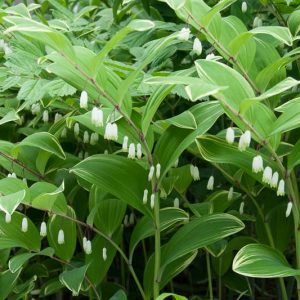
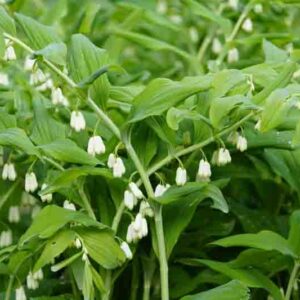
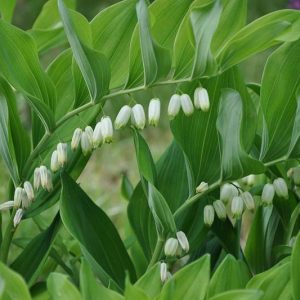
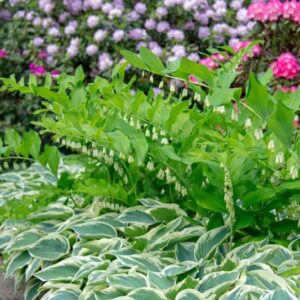
Solomon’s seal (Polygonatum) brings arching lines into the shade garden. Its stems rise above hostas and curve outward, carrying regularly spaced leaves and small pendent spring flowers beneath them.
Variegated forms are especially effective in dark woodland settings, where cream-edged leaves catch the light. Unlike another broad mound of foliage, Solomon’s seal occupies vertical space without creating a visually solid wall.
Use it behind small and medium hostas or allow it to weave naturally between larger clumps. Many Polygonatum species spread gradually by rhizomes, so allow enough room for the colony that may eventually develop.
See Gardenia’s Solomon’s seal guide for more varieties and planting ideas.
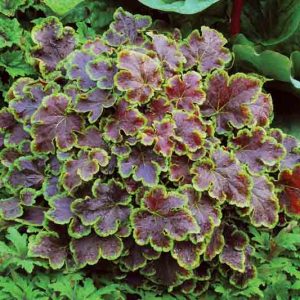
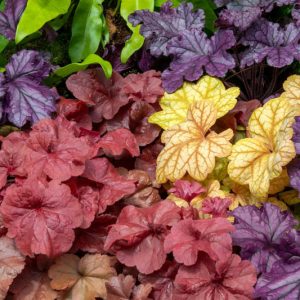
Coral bells (Heuchera) offer one of the widest foliage palettes available for shade. Depending on cultivar, leaves may be lime, caramel, amber, bronze, burgundy, plum, silver, or almost black.
Use foliage color deliberately:
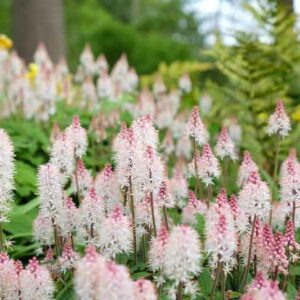
Foamflower (Tiarella cordifolia) offers a softer woodland effect, with attractively marked foliage and airy spring flowers. Heucherella, hybrids between Heuchera and Tiarella, extend the possibilities further.
All three are useful near the front of hosta plantings, where their smaller scale creates a transition toward a path or lawn.
Hostas disappear underground during winter and often do not dominate the garden until well into spring. Instead of treating that dormancy as a disadvantage, use the same space for an earlier layer of flowers and foliage.
Hellebores can flower from winter through spring, depending on climate, species, and cultivar. By the time their display is declining, hosta shoots are emerging.
Bleeding hearts provide another useful seasonal relay. Traditional bleeding heart (Lamprocapnos spectabilis) flowers while hostas are developing and may later become dormant, particularly in warm or dry summers. Expanding hosta foliage can help disguise the gap.
Design by succession: The best hosta gardens are never dependent on a single moment. Use hellebores and bulbs before hostas emerge, spring woodland perennials while hosta leaves unfurl, summer flowers during peak foliage, and grasses or sedges to carry texture toward fall.
Shade-tolerant sedges provide the fine, linear foliage that many shaded gardens lack. The genus Carex is enormous, however, and its members vary greatly in moisture requirements. Do not assume every sedge enjoys wet ground.
Sedges can be used:
For eastern and central North American gardens, Pennsylvania sedge (Carex pensylvanica) is especially useful in appropriate sites. Its low, arching foliage can form attractive colonies in woodland conditions and tolerates considerably drier soil than many gardeners expect from a sedge.
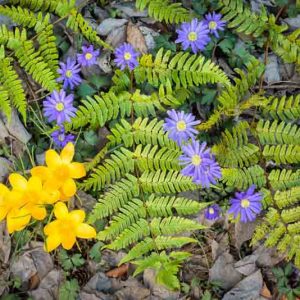
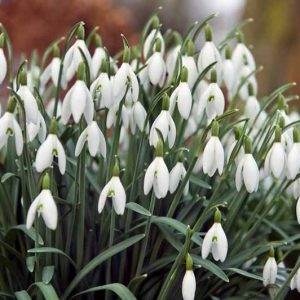
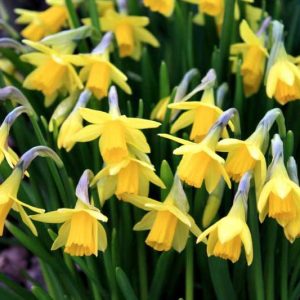
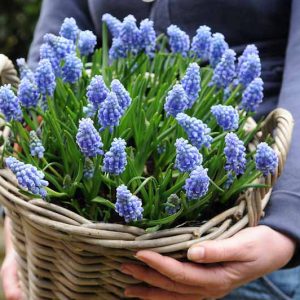
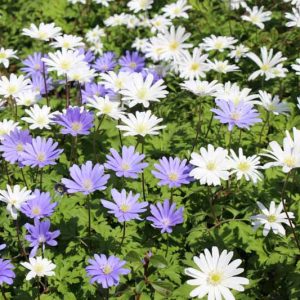
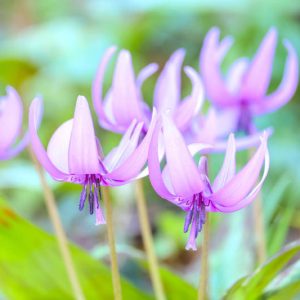
Spring bulbs are among the most efficient hosta companions because they occupy the same ground at different times.
Good choices include:
They flower while deciduous trees are still relatively open and before hostas reach full size. As bulb foliage begins to yellow, expanding hosta leaves help hide it. This allows bulb foliage to mature naturally and replenish the bulb rather than being removed while still green.
Moisture is one of the most useful ways to narrow a long companion list.
These combinations create especially lush hosta plantings where soil remains evenly moist but drains adequately.
This is perhaps the easiest moisture range for creating a varied, layered hosta border.
Dry shade is more challenging because hostas themselves perform best with adequate moisture. Where mature tree roots compete strongly for water, organic mulch and supplemental irrigation may still be necessary.
Important: A “dry-shade companion” does not turn a hosta border into a drought garden. It simply means choosing surrounding plants better able to cope with periodic moisture competition while maintaining enough water for the hostas themselves.
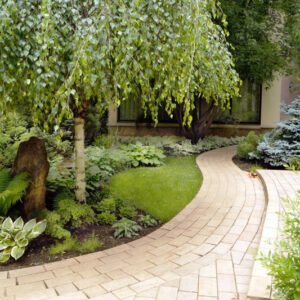
Trees can provide exactly the filtered shade hostas enjoy, but they may also create one of the most difficult hosta-growing situations: dry shade caused by root competition. A mature tree can absorb a large share of the available moisture, leaving newly planted hostas struggling even though the light appears ideal.
Be particularly cautious beneath large trees with dense, shallow, or highly competitive root systems. Depending on species, age, soil, and local conditions, these may include:
This is not a universal blacklist. Hostas may grow successfully beneath some of these trees where soil depth, rainfall, irrigation, root density, and planting distance are favorable. The important point is to evaluate the ground beneath the canopy rather than assuming that shade alone makes a site suitable.
Look particularly for these warning signs:
Gardenia tip: Do not assume shade beneath a tree is automatically good hosta habitat. If the soil is threaded with roots and dries rapidly after rain, the limiting factor is probably not light – it is water.
Large trees can also create maintenance problems through falling debris. Eucalyptus species may shed bark, leaves, and twigs, while shagbark hickory (Carya ovata) can shed leaves, nuts, twigs, and strips of its characteristically shaggy bark. Rather than treating these trees as automatically harmful to hostas, consider whether heavy litter will repeatedly accumulate over or around hosta crowns.
Where tree-root competition is severe, placing hostas farther from the trunk, improving moisture conservation with organic mulch, providing supplemental irrigation, or growing hostas in containers may be more successful than repeatedly trying to establish them among dense roots.
Thinking in layers makes a hosta border easier to design. Every companion should have a purpose and a position.
| Position | Good Choices | Purpose |
|---|---|---|
| In front | Tiarella, Heuchera, Epimedium, small Carex, miniature hostas | Softens paths and conceals bare ground |
| Between | Ferns, Brunnera, Astilbe, Hakonechloa, Heuchera | Breaks up repeated hosta mounds |
| Behind | Tall ferns, Solomon’s seal, tall Astilbe, suitable shade-tolerant shrubs | Adds height and layered structure |
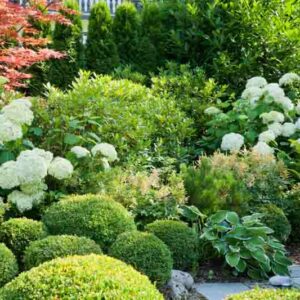
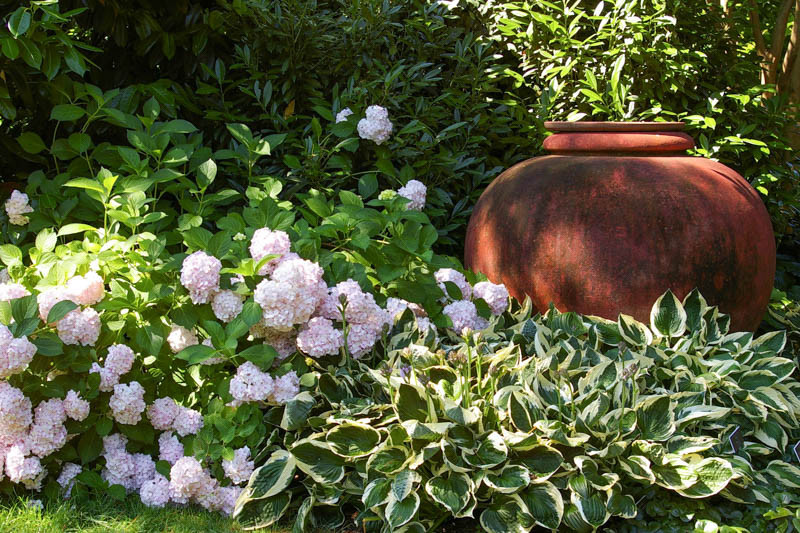
Hostas can also make attractive underplantings for suitable hydrangeas and other woodland shrubs, provided the site offers enough light for the shrub to flower well and enough moisture for both plants. Allow for the mature spread and root system of the woody plant rather than filling every gap around a newly planted shrub.
Try Japanese painted fern, silver Brunnera, white Astilbe, pale Heuchera, or white Tiarella for a sophisticated cool-toned planting. Fine foliage is particularly useful because it contrasts with the hosta’s broad leaves.
Deep green and burgundy make golden foliage appear even brighter. Try dark Heuchera, rich green ferns, or a shadowed evergreen background.
Many gold, yellow, or green hostas can tolerate more light than strongly glaucous blue cultivars, although the amount varies considerably by cultivar, climate, and available soil moisture. See Gardenia’s hostas tolerant of more sun.
A strongly variegated hosta already attracts attention. Surround it with relatively quiet plants such as green ferns, sedges, Solomon’s seal, or solid-colored Heuchera rather than combining too many patterned leaves in one small area.
For more inspiration, explore Gardenia’s hosta plant combination ideas, with ready-made shade garden schemes showing hostas paired with compatible perennials, grasses, ferns, and woodland plants.
Blue Hosta + Japanese painted fern + silver Brunnera + white Tiarella
Why it works: The palette remains cool and harmonious, but every plant contributes a different texture. Broad hosta leaves sit beside finely cut fern fronds, heart-shaped Brunnera foliage, and low Tiarella. Spring flowers gradually give way to a foliage-led summer display.
Gold Hosta + burgundy Heuchera + green fern + white Astilbe
Why it works: Dark burgundy and green intensify the hosta’s golden foliage, while white Astilbe introduces vertical flowers and brightens the shade.
Variegated Hosta + Solomon’s seal + Japanese forest grass + hellebore
Why it works: Arching Solomon’s seal and flowing grass blades soften the hosta’s broad mound. Hellebores provide early flowers, while hostas and Hakonechloa carry the composition through summer.
Hosta + Astilbe + fern + Tiarella
Why it works: All four thrive in humus-rich, moisture-retentive conditions when drainage is adequate. The combination layers broad leaves, fern texture, airy flowers, and low groundcover.
Hosta + Epimedium + hellebore + Pennsylvania sedge
Why it works: The surrounding plants cope better with periodic root competition than an Astilbe-heavy scheme, while Epimedium and hellebores provide spring interest before hostas dominate the bed.
Gardenia’s four-plant design formula: Start with one hosta + one fine-textured foliage plant + one seasonal flowering plant + one low edging or matrix plant. Repeat that combination before adding more species. Repetition creates rhythm; too many unrelated one-off plants create visual noise.
Looking for a complete planting scheme rather than individual companion suggestions? Browse Gardenia’s hosta plant combination ideas for designed shade-garden combinations that can help you translate these principles into an actual border.
Build Your Hosta Garden Before You Plant
Try Gardenia’s Garden Design Tool to combine hostas with ferns, grasses, flowering perennials, and groundcovers, then review size, spacing, bloom sequence, and growing-condition compatibility before planting.
Hostas are native to Asia, so a hosta border is not a native plant garden. However, North American gardeners who want to increase native plant diversity can surround hostas with regionally appropriate woodland species.
Some particularly useful choices include:
Native plant note: “Native to North America” is only a starting point. A plant native to Virginia may not be native to Oregon, Arizona, or California. Check regional native status before including a plant specifically for ecological or habitat value.
Mature size is frequently overlooked because gardeners choose companions while every plant is still small.
Use companions substantial enough not to disappear beneath enormous leaves:
These are the easiest to combine. Ferns, Brunnera, Heuchera, Astilbe, Tiarella, Hakonechloa, Epimedium, and woodland bulbs can all work when growing conditions match.
Miniatures need restraint. Large ferns and vigorous groundcovers can overwhelm them quickly. Better companions include diminutive ferns, compact sedges, small Tiarella, tiny spring bulbs, mossy stones, and other small woodland plants.
Explore Gardenia’s miniature and very small hostas.
Compare Hostas Side by Side
Not sure which hosta best fits your planting? Use Gardenia’s Hosta Comparison Tool to compare varieties side by side before choosing the plants that will anchor your shade garden.
A poor hosta companion is usually a mismatch in growing conditions or vigor rather than a plant that belongs on a universal blacklist.
The lesson is simple: choose companions for the garden you actually have, not for a generalized idea of a “shade garden.”
Claims that certain companion plants reliably repel slugs or protect neighboring hostas should be treated cautiously. Slug pressure is influenced by moisture, weather, hiding places, decaying debris, predator populations, and the susceptibility of individual hosta cultivars.
A more dependable strategy includes:
For a more complete approach, read Gardenia’s guide to protecting hostas from slugs and snails.
Perhaps the most common hosta design mistake is buying one of every attractive cultivar. Blue sits beside gold, gold beside white-edged green, white-edged green beside chartreuse, and soon the border resembles a nursery display rather than a garden.
Choose fewer varieties and repeat them.
A simple approach is to:
A ribbon of Japanese forest grass or repeated clumps of fern can connect several different hostas much more effectively than a collection of isolated plants.
Most importantly, leave room for maturity. Hostas often become dramatically larger after establishment. Designing around mature spread prevents the border from becoming overcrowded just when it begins to look established.
A useful final test: Stand back from the planting and ignore the individual cultivars. Can you see repeated shapes, contrasting textures, a clear foreground and background, and interest in more than one season? If so, you are designing a garden rather than simply displaying hostas.
The best hosta combinations begin with compatibility, not flower color. Gardenia’s approach is to match light, soil moisture, drainage, root competition, and mature size first. Only then should color, texture, height, growth habit, and bloom season determine the final arrangement.
Within those compatible conditions, contrast is what makes hostas shine. Place broad leaves beside fine fern fronds, static mounds beside flowing Japanese forest grass, low foliage beneath arching Solomon’s seal, and summer hostas among plants that begin their display months earlier.
Think of every companion as performing a particular job: one may brighten spring, another soften the border edge, another add summer flowers, and another introduce fine foliage or autumn movement. When those roles are planned rather than accidental, the planting remains interesting for far longer than a bed built around flower color alone.
The result is more than a collection of shade plants. It is a layered garden in which hostas become the structural heart of a planting that changes from spring through fall.
Turn Inspiration Into a Planting Plan
Explore Gardenia’s hosta plant combination ideas, refine your choices with the Plant Finder, compare hostas with the Hosta Comparison Tool, and bring the final combination together in the Garden Design Tool.
Ferns, Astilbe, Heuchera, Brunnera, Japanese forest grass, Solomon’s seal, Epimedium, Tiarella, hellebores, sedges, bleeding heart, woodland phlox, and spring bulbs are among the best hosta companions. Choose according to light, moisture, drainage, mature size, and root competition.
Low-growing Tiarella, Heuchera, Epimedium, small sedges, miniature hostas, and suitable spring bulbs work well in front of hostas. Choose plants that stay low enough to reveal the hosta foliage and share compatible light and soil-moisture requirements.
Truly dry shade is not ideal for hostas, which need adequate moisture. Where soil periodically becomes dry because of root competition, established Epimedium, Christmas fern and other suitable ferns, hellebores, and dry-shade-tolerant sedges can be better companions than moisture-demanding Astilbe.
Yes. Ferns and hostas form one of the strongest foliage combinations for shade. Their growing conditions often overlap, while finely divided fern fronds provide excellent textural contrast with broad hosta leaves. Match the fern species to the site’s moisture, soil, and climate.
Yes. Hostas can make attractive underplantings for suitable hydrangeas in partial shade. Give both plants enough room at maturity and make sure the site provides sufficient moisture, drainage, and light for the particular hydrangea type to grow and flower well.
Yes, but success depends on more than shade. Mature trees can create severe root competition and dry soil beneath their canopies. Hostas are more likely to thrive where soil retains adequate moisture and where dense surface roots do not monopolize the available water.
Avoid plants requiring very dry or permanently wet soil, overly aggressive groundcovers, plants that will overwhelm the hosta at maturity, and sun-loving plants that perform poorly in shade. Compatibility in light, moisture, drainage, and mature size matters more than simply sharing a shade-tolerant label.
Japanese painted fern, silver Brunnera, white Astilbe, pale Heuchera, Tiarella, and other cool-toned woodland plants complement blue hostas beautifully. Fine or narrow foliage is particularly effective because it contrasts with the hosta’s broad leaves.
Depending on your region, North American native companions can include Christmas fern, northern maidenhair fern, foamflower, woodland phlox, Pennsylvania sedge, American alumroot, and smooth Solomon’s seal. Hostas themselves are native to Asia, so check regional native status when designing a native-focused planting.
Updated: September 2026 • Reviewed by Gardenia Editors
Shutterstock
| Hardiness |
3 - 9 |
|---|---|
| Heat Zones |
1 - 8 |
| Climate Zones | 1, 1A, 1B, 2, 2A, 2B, 3, 3A, 3B, 4, 5, 6, 7, 8, 9, 10, 14, 15, 16, 17, 18, 19, 20, 21 |
| Plant Type | Perennials |
| Plant Family | Asparagaceae |
| Genus | Hosta |
| Exposure | Partial Sun, Shade |
| Season of Interest | Spring (Mid, Late), Summer (Early, Mid, Late), Fall |
| Maintenance | Low |
| Soil Drainage | Moist but Well-Drained |
| Landscaping Ideas | Patio And Containers, Small Gardens |
Create a membership account to save your garden designs and to view them on any device.
Becoming a contributing member of Gardenia is easy and can be done in just a few minutes. If you provide us with your name, email address and the payment of a modest $25 annual membership fee, you will become a full member, enabling you to design and save up to 25 of your garden design ideas.
Join now and start creating your dream garden!