Variegated Solomon’s Seal, Striped Solomon’s Seal, Fragrant Solomon’s Seal, Variegated Fragrant Solomon’s Seal, Angled Solomon’s Seal, Japanese Solomon’s Seal, Variegated Solomon’s Seal ‘Variegatum’, polygonatum odoratum ‘Variegatum’, polygonatum odoratum var. pluriflorum ‘Variegatum’, polygonatum officinale ‘Variegatum’, convallaria odorata, polygonatum falcatum ‘Variegatum’, polygonatum planifolium, polygonatum quelpaertense

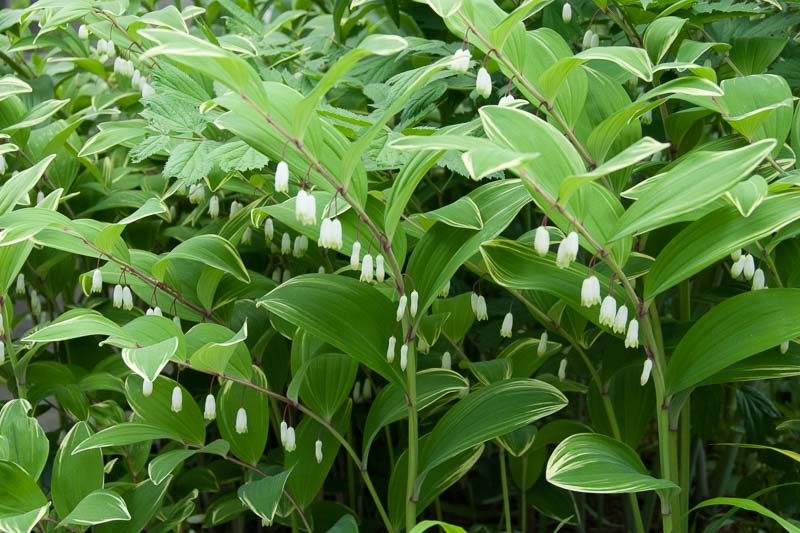
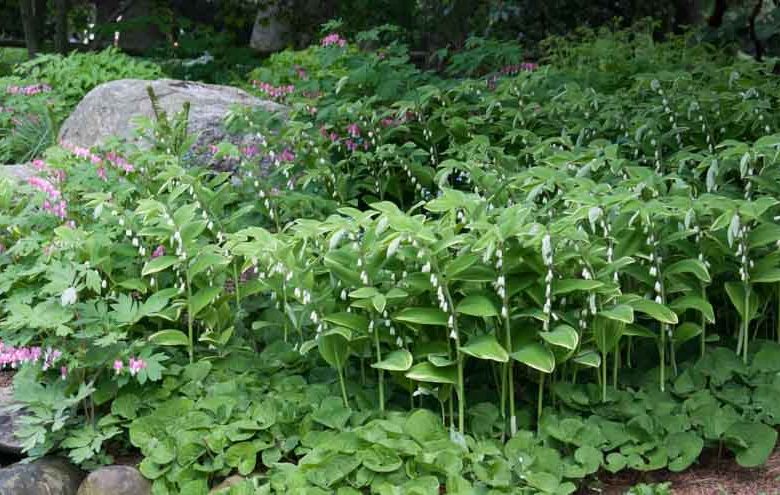
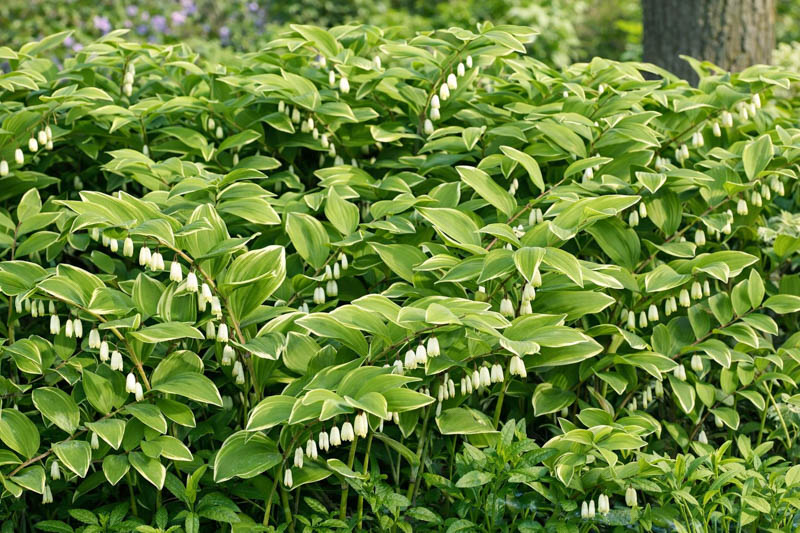
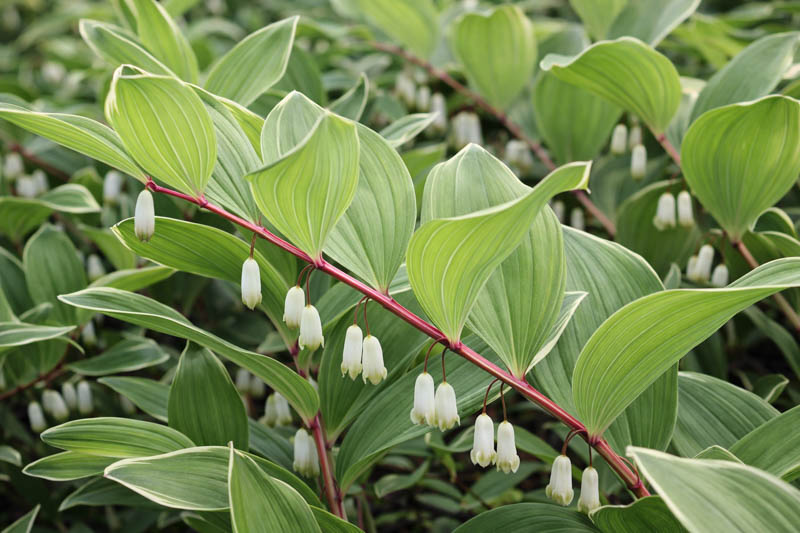
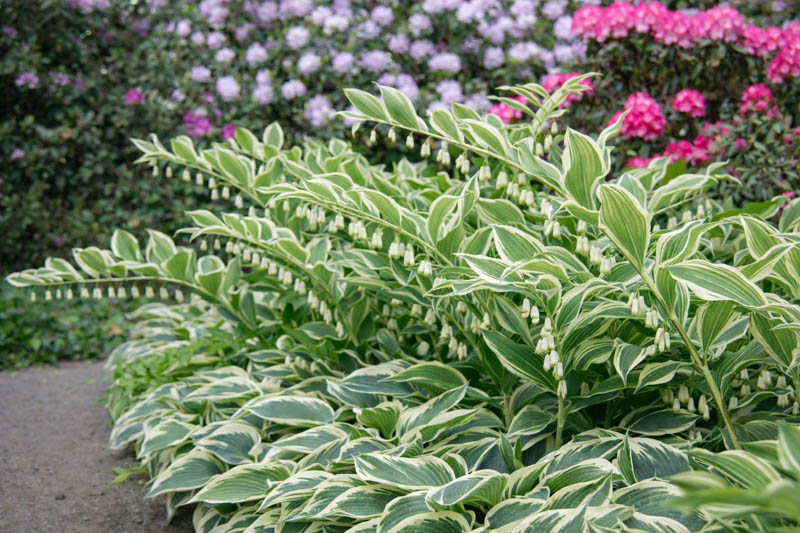


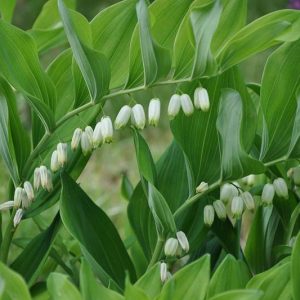
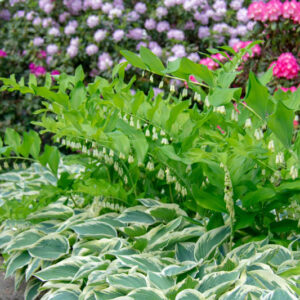
Polygonatum odoratum ‘Variegatum’, commonly called Fragrant Solomon’s Seal or Variegated Solomon’s Seal, is the kind of shade perennial that quietly upgrades an entire garden. In late spring to early summer, it lifts slightly arching stems lined with creamy-white, green-tipped bells that hang like tiny lanterns – and yes, they can be pleasantly sweetly scented.
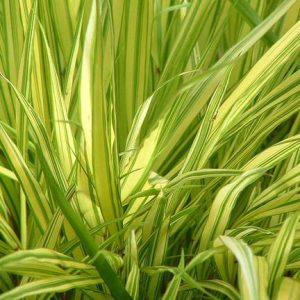
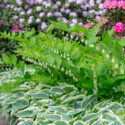
But the real magic is the foliage: fresh green leaves streaked and edged in creamy white that brighten dim corners like natural spotlighting. Add yellow fall color and those blue-black berries later in the season, and you get a plant with long-running interest that feels elegant without being fussy.
Summary: Rhizomatous shade-loving perennial with arching stems, fragrant white spring bells, and bright green-and-cream variegated foliage.
Use: Perfect for woodland gardens, shade borders, and elegant underplanting beneath shrubs and trees.
Highlight: Variegated leaves that glow in shade, plus sweetly scented flowers in late spring to early summer.
Note: Best in part shade to full shade with humus-rich, moist, well-drained soil; dislikes hot, dry conditions.
| Botanical Name | Polygonatum odoratum ‘Variegatum’ |
|---|---|
| Family | Asparagus family (Asparagaceae) |
| Common Names | Fragrant Solomon’s Seal, Variegated Solomon’s Seal |
| Native Range | Temperate regions of Europe and Asia (woodlands and shaded slopes) |
| Plant Type and Habit | Herbaceous perennial that spreads slowly by rhizomes to form polite colonies |
| Hardiness (approx. USDA) | Hardy in USDA Zones 3-8 (varies by region and moisture) |
| Height | 2-3 ft. (60-90 cm) |
| Spread | 9-12 in. (22-30 cm) initially; slowly expands into colonies |
| Sun and Exposure | Best in part shade to full shade; appreciates dappled light |
| Soil | Fertile, humus-rich, moist, well-drained soil |
| Bloom Time | Late spring to early summer |
| Flower Color | Creamy-white bells tipped with green |
| Foliage Color | Bright green leaves splashed and edged with creamy white; yellows in fall |
| Drought Tolerant | Some tolerance once established, but best with consistent moisture – see drought-tolerant |
| Attracts | Spring pollinators such as bees may visit the blooms |
| Deer / Rabbit | Often considered resistant to deer and rabbits (local pressure varies) |
| Toxicity | All parts may cause severe discomfort if ingested |
| Invasive Status | Spreads by rhizomes, but typically behaves politely in gardens |
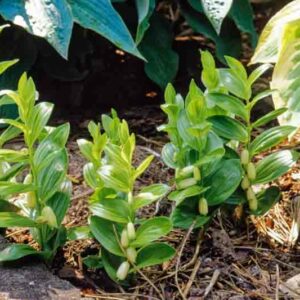
Fragrant Solomon’s Seal is a rhizomatous perennial that rises each spring with smooth, slightly angled stems and alternating leaves that look like they were neatly “laddered” along the arch. It has an effortlessly refined habit: not stiff, not floppy – just a graceful curve that reads as calm, intentional design in shady beds.
This species is native to temperate Europe and Asia, where it naturally grows on shaded slopes and in woodland settings with cool roots and leaf-litter soil.
Expect clumps to reach roughly 2-3 ft. tall (60-90 cm) and spread 9-12 in. (22-30 cm) at first, then slowly expand by rhizomes into tidy colonies. It is not a “take over your garden” plant – it’s more of a patient, long-game performer that gets better each year.
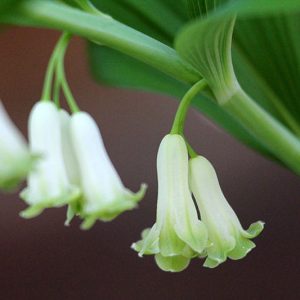
In late spring to early summer, small creamy-white, vase-shaped bells tipped in green dangle from the leaf axils. They hang under the stems, so you notice them most when you’re nearby – along a path, beside steps, or at the front edge of a shade border. The flowers can be gently fragrant, especially in still air.
The foliage is the main event for many gardeners: elliptic green leaves splashed and edged with creamy white that brighten shade without shouting. In fall, the leaves turn attractive yellow, then the plant goes dormant. Later in the season, the flowers may be followed by blue-black berries that add a subtle woodland touch.
Variegated Solomon’s Seal is broadly hardy (often listed around USDA Zones 3-8), with its real “make or break” factor being summer heat and moisture balance. Cold is usually manageable. Hot, dry, exposed sites are the bigger challenge.
Perennial Plant Association’s 2013 Perennial Plant of the Year
If you garden by zone and want more shade performers that thrive in woodland light, these guides are ideal companions to this plant’s style and needs:
Solomon’s Seal is not usually planted as a pollinator headline, but spring blooms can still be visited by early foragers such as bees. Think of it as a stability plant: it provides structure and seasonal continuity while your flashier bloomers handle the “big show.”
Many gardeners consider Solomon’s Seal to be a good candidate where browsing is an issue, and it’s often listed as resistant to deer and rabbits. Of course, hungry wildlife can surprise you, so it’s smart to build a broader “resistant” palette. These resources help you plan strategically:
This is not a desert plant, but it can handle short dry periods once established – especially in shade with decent soil. The best approach is woodland logic: keep roots cool with organic matter, water deeply during prolonged drought, and avoid repeated shallow sprinkling. If you are building a broader low-water plant list, this reference can help you compare options: drought-tolerant.
Humans: Considered harmful if eaten; accidental ingestion is usually low severity and most often causes gastrointestinal upset. Avoid eating any part, and keep berries away from children.
Pets (especially dogs): Listed as toxic to pets if eaten. Dogs that chew or ingest plant parts may develop vomiting, drooling, and diarrhea. Prevent access if you have a dog that samples plants.
It spreads by rhizomes and will form colonies in good conditions, but it’s generally considered well-behaved rather than invasive. If a clump becomes larger than you want, simply divide and relocate sections – it responds well to practical editing.
Skip heavy feeding. In a good soil, Solomon’s Seal prefers steady, natural fertility rather than fertilizer spikes. A light compost top-dress in spring is usually perfect.
Solomon’s Seal is famously low-drama, but slugs and snails can nibble tender new growth in spring – especially in moist shade. If you notice ragged holes, check at dusk and manage early.
Solomon’s seal is the common name for Polygonatum species—shade-loving woodland perennials with arching stems, dangling bell-shaped spring flowers, and thick, jointed rhizomes that slowly spread to form clumps/colonies.
Historically, the rhizomes (often called “root”) of various Polygonatum species were used in traditional herbal medicine for different ailments, and in some places were also used as food (e.g., processed rhizomes; young shoots cooked). Modern use exists, but the strength of evidence depends on the claim and preparation—don’t self-treat serious conditions without professional guidance
In traditional herbal practice, Solomon’s seal is most often described as a soothing/supportive herb (especially the rhizome) and is used in various traditions for “tonic” purposes—however, “benefits” vary widely by species and use, and aren’t the same as proven clinical effects.
Polygonatum odoratum (often sold as variegated ornamental forms) is native across parts of Europe and Asia.
Polygonatum biflorum (“smooth Solomon’s seal”) is native to eastern North America.
It’s often described as deer-resistant / not favored, but that’s not a guarantee—deer may still browse it, especially when food is scarce or in high-pressure areas.
The name is commonly explained by the rhizome: old stems leave distinct scars on the rhizome that were said to resemble King Solomon’s “seal,” which is where the common name comes from.
What gardeners call the “root” is actually a rhizome (an underground stem). It’s thick and fleshy, spreads slowly, and shows rounded scars where last year’s stems grew—useful for identification (and tied to the plant’s common name).
Updated: January 2026 • Reviewed by Gardenia Editors
| Hardiness |
3 - 8 |
|---|---|
| Heat Zones |
1 - 9 |
| Climate Zones | 1, 2, 3, 4, 5, 6, 7, 8, 9, 14, 15, 16, 17, A1, A2, A3 |
| Plant Type | Perennials |
| Plant Family | Asparagaceae |
| Genus | Polygonatum |
| Common names | Solomon's Seal |
| Exposure | Partial Sun, Shade |
| Season of Interest | Spring (Late), Summer (Early) |
| Height | 2' - 3' (60cm - 90cm) |
| Spread | 9" - 1' (23cm - 30cm) |
| Spacing | 12" - 18" (30cm - 50cm) |
| Maintenance | Low |
| Water Needs | Average |
| Soil Type | Clay, Loam |
| Soil pH | Acid, Alkaline, Neutral |
| Soil Drainage | Moist but Well-Drained |
| Characteristics | Cut Flowers, Fragrant, Plant of Merit, Showy |
| Tolerances | Full Shade, Drought, Dry Soil, Wet Soil, Deer, Rabbit, Heat, Erosion |
| Garden Uses | Beds And Borders, Ground Covers |
| Garden Styles | City and Courtyard, Informal and Cottage |
| Toxic to Humans | Low severity |
| Toxic to Cats | No known toxicity |
| Toxic to Dogs | Toxic |
| Toxic to Horses | No known toxicity |


| Hardiness |
3 - 8 |
|---|---|
| Heat Zones |
1 - 9 |
| Climate Zones | 1, 2, 3, 4, 5, 6, 7, 8, 9, 14, 15, 16, 17, A1, A2, A3 |
| Plant Type | Perennials |
| Plant Family | Asparagaceae |
| Genus | Polygonatum |
| Common names | Solomon's Seal |
| Exposure | Partial Sun, Shade |
| Season of Interest | Spring (Late), Summer (Early) |
| Height | 2' - 3' (60cm - 90cm) |
| Spread | 9" - 1' (23cm - 30cm) |
| Spacing | 12" - 18" (30cm - 50cm) |
| Maintenance | Low |
| Water Needs | Average |
| Soil Type | Clay, Loam |
| Soil pH | Acid, Alkaline, Neutral |
| Soil Drainage | Moist but Well-Drained |
| Characteristics | Cut Flowers, Fragrant, Plant of Merit, Showy |
| Tolerances | Full Shade, Drought, Dry Soil, Wet Soil, Deer, Rabbit, Heat, Erosion |
| Garden Uses | Beds And Borders, Ground Covers |
| Garden Styles | City and Courtyard, Informal and Cottage |
| Toxic to Humans | Low severity |
| Toxic to Cats | No known toxicity |
| Toxic to Dogs | Toxic |
| Toxic to Horses | No known toxicity |
How many Polygonatum odoratum ‘Variegatum’ (Solomon’s Seal) do I need for my garden?
| Plant | Quantity | |
|---|---|---|
| Polygonatum odoratum ‘Variegatum’ (Solomon’s Seal) | N/A | Buy Plants |
Create a membership account to save your garden designs and to view them on any device.
Becoming a contributing member of Gardenia is easy and can be done in just a few minutes. If you provide us with your name, email address and the payment of a modest $25 annual membership fee, you will become a full member, enabling you to design and save up to 25 of your garden design ideas.
Join now and start creating your dream garden!
Create a membership account to save your garden designs and to view them on any device.
Becoming a contributing member of Gardenia is easy and can be done in just a few minutes. If you provide us with your name, email address and the payment of a modest $25 annual membership fee, you will become a full member, enabling you to design and save up to 25 of your garden design ideas.
Join now and start creating your dream garden!