American Strawberry Bush, Strawberry Bush, Brook Euonymus, Hearts-a-burstin, Bursting Heart, Wahoo, Euonymus americana
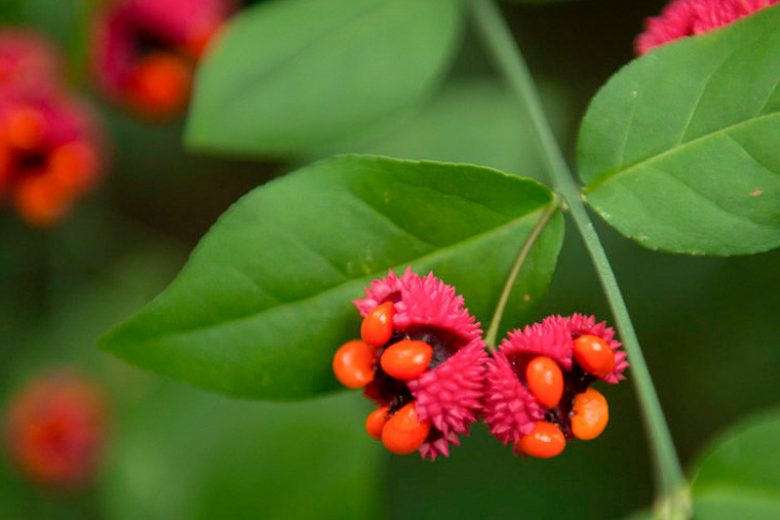
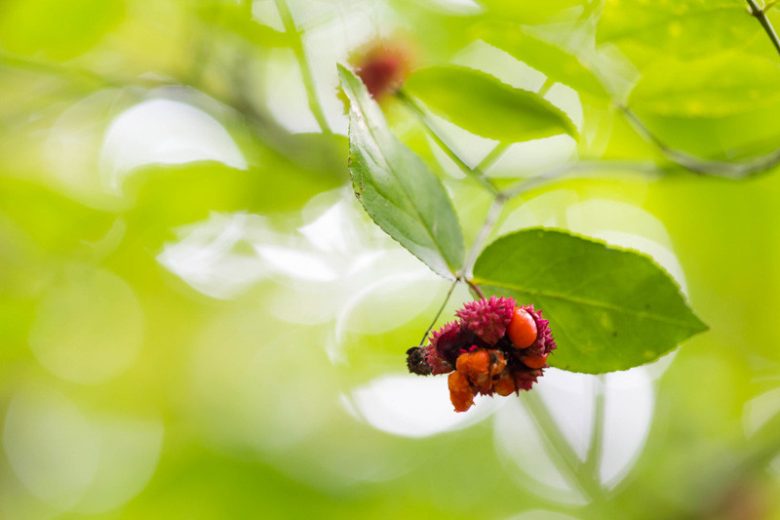
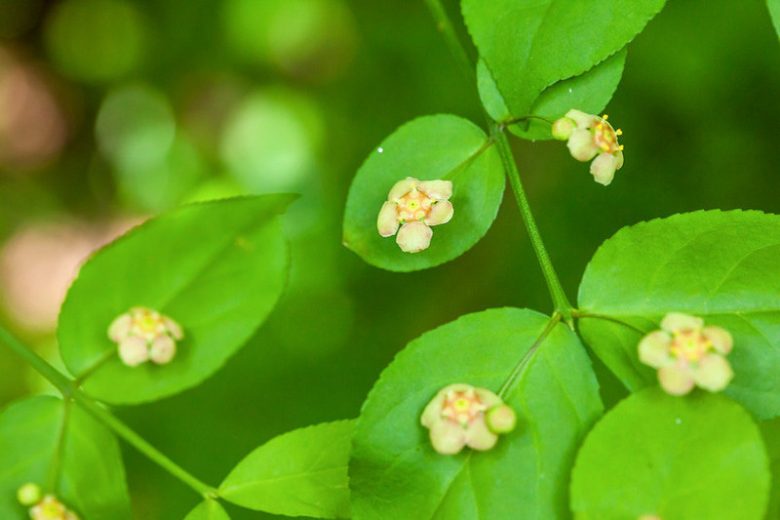
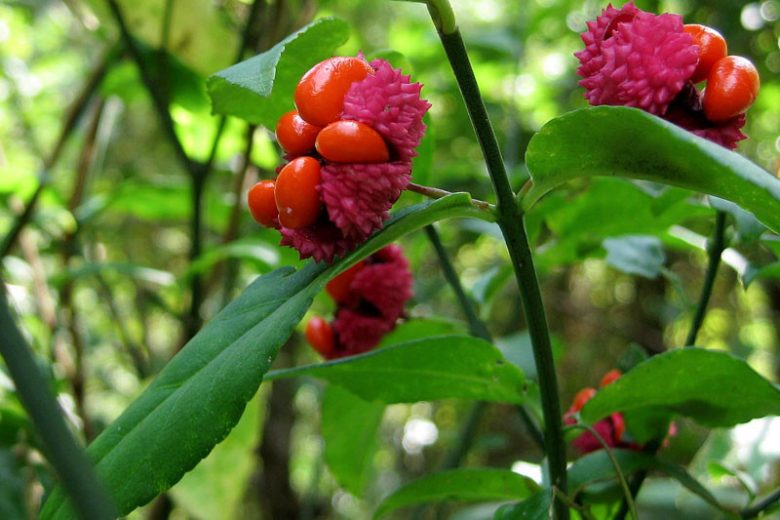


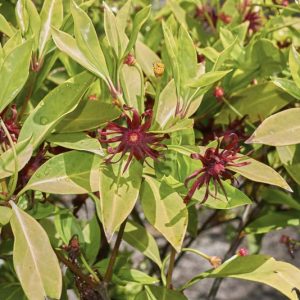
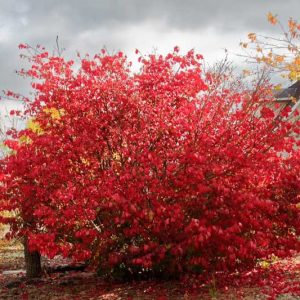
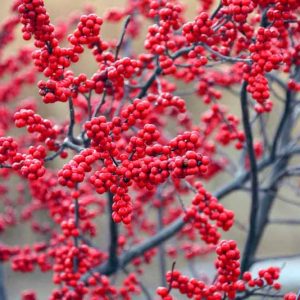
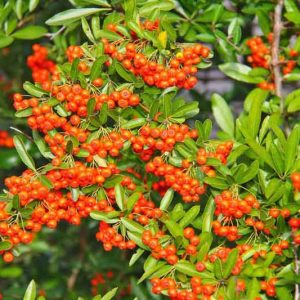
Noted for its very ornamental fruits and attractive fall color, Euonymus americanus (American Strawberry Bush) is an airy, deciduous shrub with slender stems bearing opposite, lance-shaped, bright green leaves, 2 in. long (5 cm). The foliage turns subtle shades of orange-red in the fall. In late spring to early summer, a profusion of tiny, pale green flowers with 5 clawed petals and purple stamens bloom from the leaf axils. Fairly inconspicuous, they are replaced by very showy, 5-lobed warty seed capsules that mature during the fall and become pinkish-red. Dangling on slender peduncles, each seed capsule splits open to reveal pea-sized, bright orange-red berries. They are very attractive to birds and small mammals and are a great source of fat and sugar for these animals. The angular stems remain green through the winter and will become flushed with purple when exposed to sunlight. Native to the eastern United States, the American Strawberry Bush occurs naturally on wooded slopes, moist understory forest areas, low sandy woods, ravines, and streambanks. It reseeds freely in moist locations and tends to sucker from the roots to form thickets. Adding a bold splash of color in the fall, the American Strawberry Bush is a good shrub for naturalizing.
| Hardiness |
6 - 9 |
|---|---|
| Climate Zones | 3, 3B, 4, 5, 6, 7, 8, 9, 14, 15, 16, 17 |
| Plant Type | Shrubs |
| Plant Family | Celastraceae |
| Genus | Euonymus |
| Common names | Strawberry Bush, Wahoo |
| Exposure | Partial Sun |
| Season of Interest | Spring (Late), Summer (Early, Late), Fall |
| Height | 4' - 6' (120cm - 180cm) |
| Spread | 4' - 6' (120cm - 180cm) |
| Spacing | 48" - 72" (120cm - 180cm) |
| Maintenance | Low |
| Water Needs | Average |
| Soil Type | Clay, Loam, Sand |
| Soil pH | Acid, Alkaline, Neutral |
| Soil Drainage | Moist but Well-Drained, Well-Drained |
| Characteristics | Showy, Fruit & Berries |
| Native Plants | United States, Northeast, Pennsylvania, Delaware, Maryland, New Jersey, New York, Illinois, Indiana, Midwest, Missouri, Ohio, Southeast, Louisiana, Mississippi, North Carolina, South Carolina, Tennessee, Virginia, West Virginia, Alabama, Arkansas, Florida, Georgia, Kentucky, Southwest, Texas, Oklahoma |
| Tolerances | Full Shade, Clay Soil, Fire |
| Attracts | Birds |
| Garden Uses | Hedges And Screens |
| Garden Styles | Informal and Cottage, Prairie and Meadow |
| Toxic to Humans | Low severity |
| Toxic to Cats | No known toxicity |
| Toxic to Dogs | No known toxicity |
| Toxic to Horses | No known toxicity |


| Hardiness |
6 - 9 |
|---|---|
| Climate Zones | 3, 3B, 4, 5, 6, 7, 8, 9, 14, 15, 16, 17 |
| Plant Type | Shrubs |
| Plant Family | Celastraceae |
| Genus | Euonymus |
| Common names | Strawberry Bush, Wahoo |
| Exposure | Partial Sun |
| Season of Interest | Spring (Late), Summer (Early, Late), Fall |
| Height | 4' - 6' (120cm - 180cm) |
| Spread | 4' - 6' (120cm - 180cm) |
| Spacing | 48" - 72" (120cm - 180cm) |
| Maintenance | Low |
| Water Needs | Average |
| Soil Type | Clay, Loam, Sand |
| Soil pH | Acid, Alkaline, Neutral |
| Soil Drainage | Moist but Well-Drained, Well-Drained |
| Characteristics | Showy, Fruit & Berries |
| Native Plants | United States, Northeast, Pennsylvania, Delaware, Maryland, New Jersey, New York, Illinois, Indiana, Midwest, Missouri, Ohio, Southeast, Louisiana, Mississippi, North Carolina, South Carolina, Tennessee, Virginia, West Virginia, Alabama, Arkansas, Florida, Georgia, Kentucky, Southwest, Texas, Oklahoma |
| Tolerances | Full Shade, Clay Soil, Fire |
| Attracts | Birds |
| Garden Uses | Hedges And Screens |
| Garden Styles | Informal and Cottage, Prairie and Meadow |
| Toxic to Humans | Low severity |
| Toxic to Cats | No known toxicity |
| Toxic to Dogs | No known toxicity |
| Toxic to Horses | No known toxicity |
How many Euonymus americanus (American Strawberry Bush) do I need for my garden?
| Plant | Quantity | |
|---|---|---|
| Euonymus americanus (American Strawberry Bush) | N/A | Buy Plants |
Create a membership account to save your garden designs and to view them on any device.
Becoming a contributing member of Gardenia is easy and can be done in just a few minutes. If you provide us with your name, email address and the payment of a modest $25 annual membership fee, you will become a full member, enabling you to design and save up to 25 of your garden design ideas.
Join now and start creating your dream garden!
Create a membership account to save your garden designs and to view them on any device.
Becoming a contributing member of Gardenia is easy and can be done in just a few minutes. If you provide us with your name, email address and the payment of a modest $25 annual membership fee, you will become a full member, enabling you to design and save up to 25 of your garden design ideas.
Join now and start creating your dream garden!