Cinnamon Fern, Buckhorn Fern, Osmundastrum cinnamomeum

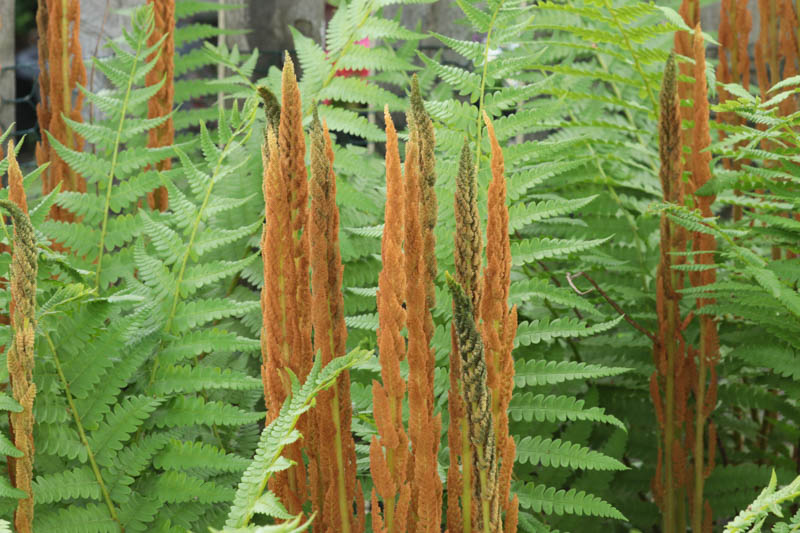
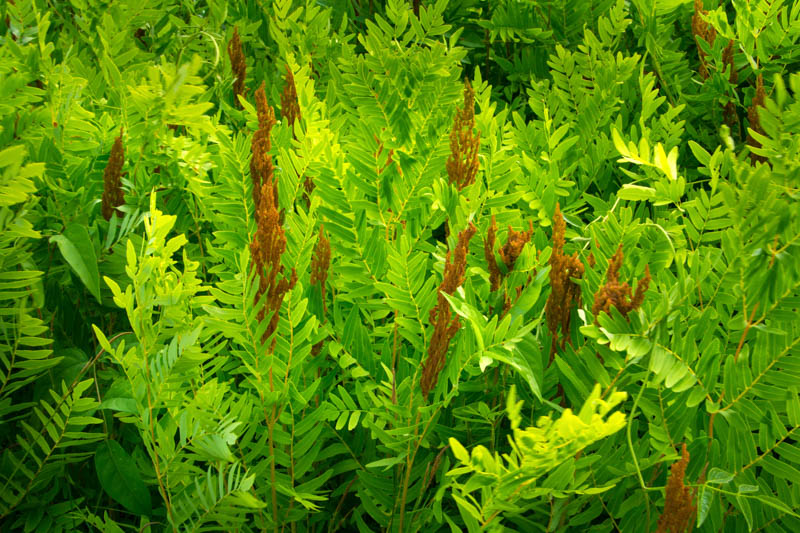


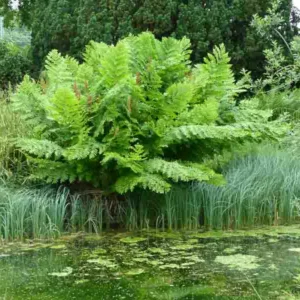
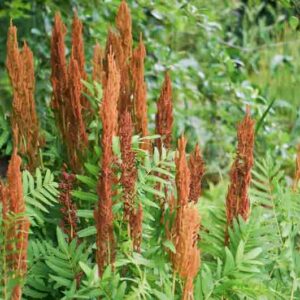
Osmunda cinnamomea, more accurately known today as Osmundastrum cinnamomeum, and commonly called cinnamon fern, is a bold, deciduous fern that loves wet ground and shade. Its tall, arching sterile fronds form a lush, vase-shaped clump of blue-green foliage, while its separate fertile fronds stand upright in the center like cinnamon sticks, ripening to a rich, warm brown that gives the plant its common name. A classic native fern of wetlands, bogs, and moist woodlands, it is a superb choice for rain gardens, streambanks, pond edges, and any consistently damp corner of the garden.
In spring, furry, silvery fiddleheads emerge and unfurl into long, graceful fronds. Soon after, the fertile fronds rise in the center, densely packed with sporangia that turn a striking cinnamon brown as spores ripen. Around them, the sterile fronds arch outward, creating a dramatic fountain of foliage. Low maintenance, long lived, and impressively tolerant of clay and wet soils, cinnamon fern is a standout accent or mass-planting fern wherever moisture is abundant. It also shines in naturalistic plantings and rain gardens, where it helps stabilize wet soils and support wildlife.
Summary: A clump-forming, deciduous fern with separate, cinnamon-brown fertile spikes and arching, blue-green sterile fronds that form a dramatic, vase-shaped clump in moist to wet soils.
Use: Rain gardens, bog gardens, streambanks, pond edges, wet meadows, shady borders, woodland gardens, and naturalized swales.
Highlight: Striking cinnamon-colored fertile fronds rising from a fountain of lush foliage, plus excellent tolerance of wet and clay soils.
Note: Thrives in part shade to full shade with consistently moist to wet, acidic, humus-rich soil. Can handle more sun if the soil never dries out.
| Botanical Name | Osmundastrum cinnamomeum (syn. Osmunda cinnamomea) |
|---|---|
| Family | Osmundaceae |
| Common Names | Cinnamon fern, buckhorn fern |
| Native Range | Native to the Americas and eastern Asia, widespread in eastern North America from Canada south through the eastern and central United States, and south into Mexico, Central and South America. |
| Plant Type and Habit | Deciduous, clump-forming fern with a bold, vase-shaped, upright to arching habit and distinct fertile and sterile fronds. Slowly increases by short rhizomes and spores. |
| Hardiness (approx. USDA) | Hardy in about USDA Zones 4 to 9, depending on local conditions. |
| Size | Typically 2 to 5 ft. tall (60 to 150 cm) and 2 to 3 ft. wide (60 to 90 cm), with older clumps sometimes appearing larger in rich, wet soils. |
| Sun and Exposure | A part shade to full shade lover. Tolerates morning or dappled sun, and even fuller sun in cool climates or where the soil is saturated or standing in water. |
| Soil | Fertile, humus-rich, consistently moist to wet, acidic soils. Performs beautifully in boggy or peaty ground and along streams. Tolerates heavy, clayey, or sandy soils if moisture is constant and drainage is not stagnant. |
| Seasonal Interest | Spectacular silvery, furry fiddleheads in spring, followed by lush, blue-green sterile fronds and dramatic cinnamon-brown fertile fronds. Foliage turns golden to bronze in fall before dying back. |
| Primary Uses | Shady beds and borders, underplanting of roses and shrubs, cottage and woodland gardens, bog and rain gardens, along streams, ponds, and water gardens, and in naturalized wet meadows. |
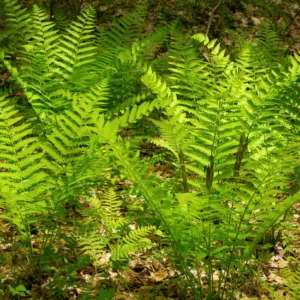
Cinnamon fern is a striking, clumping fern that produces two distinct kinds of fronds. The sterile fronds are long, arching, and blue-green, with deeply lobed pinnae that give them a finely divided, lacy look. These fronds form the familiar vase-shaped clump that can reach 2 to 5 ft. tall. In the center of the clump, separate fertile fronds rise more stiffly upright, shorter and narrower, and densely covered with sporangia that mature into a rich cinnamon brown.
In early spring, the new fronds unfurl from fuzzy, silvery fiddleheads that are among the earliest fern growths to appear in wet woods. As the season progresses, the fertile fronds brown and persist as cinnamon-colored spikes even after the sterile fronds are killed by frost, adding texture to the winter garden in mild climates.
Cinnamon fern is the recipient of the prestigious Award of Garden Merit of the Royal Horticultural Society for its outstanding qualities
Osmunda cinnamomea is widely distributed. In North America it occurs throughout much of the eastern United States and southeastern Canada, from Labrador and Newfoundland west to Ontario and Minnesota and south to Florida, the Gulf States, and eastern Texas and Oklahoma. It also extends into Mexico, Central America, the Caribbean, and parts of South America, and is disjunct in eastern Asia, where related populations occur from Siberia to Japan, China, and Southeast Asia.
In the wild, you will find cinnamon fern in bogs, swamps, wet savannas, peatlands, marshy woods, seeps, and stream margins, often in acidic soils. It is a classic indicator of wet, nutrient-moderate to nutrient-poor sites that remain moist or saturated for much of the growing season.
Cinnamon fern grows from a short, sometimes trunk-like rhizome with a dense mass of dark, fibrous roots. Over time, these roots can build a substantial crown, giving older clumps a slightly elevated, almost stump-like base. The plant is clump forming, not a rampant runner, but in ideal wet conditions it can create impressive colonies as spores germinate nearby and new crowns develop.
Its growth rate is moderate. Once established in a moist, shaded site, cinnamon fern is long lived and durable, tolerating periodic flooding, seasonal high water, and heavy soils far better than many perennials. In consistently wet spots, it can become one of the dominant foliage plants, adding strong structure and height.
Like other ferns, cinnamon fern does not flower. Instead, it reproduces by spores. The sori are borne on modified pinnae of the fertile fronds, which are tightly packed and beadlike. As the spores mature, the entire fertile frond changes from green to warm cinnamon brown and eventually releases clouds of microscopic spores into the air.
The spores must germinate relatively quickly under moist, suitable conditions. Successful germination produces tiny, heart shaped gametophytes that in turn give rise to new sporophyte plants. In gardens, most gardeners rely on mature divisions rather than spores, but the natural spore based life cycle is what allows cinnamon fern to gradually naturalize in favorable wetlands.
The foliage is the main show. Fresh spring fiddleheads and newly unfurled fronds are bright green and softly hairy, contrasting beautifully with darker evergreen shrubs or conifers. As the season progresses, the sterile fronds deepen to rich blue green, forming a bold, architectural clump that holds its shape well through summer.
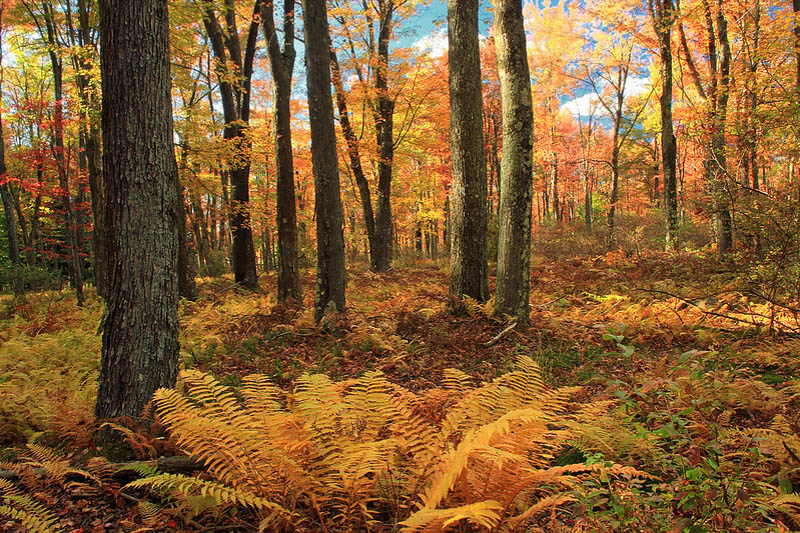
In fall, fronds often shift to golden or coppery tones before collapsing with frost. In mild climates, some fronds may linger into early winter, but cinnamon fern is usually treated as deciduous rather than evergreen.
Cinnamon fern is hardy in roughly USDA Zones 4 to 9. It tolerates cold winters and summer heat as long as its roots remain cool and moist. This wide hardiness range, combined with its affinity for wet soils, makes it a valuable structural plant across much of North America.
As a native wetland fern, Osmunda cinnamomea helps stabilize soils in sensitive riparian zones and peatlands. The dense root and rhizome system anchors streambanks, bog edges, and wet forest floors, reducing erosion and protecting water quality. Its presence often indicates relatively healthy, undisturbed hydrology.
By protecting the duff layer and moderating temperature and moisture at ground level, cinnamon fern supports a suite of woodland and wetland species, including pollinator plants such as bee and butterfly host and nectar plants that thrive in similar habitats.
Cinnamon fern is generally considered rabbit and deer resistant. Browsing mammals rarely cause significant damage, likely because mature fronds are fibrous and not especially palatable. In areas with high deer pressure, it is a reliable structural plant for moist shade and wet sites where many flowering perennials are heavily browsed.
Unlike some woodland ferns that handle dry shade, cinnamon fern is decidedly a moisture lover. Once established, it may survive brief dry spells, especially in deep, organic soils, but fronds will brown and decline if soil moisture is not quickly restored. It is not considered a drought tolerant fern and should be reserved for areas that remain reliably moist or wet.
Cinnamon fern is not widely listed as highly toxic to humans or pets, and many ferns are generally regarded as low risk ornamentals. However, some fern species can cause gastrointestinal upset or other issues if ingested in quantity, and there is ongoing discussion about potential long term risks from eating wild fern fiddleheads. It is safest to grow cinnamon fern as an ornamental, not an edible, and to discourage pets or children from chewing on fronds. Consult a medical or veterinary professional if ingestion is suspected.
Osmunda cinnamomea is a native fern and not considered invasive in its home range. It forms sizable clumps and can slowly colonize suitable wet ground through spores, but it does not send long, aggressive runners. In gardens, its spread is usually gentle and easy to manage.
Cinnamon fern needs little to no fertilizer. An annual application of compost, leaf mold, or shredded leaves in spring is usually enough to maintain vigorous, healthy growth, especially in fertile, wet soils.
Cinnamon fern is generally pest free. Occasionally, specialized insects such as the Osmunda borer moth or sporangia feeding bugs and thrips may nibble at fertile fronds. These issues are usually cosmetic and rarely threaten plant health. Thinning dense clumps and maintaining good vigor normally prevents recurring problems.
No. Osmunda cinnamomea (Osmundastrum cinnamomeum) is a native, clump-forming fern. It may slowly form colonies in suitable wet ground as spores germinate nearby, but it does not spread aggressively by runners and is not considered invasive in its native range.
Cinnamon fern is usually deciduous. Its sterile fronds remain attractive from spring through fall, then die back after hard freezes. In mild climates, some fronds may linger into winter, but it is best treated as a deciduous fern rather than a true evergreen.
Cinnamon fern prefers part shade to full shade. It can handle some morning or dappled sun, and even more sun in cool climates or waterlogged soils. Prolonged, hot afternoon sun in dry or average soils often leads to leaf scorch and weak growth.
Mature clumps of Osmunda cinnamomea typically reach about 2 to 5 feet tall and 2 to 3 feet wide, with the sterile fronds forming a broad, arching fountain and the fertile fronds standing slightly shorter and more upright in the center.
Yes. Cinnamon fern is generally deer and rabbit resistant. Browsing mammals rarely cause serious damage, making this fern a dependable choice for moist, shady gardens in regions with high deer pressure.
Cinnamon fern thrives in fertile, humus-rich, acidic soil that stays consistently moist to wet. It performs especially well in boggy, peaty, or streamside conditions and tolerates sandy or clay soils as long as moisture is reliable.
Yes, cinnamon fern tolerates shallow standing water and is often found in swamps, boggy ground, and along streams. It performs best where the root zone is consistently moist or saturated but not in deep, stagnant water that covers the crown.
No. Cinnamon fern is not a drought tolerant fern. It may survive short dry spells once established, but it is adapted to moist to wet sites and will decline or go dormant early if soil conditions stay dry.
The easiest method is division. In early spring, as new fiddleheads emerge, lift and divide mature clumps into sections with several crowns and roots, then replant immediately. Advanced gardeners can also collect ripe spores from fertile fronds and sow them on sterile media.
Cinnamon fern is not widely listed as highly toxic to people or common household pets and is generally considered a low risk ornamental. It is grown for decorative use rather than for food, so intentional eating of fronds or fiddleheads should be discouraged, and any ingestion should be discussed with a medical or veterinary professional.
Lady Bird Johnson Wildflower Center, Native Plant Database: Osmunda cinnamomea.
USDA PLANTS Database: Osmunda cinnamomea (cinnamon fern)
Go Botany, Native Plant Trust: Osmundastrum cinnamomeum.
Updated: December 2025 • Reviewed by Gardenia Editors
| Hardiness |
4 - 9 |
|---|---|
| Heat Zones |
1 - 8 |
| Climate Zones | 1, 2, 3, 4, 5, 6 |
| Plant Type | Ferns |
| Plant Family | Osmundaceae |
| Genus | Osmunda |
| Common names | Cinnamon Fern, Fern |
| Exposure | Partial Sun |
| Season of Interest | Spring (Mid, Late), Summer (Early, Mid, Late), Fall |
| Height | 2' - 5' (60cm - 150cm) |
| Spread | 2' - 3' (60cm - 90cm) |
| Spacing | 36" (90cm) |
| Maintenance | Low |
| Water Needs | Average, High |
| Soil Type | Clay, Loam, Sand |
| Soil pH | Acid |
| Soil Drainage | Moist but Well-Drained, Poorly Drained |
| Characteristics | Plant of Merit, Showy |
| Native Plants | United States, Pennsylvania, Rhode Island, Vermont, Connecticut, Delaware, Maine, Massachusetts, Maryland, New Hampshire, New Jersey, New York, Northeast, Midwest, Southeast, Southwest, Illinois, Indiana, Iowa, Michigan, Minnesota, Missouri, Ohio, Wisconsin, Louisiana, Mississippi, North Carolina, South Carolina, Tennessee, Virginia, West Virginia, Alabama, Arkansas, Florida, Georgia, Kentucky, Texas, Oklahoma |
| Tolerances | Full Shade, Deer, Rabbit, Clay Soil, Wet Soil, Heat |
| Garden Uses | Beds And Borders, Bog Gardens, Ponds And Streams, Rain Gardens, Underplanting Roses And Shrubs |
| Garden Styles | City and Courtyard, Informal and Cottage, Prairie and Meadow, Traditional Garden |
| Toxic to Humans | No known toxicity |
| Toxic to Cats | No known toxicity |
| Toxic to Dogs | No known toxicity |
| Toxic to Horses | No known toxicity |


| Hardiness |
4 - 9 |
|---|---|
| Heat Zones |
1 - 8 |
| Climate Zones | 1, 2, 3, 4, 5, 6 |
| Plant Type | Ferns |
| Plant Family | Osmundaceae |
| Genus | Osmunda |
| Common names | Cinnamon Fern, Fern |
| Exposure | Partial Sun |
| Season of Interest | Spring (Mid, Late), Summer (Early, Mid, Late), Fall |
| Height | 2' - 5' (60cm - 150cm) |
| Spread | 2' - 3' (60cm - 90cm) |
| Spacing | 36" (90cm) |
| Maintenance | Low |
| Water Needs | Average, High |
| Soil Type | Clay, Loam, Sand |
| Soil pH | Acid |
| Soil Drainage | Moist but Well-Drained, Poorly Drained |
| Characteristics | Plant of Merit, Showy |
| Native Plants | United States, Pennsylvania, Rhode Island, Vermont, Connecticut, Delaware, Maine, Massachusetts, Maryland, New Hampshire, New Jersey, New York, Northeast, Midwest, Southeast, Southwest, Illinois, Indiana, Iowa, Michigan, Minnesota, Missouri, Ohio, Wisconsin, Louisiana, Mississippi, North Carolina, South Carolina, Tennessee, Virginia, West Virginia, Alabama, Arkansas, Florida, Georgia, Kentucky, Texas, Oklahoma |
| Tolerances | Full Shade, Deer, Rabbit, Clay Soil, Wet Soil, Heat |
| Garden Uses | Beds And Borders, Bog Gardens, Ponds And Streams, Rain Gardens, Underplanting Roses And Shrubs |
| Garden Styles | City and Courtyard, Informal and Cottage, Prairie and Meadow, Traditional Garden |
| Toxic to Humans | No known toxicity |
| Toxic to Cats | No known toxicity |
| Toxic to Dogs | No known toxicity |
| Toxic to Horses | No known toxicity |
How many Osmunda cinnamomea (Cinnamon Fern) do I need for my garden?
| Plant | Quantity | |
|---|---|---|
| Osmunda cinnamomea (Cinnamon Fern) | N/A | Buy Plants |
Create a membership account to save your garden designs and to view them on any device.
Becoming a contributing member of Gardenia is easy and can be done in just a few minutes. If you provide us with your name, email address and the payment of a modest $25 annual membership fee, you will become a full member, enabling you to design and save up to 25 of your garden design ideas.
Join now and start creating your dream garden!
Create a membership account to save your garden designs and to view them on any device.
Becoming a contributing member of Gardenia is easy and can be done in just a few minutes. If you provide us with your name, email address and the payment of a modest $25 annual membership fee, you will become a full member, enabling you to design and save up to 25 of your garden design ideas.
Join now and start creating your dream garden!