White Japanese Beautyberry, White Beautyberry, Pearl Beautyberry, Japanese Beautyberry, East Asian Beautyberry, Leucocarpa Beautyberry, Amictonis japonica
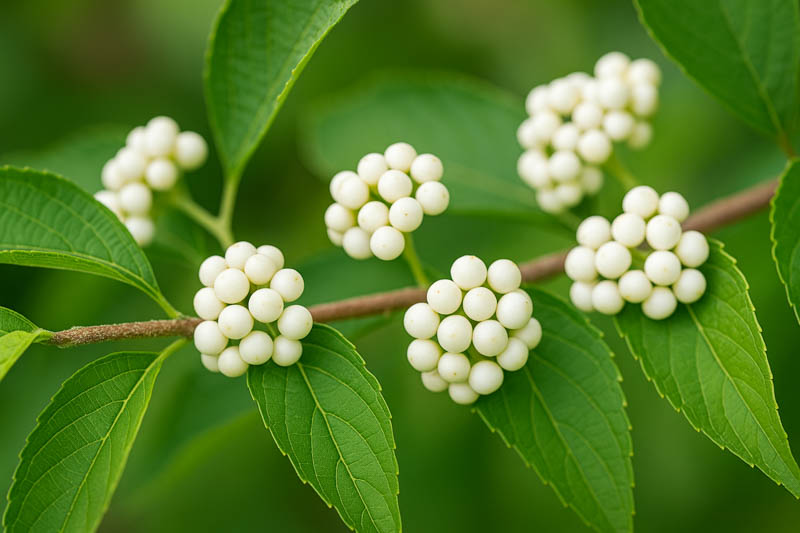


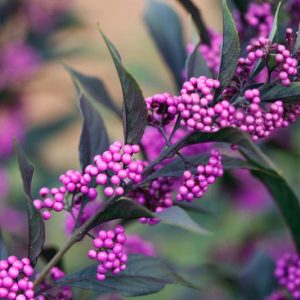
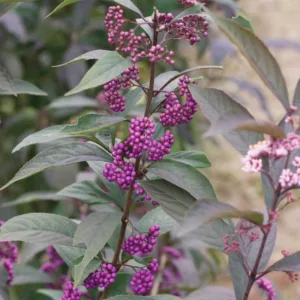
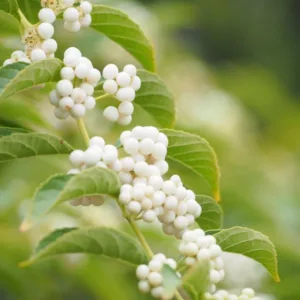
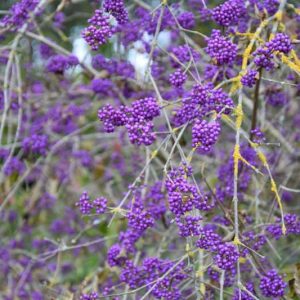
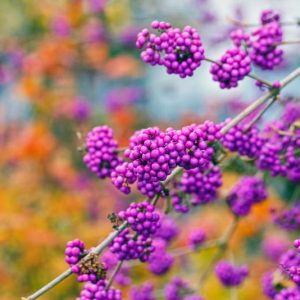
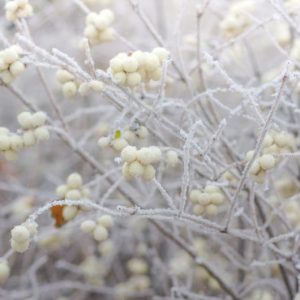
If purple beautyberries are the confetti of autumn, Callicarpa japonica ‘Leucocarpa’ is the string of pearls. This white-fruited Japanese beautyberry lights up borders just when summer color is fading. Pink to lilac blossoms in midsummer quietly set the scene, then fall arrives and the stems bead up with milky berries that shine against turning leaves and bare twigs. Tough, tidy, and easy to prune, it is a small-space superstar for four-season interest.
Summary: Deciduous, arching shrub with dainty summer flowers and showy clusters of white berries that glow from late summer into winter. Compact habit suits front borders and small gardens.
Use: Mixed borders, fall focal points, woodland edge, massing, foundation plantings, cut stems for vases and holiday decor.
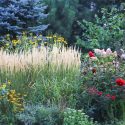
Highlight: The white fruit reads from a distance and pairs beautifully with burgundy foliage, red or yellow twig dogwoods, and blue conifers.
Note: Heaviest berrying with good sun and a nearby beautyberry partner that blooms at the same time.
| Botanical Name | Callicarpa japonica ‘Leucocarpa’ |
|---|---|
| Family | Lamiaceae (mint family) |
| Common Names | White Japanese beautyberry, white beautyberry, pearl beautyberry |
| Native Range | Species native to Japan and Korea. ‘Leucocarpa’ is a white-fruited selection grown in temperate gardens worldwide. |
| Plant Type & Habit | Deciduous shrub with arching, fountain-like branches; multi-stemmed and bushy |
| Hardiness (USDA) | Zones 5 to 8 in average gardens; best fruiting where summers are warm and winters are cold enough to set buds |
| Size | 4 to 6 ft tall and wide (1.2 to 1.8 m); can reach 7 ft in rich soil |
| Sun & Exposure | Full sun to light shade; 6 hours of sun gives the best berry set and color |
| Soil | Average, well drained soil with steady moisture; tolerates clay if not waterlogged; pH slightly acidic to neutral |
| Bloom & Fruit | Small pink to lilac flowers in leaf axils in early to midsummer; clusters of pearl-white berries ripen late summer to fall and can persist into early winter |
| Primary Uses | Fall and winter interest, specimen in small beds, mixed borders, foundation accents, cut stems for arrangements |
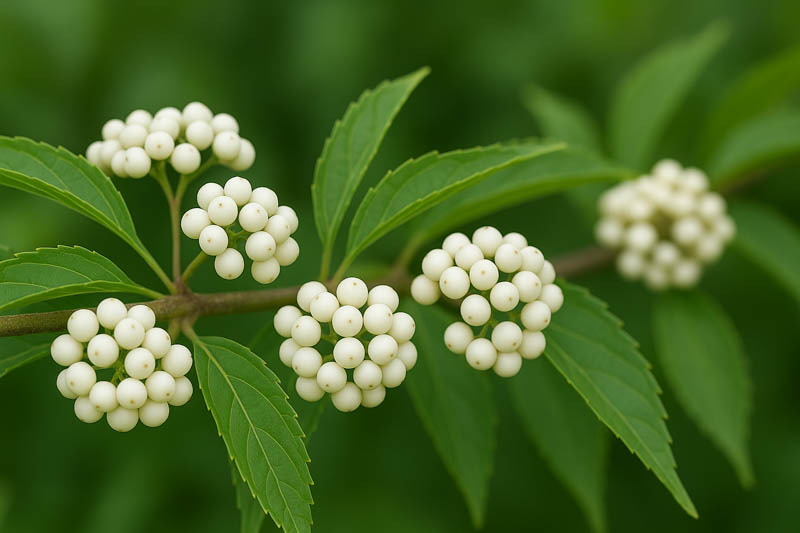
‘Leucocarpa’ is a white-fruited selection of Japanese beautyberry chosen for its luminous pearl-like berries. The shrub forms an easy, rounded fountain of stems with fresh green leaves through summer. Small pink lavender blooms appear in the leaf axils and invite bees. By late summer, the flowers give way to tight clusters of glossy white berries that line the stems like beads. After the foliage turns yellow to soft gold and drops, the berries keep shining on bare twigs for a clean, modern winter look.
Callicarpa japonica is native to Japan and Korea, where it grows in light woodland, thickets, and forest edges. The selection ‘Leucocarpa’ was propagated for gardens and is now grown widely wherever winters are cold enough to set flower buds and summers provide warmth for fruit to ripen.
Multi-stemmed and arching with a naturally rounded, slightly layered silhouette. New shoots rise from the base and bow outward, so the plant reads as a soft dome. Fruiting occurs on the current season’s growth from buds formed on one-year-old wood, which is why annual late winter pruning keeps it productive.
Moderate. Expect 8 to 16 inches (20-40 cm) of extension growth per year in average soil and regular moisture. In rich beds with irrigation it can put on closer to 18 inches (45 cm) and reach mature size quickly.
Beautyberries are long-lived shrubs in good conditions. Plan on 15 to 20 plus years with simple renewal pruning. Old clumps can be refreshed by removing several of the oldest stems at the base each spring.
Typically 4 to 6 ft tall and wide (1.2 to 1.8 m), occasionally larger in rich soil. The scale is friendly to town gardens, path edges, and the front third of borders.
Small, nectar-rich blossoms open in early to midsummer. Color is soft pink to lilac and the clusters sit neatly along the stems in the leaf axils. The display is delicate rather than showy, but it is busy with pollinators and sets the stage for heavy autumn fruiting.
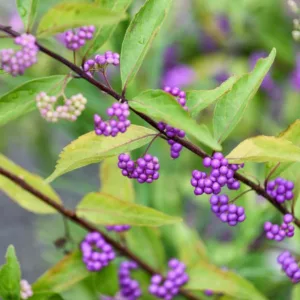
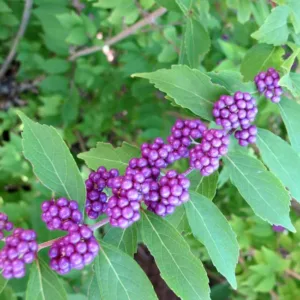
Round, glossy, white berries about 0.15 to 0.25 in (0.4 to 0.6 cm) wide cluster tightly along the stems. They color up from late August into September in many climates, peak in fall, and can hold into early winter. Birds eventually take them, but white fruit often lingers longer than purple because it is less visible to some species.
Opposite, elliptic to ovate leaves 2 to 4 in long (5-10 cm) with a clean, mid-green surface and lightly toothed edges. Foliage stays fresh looking through summer and warms to buttery yellow in fall, a nice foil for the pale berries.
Generally hardy in USDA Zones 5 to 8. Winter buds are reliable in Zone 5 with some shelter from north winds. In hot summer regions, afternoon shade and mulch help avoid leaf scorch and extend berry life.
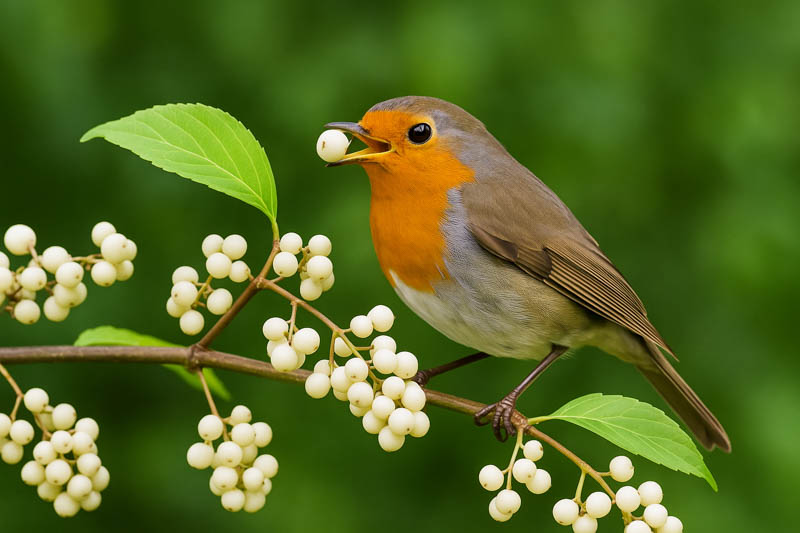
Flowers attract bees and small pollinators. Berries feed birds late in the season when other fruit is gone. The shrub’s twiggy structure offers small birds shelter on cold days. If you want berries to last for display, plant one for the birds and one for yourself. Small Trees and Shrubs Birds Can’t Resist.
Beautyberry fruit is grown for ornament. It is not a culinary berry and flavor is bland to astringent. Leave the clusters for winter interest and birds. As with any ornamental, avoid eating seeds and large quantities of raw fruit.
Not considered invasive in home gardens. Self seeding is light where berries fall and germinate in mulched beds. Pull or transplant seedlings while small if they appear where you do not want them.
Full sun to light shade. Aim for at least 6 hours of direct sun for the densest clusters. In hot summer zones, morning sun with light afternoon shade keeps leaves handsome and berries longer lasting.
Average garden soil is fine if it drains. Beautyberries like consistent moisture but dislike wet feet in winter. Improve clay with compost and plant slightly high so crowns sit just above grade. A 2 to 3 in mulch keeps roots cool and happy.
Deep weekly watering in the first growing season. Once established, water during dry spells, especially from flowering through early fruit fill. Even moisture at that time dramatically improves berry density.
Light feeders. A spring topdress of compost or a balanced organic fertilizer is usually enough. Avoid high nitrogen lawn fertilizers drifting under the shrub. They push leafy shoots at the expense of flowers and berries.
Prune in late winter or very early spring before growth begins. Remove the oldest stems at the base to open the center, then shorten remaining stems by one third to one half to a strong outward bud. This stimulates sturdy new shoots that flower and fruit heavily the same season. Avoid hard summer pruning which can reduce the current year’s display.
Beautyberry looks best as a natural fountain. For a more formal outline, tip prune evenly after flowering. In cold regions where tips may winterkill, a spring cutback to live wood is all that is needed.
Often one will fruit, but you get heaviest clusters when a second beautyberry is nearby and blooming at the same time. Plant a second C. japonica for the biggest clusters; overlapping bloom from C. dichotoma may help, but results vary.
Late winter to early spring. Remove a third of the oldest stems at the base, then shorten remaining shoots by one third to one half to a strong outward bud. Beautyberry fruits on new wood.
They can persist into early winter in many climates. Birds eventually take them. Cold snaps and strong sun shorten display. Afternoon shade helps berries hold longer in hot regions.
Light shade is fine, but deep shade reduces flowers and berries. Aim for morning sun or dappled light plus bright afternoons.
Yes, in a large pot 16 to 20 in wide with quality mix. Water and feed consistently. Expect to transplant to open ground after 2 to 3 years for best long term performance.
Updated: November 2025 • Reviewed by Gardenia Editors
| Hardiness |
5 - 8 |
|---|---|
| Heat Zones |
3 - 12 |
| Climate Zones | 2B, 3A, 3B, 4, 5, 6, 7, 8, 9, 14, 15, 16, 17, 18, 19, 20, 21, 22, 23, 24 |
| Plant Type | Shrubs |
| Plant Family | Lamiaceae |
| Genus | Callicarpa |
| Common names | Beautyberry |
| Exposure | Full Sun, Partial Sun |
| Season of Interest | Summer (Early, Mid, Late), Fall, Winter |
| Height | 4' - 6' (120cm - 180cm) |
| Spread | 4' - 6' (120cm - 180cm) |
| Spacing | 48" - 72" (120cm - 180cm) |
| Maintenance | Low |
| Water Needs | Average |
| Soil Type | Clay, Loam, Sand |
| Soil pH | Acid, Neutral |
| Soil Drainage | Well-Drained |
| Characteristics | Showy, Fruit & Berries |
| Tolerances | Heat |
| Attracts | Bees, Birds, Butterflies |
| Garden Uses | Beds And Borders, Hedges And Screens |
| Garden Styles | Informal and Cottage, Prairie and Meadow, Traditional Garden |
| Toxic to Humans | No known toxicity |
| Toxic to Cats | No known toxicity |
| Toxic to Dogs | No known toxicity |
| Toxic to Horses | No known toxicity |


| Hardiness |
5 - 8 |
|---|---|
| Heat Zones |
3 - 12 |
| Climate Zones | 2B, 3A, 3B, 4, 5, 6, 7, 8, 9, 14, 15, 16, 17, 18, 19, 20, 21, 22, 23, 24 |
| Plant Type | Shrubs |
| Plant Family | Lamiaceae |
| Genus | Callicarpa |
| Common names | Beautyberry |
| Exposure | Full Sun, Partial Sun |
| Season of Interest | Summer (Early, Mid, Late), Fall, Winter |
| Height | 4' - 6' (120cm - 180cm) |
| Spread | 4' - 6' (120cm - 180cm) |
| Spacing | 48" - 72" (120cm - 180cm) |
| Maintenance | Low |
| Water Needs | Average |
| Soil Type | Clay, Loam, Sand |
| Soil pH | Acid, Neutral |
| Soil Drainage | Well-Drained |
| Characteristics | Showy, Fruit & Berries |
| Tolerances | Heat |
| Attracts | Bees, Birds, Butterflies |
| Garden Uses | Beds And Borders, Hedges And Screens |
| Garden Styles | Informal and Cottage, Prairie and Meadow, Traditional Garden |
| Toxic to Humans | No known toxicity |
| Toxic to Cats | No known toxicity |
| Toxic to Dogs | No known toxicity |
| Toxic to Horses | No known toxicity |
How many Callicarpa japonica ‘Leucocarpa’ (Japanese Beautyberry) do I need for my garden?
| Plant | Quantity | |
|---|---|---|
| Callicarpa japonica ‘Leucocarpa’ (Japanese Beautyberry) | N/A | Buy Plants |
Create a membership account to save your garden designs and to view them on any device.
Becoming a contributing member of Gardenia is easy and can be done in just a few minutes. If you provide us with your name, email address and the payment of a modest $25 annual membership fee, you will become a full member, enabling you to design and save up to 25 of your garden design ideas.
Join now and start creating your dream garden!
Create a membership account to save your garden designs and to view them on any device.
Becoming a contributing member of Gardenia is easy and can be done in just a few minutes. If you provide us with your name, email address and the payment of a modest $25 annual membership fee, you will become a full member, enabling you to design and save up to 25 of your garden design ideas.
Join now and start creating your dream garden!