Roundleaf Ragwort, Round-leaved Ragwort, Spoon-leaved Ragwort, Spoonleaf Ragwort, Roundleaf Groundsel, Roundleaf Groundsel, Running Groundsel, Running Ragwort, Squaw Weed
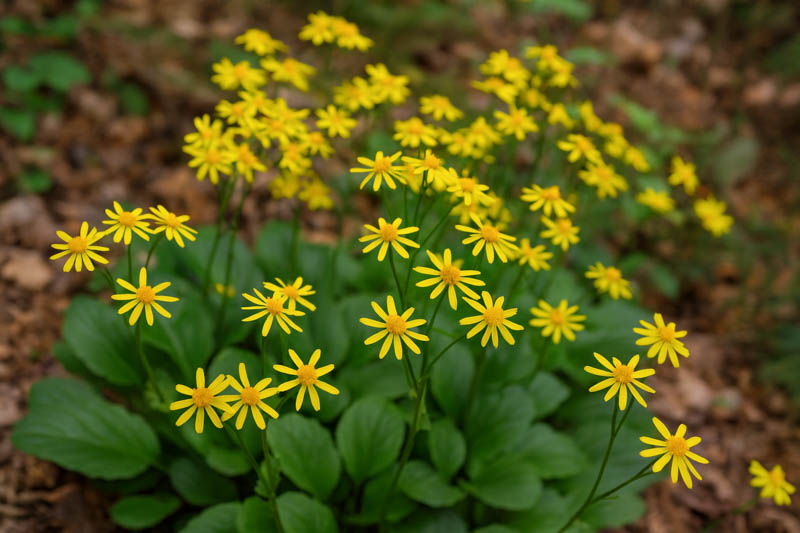
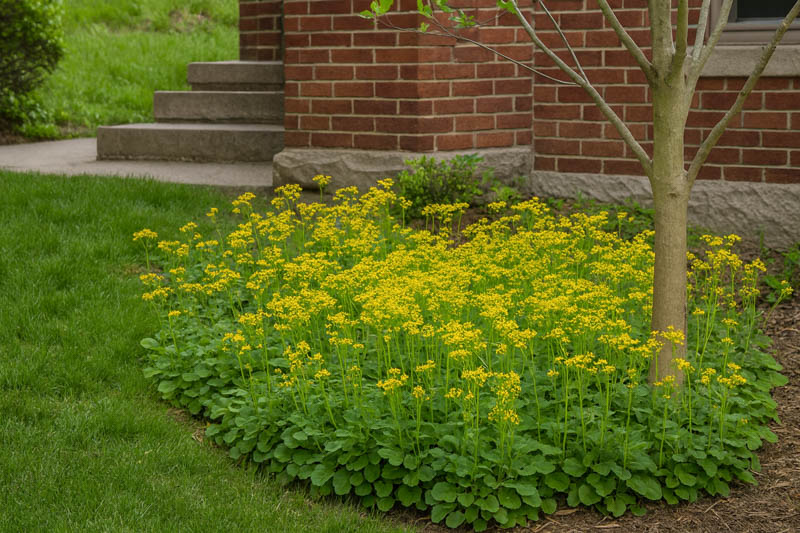


Want an easy, pollinator-friendly native that carpets shady ground with glossy foliage and a burst of yellow spring flowers? Say hello to Packera obovata, commonly called roundleaf ragwort, roundleaf groundsel, or golden groundsel. This tough, rhizomatous native perennial wildflower spreads into dense colonies of rounded, semi-evergreen leaves topped with cheerful yellow daisies in spring.
Packera obovata care is wonderfully simple: plant it in part shade to shade with average, moist to dry-mesic soil, water it well its first season, and let it knit into a living green mulch. It’s a premier choice for woodland groundcovers, shady lawn alternatives, rain gardens, slopes, and naturalistic native plantings across much of eastern North America.

Summary: Vigorous, colonial native groundcover with semi-evergreen, rounded leaves and bright yellow, daisy-like flower clusters in spring.
Use: Woodland groundcover, shady lawn alternative, rain garden edges, slopes, naturalistic borders, and native wildflower meadows.
Highlight: Thrives in part shade to shade with average, moist to dry-mesic soils, quickly forming a dense, weed-suppressing carpet that glows with golden blooms in spring.
Note: Deer resistant, semi-evergreen, and low maintenance. Spreads by short rhizomes and self-seeding to create a dynamic, wildlife-friendly matrix under trees and shrubs.
| Botanical Name | Packera obovata (Muhl. ex Willd.) W.A. Weber & Á. Löve |
|---|---|
| Family | Asteraceae (aster, daisy, or sunflower family) |
| Common Names | Roundleaf ragwort, roundleaf groundsel, spoon-leaved ragwort, golden groundsel |
| Native Range | Native to eastern North America, from Quebec and Ontario south through New England, the Mid-Atlantic, and Midwest to Texas and Florida, in moist to dry-mesic forests, rocky woodlands, stream banks, and glades. |
| Plant Type and Habit | Perennial herbaceous wildflower, spreading by short rhizomes and stolons; basal rosettes of rounded leaves forming a low, colony-forming mat with taller flowering stems. |
| Hardiness (USDA) | Zones 3 to 8 in most horticultural references. |
| Size | Basal foliage typically 4 to 6 inches tall, forming mats up to 12 to 18 inches wide per plant; flowering stems rise to about 12 to 18 inches tall in bloom. |
| Sun and Exposure | Part shade to full shade is ideal; tolerates morning or filtered sun. In full sun, prefers evenly moist, not baking-dry soil. |
| Soil | Thrives in average, moist to dry-mesic, well drained soils, often over limestone or other base-rich substrates. Handles loamy, rocky, or gravelly soils but dislikes extremely dry sand or prolonged waterlogging. |
| Seasonal Interest | Semi-evergreen foliage in many climates; showy yellow daisy-like flower clusters in spring (late February–June depending on region), followed by fluffy seed heads. |
| Primary Uses | Shade groundcover, woodland lawn alternative, edge of rain gardens and woodland paths, erosion control on slopes, underplanting for shrubs and trees, and naturalistic plantings with other spring-blooming natives. |
Packera obovata is an erect, colony-forming perennial wildflower with glossy, rounded basal leaves and bright yellow, daisy-like flowers held on wiry stems above the foliage. It looks a bit like a woodland version of a small golden daisy, but with a dense, ground-hugging base of evergreen to semi-evergreen leaves.
Basal leaves are typically oval to obovate (spoon-shaped) with gently toothed margins, forming rosettes that knit into a low mat. From these rosettes, slender stems rise in early spring, carrying loose clusters of yellow flower heads that draw pollinators and light up shady spaces.
Roundleaf ragwort is native to a broad swath of eastern North America. Its range stretches from Quebec and Ontario south through New England and the Mid-Atlantic, across the Midwest and Ohio Valley, and down to Texas and the Florida Panhandle.
In the wild, you’re likely to find Packera obovata in habitats such as:
This natural distribution explains why Packera obovata thrives in woodland shade, rocky soils, and average moisture, and why it makes such a dependable native groundcover for shaded gardens and naturalized landscapes. Best Shade Plants for Texas Yards (That Actually Thrive, Not Sulk)
Packera obovata spreads by short rhizomes and stolons, often forming broad patches over time. Individual rosettes remain neat and low, but together they create a dense, weed-suppressing colony.
The growth rate is moderate: not instant, but fast enough that you notice it filling in from year to year. In good sites with consistent moisture and dappled shade, a few plugs can become a broad patch within several seasons, especially if allowed to self-sow lightly.
Flowering usually begins in early to mid spring until early summer (roughly March to June depending on climate). Upright stems rise above the foliage and carry loose flat-topped clusters of daisy-like flower heads. Each head has bright yellow rays surrounding a golden to orange-yellow center, giving a classic wildflower look that reads beautifully from a distance.
After bloom, the flowers ripen into small, dry fruits topped with white fluff (the pappus), which catch the wind and disperse seeds. If you’re using Packera obovata as a groundcover or lawn alternative, you can either let the seed heads mature to encourage gentle self-seeding or shear them off after bloom for a tidier, less seedy look.
The foliage of Packera obovata is one of its biggest assets in shade garden design:
Upper stem leaves are smaller and more lobed, adding a bit of fine texture above the rounded base. Together, the foliage and flowers make Packera obovata groundcover a strong visual anchor in woodland beds and shady borders.
Most horticultural sources list Packera obovata as hardy in about USDA Zones 3 to 8, making it suitable for much of the northern and central United States as well as cooler parts of the South.
It tolerates cold winters, emerging early in spring, and handles summer heat well if soil is not bone dry. In hot-summer climates, situating plants in afternoon shade with decent moisture keeps foliage lush and happy.
Because it is shade tolerant, semi-evergreen, and spreading, roundleaf ragwort is exceptionally flexible. You can use Packera obovata in many ways:
Packera obovata is a strong contributor to a wildlife-friendly, pollinator-friendly landscape:
Because a Packera obovata groundcover typically requires less mowing, fertilizer, and irrigation than turf, it also supports a more stable, chemical-free habitat in residential and public gardens.
Roundleaf ragwort is widely described as deer resistant. Foliage contains pyrrolizidine alkaloids, the same class of compounds that make some related Packera and Senecio species unpalatable to browsing mammals. Deer usually sample little, if at all, making this a reliable option for high-pressure gardens.
One of the surprising traits of Packera obovata is its ability to handle drier, upland conditions better than its cousin Packera aurea, especially in partial shade. Once established, it tolerates short dry spells, particularly in cool, shaded sites with decent soil. In full sun or very shallow soils, it appreciates extra water during long droughts.
Like other ragworts, Packera obovata contains pyrrolizidine alkaloids and is considered mildly toxic if ingested in quantity. It is generally not a concern in ornamental plantings, but it should not be encouraged in livestock pastures, and pets or children should not be allowed to chew on the foliage or seed heads.
Within its native and adapted range, Packera obovata is usually considered well behaved but vigorous. It spreads steadily by rhizomes and can self-sow into nearby open soil. In designed plantings this is often a feature, not a bug, helping the plant create a cohesive, weed-suppressing matrix. Unwanted clumps or seedlings are easy to dig and thin.
In practice, Packera obovata care comes down to three main needs: decent drainage, average to moist soil, and some shade.
Plant Packera obovata where it receives:
Roundleaf ragwort is quite adaptable:
Water needs are moderate and decrease as plants establish:
Adapted to natural woodland and glade soils, Packera obovata does not require regular fertilizer.
A bit of mulch helps new plantings, but becomes less important as the groundcover thickens:
Packera obovata maintenance is refreshingly minimal:
Roundleaf ragwort is easy to propagate:
In suitable conditions, Packera obovata is a low-maintenance, trouble-free native perennial.
Updated: November 2025
Key sources for horticultural details include native plant profiles and trials from the Missouri Botanical Garden, North Creek Nurseries, regional native plant societies, USDA PLANTS, and wildflower and flora atlases across the species range.
| Hardiness |
3 - 8 |
|---|---|
| Plant Type | Perennials |
| Plant Family | Compositae |
| Exposure | Full Sun, Partial Sun, Shade |
| Season of Interest | Spring (Early, Mid, Late), Summer (Early) |
| Height | 4" - 2' (10cm - 60cm) |
| Spread | 1' - 2' (30cm - 60cm) |
| Spacing | 12" (30cm) |
| Maintenance | Average |
| Water Needs | Average |
| Soil Type | Chalk, Clay, Loam |
| Soil pH | Acid, Neutral, Alkaline |
| Soil Drainage | Moist but Well-Drained |
| Characteristics | Showy, Evergreen, Semi-Evergreen |
| Native Plants | United States, Northeast, Pennsylvania, Rhode Island, Vermont, Delaware, Maine, Massachusetts, Maryland, New Hampshire, New Jersey, New York, Illinois, Indiana, Iowa, Kansas, Michigan, Midwest, Minnesota, Missouri, Ohio, Wisconsin, Southeast, Louisiana, Mississippi, North Carolina, South Carolina, Tennessee, Virginia, West Virginia, Alabama, Arkansas, Florida, Georgia, Kentucky, Southwest, Texas, Oklahoma |
| Attracts | Butterflies |
| Garden Uses | Beds And Borders, Ground Covers, Rain Gardens |
| Garden Styles | Informal and Cottage, Prairie and Meadow |
| Toxic to Humans | No known toxicity |
| Toxic to Cats | No known toxicity |
| Toxic to Dogs | No known toxicity |
| Toxic to Horses | No known toxicity |


| Hardiness |
3 - 8 |
|---|---|
| Plant Type | Perennials |
| Plant Family | Compositae |
| Exposure | Full Sun, Partial Sun, Shade |
| Season of Interest | Spring (Early, Mid, Late), Summer (Early) |
| Height | 4" - 2' (10cm - 60cm) |
| Spread | 1' - 2' (30cm - 60cm) |
| Spacing | 12" (30cm) |
| Maintenance | Average |
| Water Needs | Average |
| Soil Type | Chalk, Clay, Loam |
| Soil pH | Acid, Neutral, Alkaline |
| Soil Drainage | Moist but Well-Drained |
| Characteristics | Showy, Evergreen, Semi-Evergreen |
| Native Plants | United States, Northeast, Pennsylvania, Rhode Island, Vermont, Delaware, Maine, Massachusetts, Maryland, New Hampshire, New Jersey, New York, Illinois, Indiana, Iowa, Kansas, Michigan, Midwest, Minnesota, Missouri, Ohio, Wisconsin, Southeast, Louisiana, Mississippi, North Carolina, South Carolina, Tennessee, Virginia, West Virginia, Alabama, Arkansas, Florida, Georgia, Kentucky, Southwest, Texas, Oklahoma |
| Attracts | Butterflies |
| Garden Uses | Beds And Borders, Ground Covers, Rain Gardens |
| Garden Styles | Informal and Cottage, Prairie and Meadow |
| Toxic to Humans | No known toxicity |
| Toxic to Cats | No known toxicity |
| Toxic to Dogs | No known toxicity |
| Toxic to Horses | No known toxicity |
How many Packera obovata (Golden Groundsel) do I need for my garden?
| Plant | Quantity | |
|---|---|---|
| Packera obovata (Golden Groundsel) | N/A | Buy Plants |
Create a membership account to save your garden designs and to view them on any device.
Becoming a contributing member of Gardenia is easy and can be done in just a few minutes. If you provide us with your name, email address and the payment of a modest $25 annual membership fee, you will become a full member, enabling you to design and save up to 25 of your garden design ideas.
Join now and start creating your dream garden!
Create a membership account to save your garden designs and to view them on any device.
Becoming a contributing member of Gardenia is easy and can be done in just a few minutes. If you provide us with your name, email address and the payment of a modest $25 annual membership fee, you will become a full member, enabling you to design and save up to 25 of your garden design ideas.
Join now and start creating your dream garden!