This romantic cottage border pairs Rosa ‘Felicia’ (repeat-blooming shrub rose, summer–fall) with Lavandula angustifolia ‘Lavenite Petite’ (perennial, early–mid summer), Eryngium ‘Big Blue’ (perennial, mid–late summer), Dianthus ‘Mrs Sinkins’ (perennial, late spring), and Cornus alba ‘Aurea’ (deciduous shrub with golden foliage and glowing red winter stems).

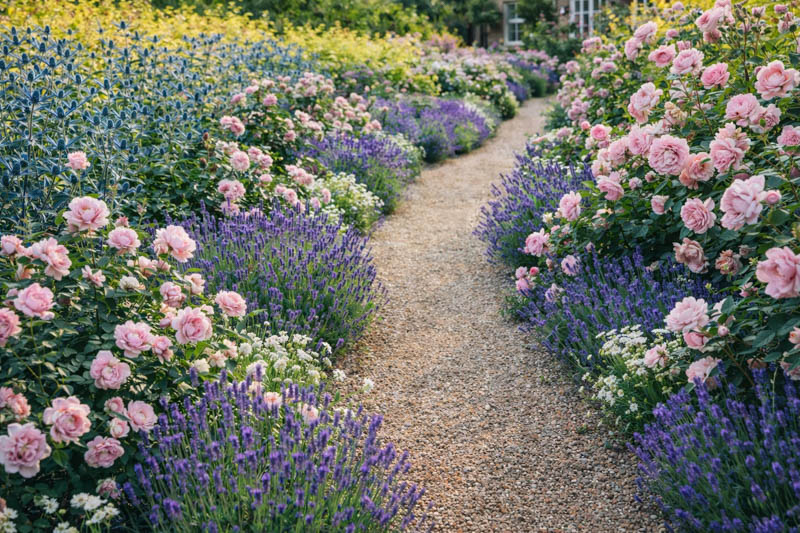
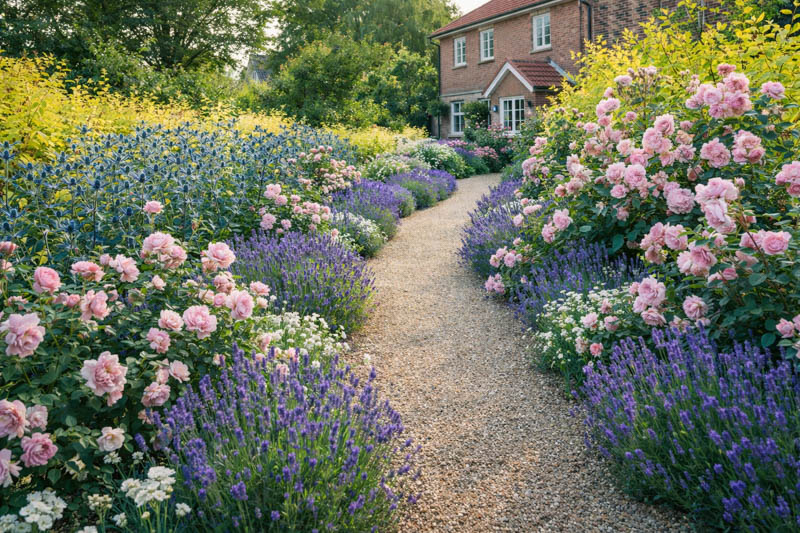


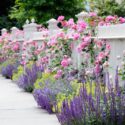
This sunny border combines a generous pink rose with broad lavender planting, blue sea holly, white Dianthus, and a bright yellow-green dogwood backdrop. Rosa ‘Felicia’ forms the largest flowering shrub in the middle of the composition, while Lavandula angustifolia ‘Lavenite Petite’ fills much of the foreground with upright purple-blue flower spikes.
To the left, Eryngium ‘Big Blue’ adds cool steel-blue flower heads and spiny foliage. White Dianthus ‘Mrs Sinkins’ brightens the lower edge, while Cornus alba ‘Aurea’ creates a broad yellow-green background that remains noticeable even when the flowers are not at their peak.
Main plants used: Rosa ‘Felicia’, Lavandula angustifolia ‘Lavenite Petite’, Eryngium ‘Big Blue’, Dianthus ‘Mrs Sinkins’, and Cornus alba ‘Aurea’
The planting succeeds because the flowers and foliage are very different in scale. The rose has large, soft flower clusters and broad green foliage, while lavender forms a much finer, more repetitive layer below. Eryngium introduces a sharper shape with metallic-blue heads, and Dianthus stays lower with small white flowers.
The dogwood adds another kind of contrast. Its yellow-green foliage forms a bright background behind the cooler blue and purple plants, making the rose stand out without needing another strong flower color.
The updated photograph also shows that the lavender should not be treated as a perfectly straight edging. It forms a broad, irregular foreground mass, which feels more natural against the large rose and taller Eryngium.
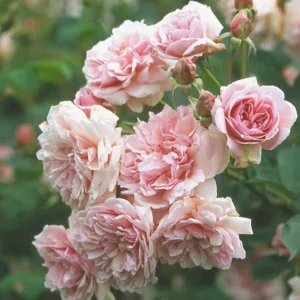
Rosa ‘Felicia’ provides the main flowering shrub. Its clusters of soft pink, fragrant flowers repeat through the season and suit the relaxed character of the border. Give the shrub good light, regular moisture during dry weather, and enough space for air to move through the branches.
Lavandula angustifolia ‘Lavenite Petite’ creates the largest perennial mass near the front. Like other English lavenders, it needs full sun and sharply drained soil. Trim lightly after flowering to keep plants compact, but avoid cutting hard into old leafless wood.
Eryngium ‘Big Blue’ provides steel-blue flower heads and a more rigid silhouette. It performs best in full sun and freely draining soil and generally resents overly rich or wet conditions. The dried flower heads can remain attractive after flowering.
Dianthus ‘Mrs Sinkins’ adds white, strongly fragrant flowers and blue-green foliage near the lower edge of the planting. Good drainage is important, especially in winter, and deadheading can help keep the plant tidy after flowering.
Cornus alba ‘Aurea’ forms the background shrub layer. Its yellow foliage brightens the border during the growing season, while red young stems provide winter interest after leaf fall. Removing some of the oldest stems in late winter encourages fresh, strongly colored growth.
Create a fragrant cottage border with a strong pink rose, generous lavender planting, cool blue accents, white flowers at the lower edge, and a bright deciduous shrub behind.
These percentages describe the overall balance of the five featured plants rather than exact numbers of individual plants.

Position ‘Felicia’ rose first where it has room to develop into a broad shrub. Use Golden Dogwood behind or beside it as a bright background rather than as a tightly clipped hedge.
Repeat Lavender in generous irregular groups through the foreground. Add Eryngium in smaller clusters beside and behind the lavender, where its blue flower heads remain visible.
Use Dianthus in lower patches at the front edge, especially where its white flowers can contrast with the purple lavender.
This combination does not have uniform moisture needs. Roses and dogwood generally perform best with more consistent moisture, while Lavender, Eryngium, and Dianthus prefer freer drainage and somewhat drier conditions once established. Avoid irrigating the whole border as though every plant needs the same amount of water.
The dogwood also becomes a substantial shrub, so allow enough room for its mature spread. If it begins to overwhelm the lower plants, selective renewal pruning is better than repeatedly shearing the entire shrub.
Finally, keep the lavender open enough for air circulation. Crowded plants in rich or damp soil tend to lose their compact shape more quickly and may become short-lived.
| Hardiness |
6 - 7 |
|---|---|
| Heat Zones |
6 - 8 |
| Exposure | Full Sun |
| Season of Interest | Spring (Late), Summer (Early, Mid, Late) |
| Maintenance | Average |
| Water Needs | Average |
| Soil Type | Loam, Sand |
| Soil pH | Neutral |
| Soil Drainage | Well-Drained |
| Characteristics | Dried Arrangements, Cut Flowers, Fragrant, Plant of Merit, Showy |
| Attracts | Butterflies, Hummingbirds |
| Landscaping Ideas | Beds And Borders, Underplanting Roses And Shrubs |
| Garden Styles | Butterfly Garden, City and Courtyard, Informal and Cottage, Pollinator Garden, Traditional Garden |





GAP Photos/Richard Bloom - The Bressingham Gardens, Norfolk, UK.
| Hardiness |
6 - 7 |
|---|---|
| Heat Zones |
6 - 8 |
| Exposure | Full Sun |
| Season of Interest | Spring (Late), Summer (Early, Mid, Late) |
| Maintenance | Average |
| Water Needs | Average |
| Soil Type | Loam, Sand |
| Soil pH | Neutral |
| Soil Drainage | Well-Drained |
| Characteristics | Dried Arrangements, Cut Flowers, Fragrant, Plant of Merit, Showy |
| Attracts | Butterflies, Hummingbirds |
| Landscaping Ideas | Beds And Borders, Underplanting Roses And Shrubs |
| Garden Styles | Butterfly Garden, City and Courtyard, Informal and Cottage, Pollinator Garden, Traditional Garden |
Recreate this garden. Specify the percentages you would like to have of each plant and input the dimensions of your garden space.We'll give you a shopping list so you know how many plants you need.
| Plant | Quantity | |
|---|---|---|
| Eryngium x zabelii 'Big Blue' (Sea Holly) | N/A | Buy Plants |
| Rosa 'Felicia' (Hybrid Musk Rose) | N/A | Buy Plants |
| Lavandula angustifolia 'Lavenite Petite' (Lavender) | N/A | Buy Plants |
| Dianthus Memories (Pink) | N/A | Buy Plants |
| Cornus alba 'Aurea' (Tatarian Dogwood) | N/A | Buy Plants |
Create a membership account to save your garden designs and to view them on any device.
Becoming a contributing member of Gardenia is easy and can be done in just a few minutes. If you provide us with your name, email address and the payment of a modest $25 annual membership fee, you will become a full member, enabling you to design and save up to 25 of your garden design ideas.
Join now and start creating your dream garden!