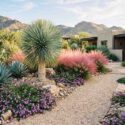
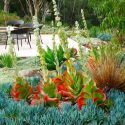
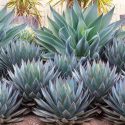
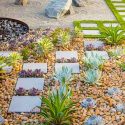
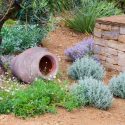
This “Desert Pollinator Garden” glows with heat-loving color and sculptural form. Parry’s Agave grounds the design while Penstemon, Red Yucca, and Autumn Sage shimmer with nectar-rich blooms. Resilient, low-water, and wildlife-friendly, it’s a celebration of desert life that’s as tough as it is breathtaking.
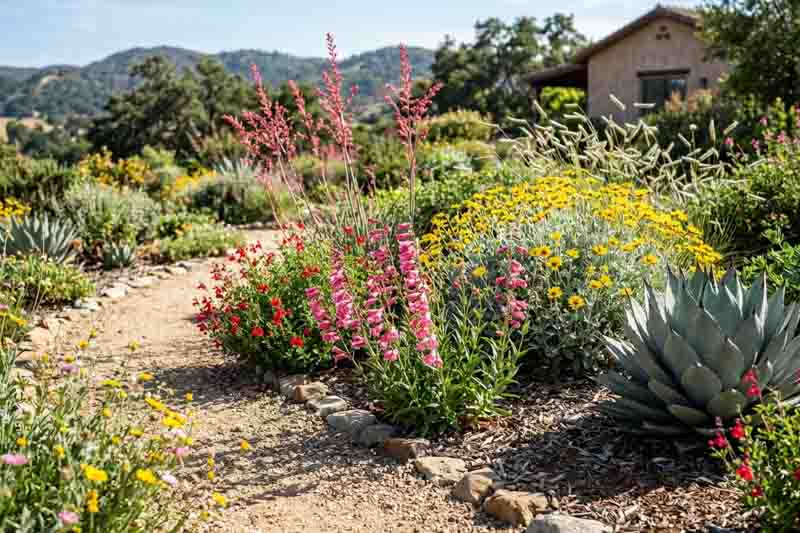


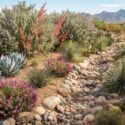
This sunny desert border combines strong evergreen forms with a long sequence of color from spring into fall. Blue-gray rosettes of Agave parryi provide the most architectural shapes, while tall pink stems of Penstemon parryi and coral-red flower stalks of Hesperaloe parviflora rise above the lower planting. Red-flowering Salvia greggii fills the middle layer, Bouteloua gracilis adds fine grassy texture, and Encelia farinosa brightens the border with silver foliage and yellow daisies.
The updated garden feels open and mature rather than tightly packed. A gravel path curves through the planting, with agaves placed as strong accents and flowering plants repeated in irregular groups. The mountains and dry landscape beyond reinforce the Southwestern setting, while the mix of silver, blue-green, pink, red, and yellow keeps the border lively without looking overdesigned.
Main plants used: Agave parryi, Penstemon parryi, Hesperaloe parviflora, Salvia greggii, Bouteloua gracilis, and Encelia farinosa
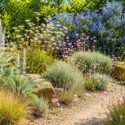
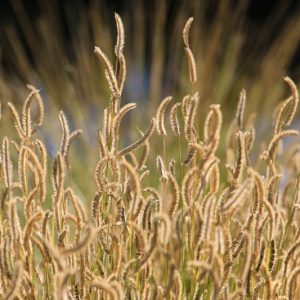
The garden depends on contrast in shape more than sheer flower density. Agave parryi forms broad, geometric rosettes, while Red Yucca sends narrow leaves and tall flower stalks upward. Blue Grama stays much finer, with airy seedheads that soften the harder outlines of the succulents.
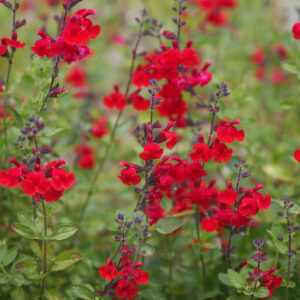
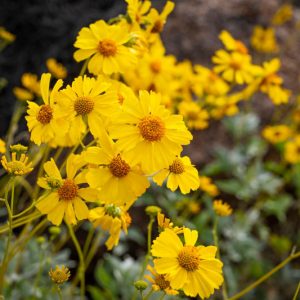
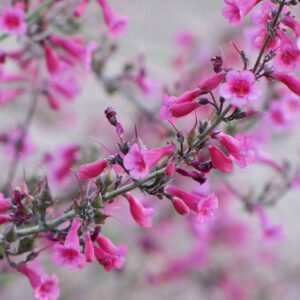
The flowering plants add color at different heights. Parry’s Penstemon rises in pink spikes, Autumn Sage creates lower red accents, and Brittlebush forms broad silver-gray mounds topped with yellow daisies. That mix keeps the border visually active without making it feel crowded.
The updated photograph also shows why the plants should not be arranged in equal blocks. Agaves work best as individual anchors, while the flowering plants and grasses can repeat more loosely around them. Exposed gravel remains visible between mature plants, which is an important part of the dry-garden character.
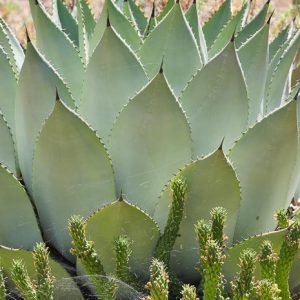
Agave parryi provides the strongest year-round structure. Its compact blue-gray rosettes stand out against gravel and stone and perform best in full sun with excellent drainage. Individual rosettes are monocarpic: after flowering, the flowering rosette dies, although offsets may continue the clump.
Penstemon parryi adds bright pink flower spikes in spring. It is well adapted to hot, dry Southwestern conditions and works best in gravelly or sandy soil with good drainage. It can reseed where conditions suit it.
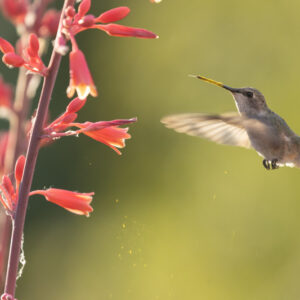
Hesperaloe parviflora, or Red Yucca, forms a low clump of narrow leaves and sends tall coral to red flower stalks above the foliage. The tubular flowers are especially attractive to hummingbirds and can provide a long season of bloom in warm climates.
Salvia greggii, or Autumn Sage, adds lower red flowers and a shrubby framework between the larger plants. It tolerates heat and dry periods once established and responds well to light pruning that encourages fresh flowering growth.
Bouteloua gracilis, or Blue Grama, contributes fine foliage and distinctive horizontal seedheads. It is a warm-season native grass that handles drought well and works particularly well as a light matrix between shrubs and succulents.
Encelia farinosa, or Brittlebush, combines pale silver-gray foliage with clear yellow daisies. It is strongly adapted to desert heat and lean soil and is most effective when used in loose mounds rather than clipped shapes.
Create an open desert border where sculptural agaves and Red Yucca are balanced by flowering perennials, silver foliage, and fine-textured native grass.
These percentages are a design guide rather than a literal plant count. These percentages are approximate design proportions rather than a literal plant count. Each of the six featured plants is represented at roughly the same level throughout the garden.
Place Agave parryi first as individual structural anchors, keeping enough distance from paths for the mature rosettes.
Repeat Red Yucca and Parry’s Penstemon where their taller flower stalks can rise clearly above the lower plants. Use Autumn Sage in smaller mounds through the middle of the border.
Thread Blue Grama through the open areas and add Brittlebush in broader silver-gray groups. Leave visible gravel between mature plants rather than allowing the entire bed to close into one continuous mass.
This is a low-water planting, but not a no-water one. Newly installed plants need regular irrigation while their roots establish, and even mature plants may benefit from occasional deep watering during extended drought.
Drainage is especially important around Agave and Red Yucca. In heavy or poorly drained soil, plant them on raised mounds or in properly constructed, freely draining beds rather than in low spots where water collects.
Finally, resist crowding the garden when it is young. Agaves, Red Yucca, Brittlebush, and Autumn Sage all broaden with age, and the open gravel visible between them will gradually narrow. Starting with more space usually produces a better long-term result than filling every gap immediately.
| Hardiness |
8 - 9 |
|---|---|
| Heat Zones |
6 - 8 |
| Climate Zones | 8, 9, 10, 11, 14, 18, 19, 20, 21 |
| Exposure | Full Sun |
| Season of Interest | Spring (Early, Mid, Late), Summer (Early, Mid, Late), Fall, Winter |
| Maintenance | Low |
| Water Needs | Low |
| Soil Type | Sand |
| Soil pH | Acid, Neutral |
| Soil Drainage | Well-Drained |
| Characteristics | Showy |
| Native Plants | United States |
| Tolerances | Drought, Dry Soil, Rocky Soil |
| Attracts | Bees, Butterflies, Hummingbirds |
| Landscaping Ideas | Beds And Borders |
| Garden Styles | Butterfly Garden, Gravel and Rock Garden, Pollinator Garden |
| Hardiness |
8 - 9 |
|---|---|
| Heat Zones |
6 - 8 |
| Climate Zones | 8, 9, 10, 11, 14, 18, 19, 20, 21 |
| Exposure | Full Sun |
| Season of Interest | Spring (Early, Mid, Late), Summer (Early, Mid, Late), Fall, Winter |
| Maintenance | Low |
| Water Needs | Low |
| Soil Type | Sand |
| Soil pH | Acid, Neutral |
| Soil Drainage | Well-Drained |
| Characteristics | Showy |
| Native Plants | United States |
| Tolerances | Drought, Dry Soil, Rocky Soil |
| Attracts | Bees, Butterflies, Hummingbirds |
| Landscaping Ideas | Beds And Borders |
| Garden Styles | Butterfly Garden, Gravel and Rock Garden, Pollinator Garden |
Recreate this garden. Specify the percentages you would like to have of each plant and input the dimensions of your garden space.We'll give you a shopping list so you know how many plants you need.
| Plant | Quantity | |
|---|---|---|
| Agave parryi (Artichoke Agave) | N/A | Buy Plants |
| Hesperaloe parviflora (Red Yucca) | N/A | Buy Plants |
| Salvia greggii (Autumn Sage) | N/A | Buy Plants |
| Bouteloua gracilis (Blue Grama) | N/A | Buy Plants |
| Encelia farinosa (Brittlebush) | N/A | Buy Plants |
| Penstemon parryi (Parry's Beardtongue) | N/A | Buy Plants |
Create a membership account to save your garden designs and to view them on any device.
Becoming a contributing member of Gardenia is easy and can be done in just a few minutes. If you provide us with your name, email address and the payment of a modest $25 annual membership fee, you will become a full member, enabling you to design and save up to 25 of your garden design ideas.
Join now and start creating your dream garden!