Bulltongue Arrowhead, Duck Potato, Lanceleaf Arrowhead, Lance-leaved Arrowhead, Bulltongue, Bulltongue Arrowhead, Lanceleaf Sagittaria
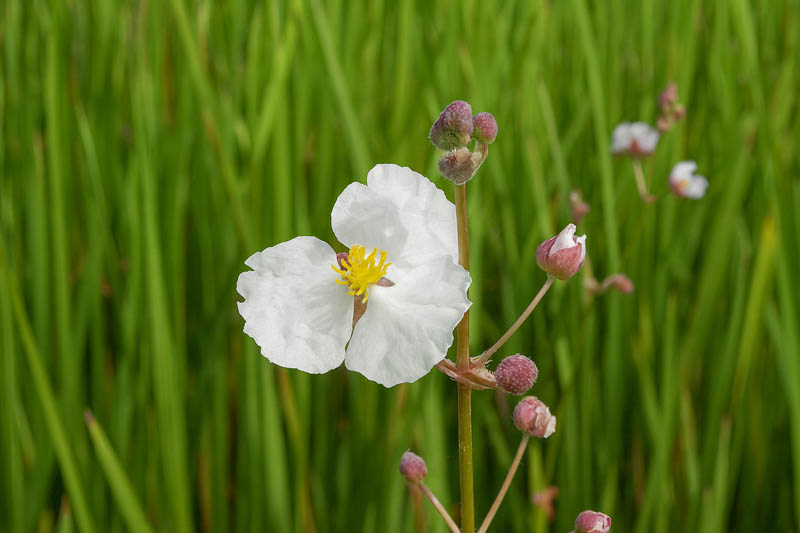


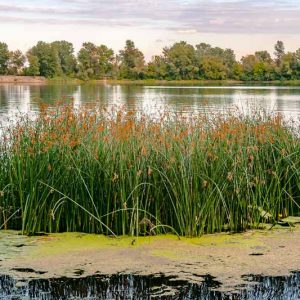
If you want a plant that turns a plain pond edge into a living, swaying wetland, Sagittaria lancifolia, commonly called lanceleaf arrowhead, duck potato, or bulltongue arrowhead, is hard to beat. This native aquatic perennial sends up elegant, lance-shaped leaves and airy spikes of white flowers that hover over shallow water. It is a classic water garden plant for naturalistic ponds, rain gardens, and restored wetlands.
Sagittaria lancifolia care is surprisingly easy. Give it full sun, shallow standing water or consistently wet soil, and room for its rhizomes to spread, and it will quickly form handsome clumps that shelter fish, frogs, and dragonflies. In its native range across the southeastern United States, this species has long been valued as a wildlife plant and traditional food source thanks to its starchy underground corms.
Summary: Native emergent aquatic perennial with tall, lance-shaped leaves and white three-petaled flowers held above the water on graceful stalks.
Use: Ponds, water gardens, naturalized shorelines, marsh plantings, wet ditches, rain gardens, stormwater ponds, habitat gardens.
Highlight: Provides excellent cover and food for wildlife, stabilizes shorelines, and adds vertical texture and seasonal flowers to shallow water.
Note: A vigorous rhizomatous native plant that can spread where conditions suit it – perfect for naturalistic plantings, less ideal for tiny ponds unless thinned regularly.
| Botanical Name | Sagittaria lancifolia L. |
|---|---|
| Family | Alismataceae (water-plantain family) |
| Common Names | Lanceleaf Arrowhead, Duck Potato, Bulltongue Arrowhead, Arrowhead |
| Native Range | Native to the southeastern United States, especially the Atlantic and Gulf coastal plains – Florida, Georgia, the Carolinas, Virginia, Maryland, Alabama, Mississippi, Louisiana, and Texas – where it grows in marshes, swamps, wet prairies, and roadside ditches. |
| Plant Type and Habit | Herbaceous perennial and water plant with clumping to slowly spreading rhizomes; foliage emerges in spring and dies back in winter in colder zones. |
| Hardiness (approx. USDA) | Generally hardy in about USDA Zones 4 to 11, with best garden performance reported from roughly Zones 6 to 11. |
| Size | Typically 2 to 4 ft. tall (0.6 to 1.2 m), sometimes to about 6 ft in rich wetlands, with clumps expanding sideways by rhizomes. |
| Sun and Exposure | Full sun is ideal for dense growth and abundant flowers, though it tolerates light partial shade in hot climates. |
| Soil / Water | An obligate wetland plant that thrives in shallow water up to about 12 in. (30 cm) deep or in saturated, mucky soil along pond margins and ditches. |
| Seasonal Interest | Showy white flowers from late spring or early summer into fall, followed by rounded seed heads; attractive vertical green foliage from spring through frost. |
| Primary Uses | Pond edges, water gardens, marsh plantings, naturalized shorelines, rain gardens, stormwater ponds, wildlife habitat, erosion control, restoration projects. |
Sagittaria lancifolia is a vigorous emergent aquatic perennial. Thick, spongy petioles rise from rhizomes anchored in the mud and carry narrow, lance-shaped leaves that can be more than 2 ft long, forming bold vertical fans of foliage.
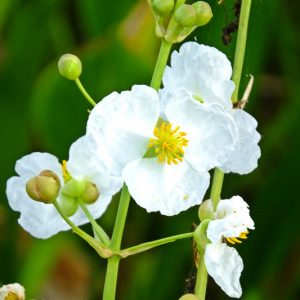
Above the leaves, branched stalks hold whorls of three-petaled white flowers with golden-yellow centers. Male and female flowers may be on the same inflorescence, often with female flowers lower on the stalk and male flowers above. The overall effect is light and airy, softening the transition between open water and land.
Lanceleaf arrowhead is a true wetland plant. In the wild it grows in marshes, wet prairies, swamps, tidal freshwater and low-salinity marshes, pond margins, sloughs, and marshy roadside ditches across the southeastern United States. It is classified as an obligate wetland species, meaning you will almost never see it in dry soils.
In gardens and designed landscapes, this makes Sagittaria lancifolia ideal for pond shelves, bog gardens, bio-swales, and rain gardens that periodically hold standing water. Best Native Aquatic Plants for South Florida
This is not a timid little marginal. Lanceleaf arrowhead forms robust clumps and spreads by rhizomes and corms, gradually knitting into colonies where conditions are favorable. In restoration or naturalized settings that is a big plus: the plant helps stabilize soft shorelines and crowd out nuisance weeds.
In small, highly manicured ponds, you may want to thin clumps every few years or confine plants to containers sunk into the shelves to keep its enthusiasm in check. Researchers classify it as a “littoral aggressive native” plant along with broadleaf arrowhead and pickerelweed – vigorous but still ecologically valuable.
Bloom time usually runs from early summer well into fall, depending on climate. Each flower is typically 1 to 1.5 in. across, with three delicate white petals and a central cluster of yellow anthers or a rounded green seed head. As the season progresses, rounded heads of tiny achenes (seeds) develop, providing food for birds and other wildlife.
The foliage is equally attractive. Dark green, arrow to lance-shaped leaves rise straight up from the water or mud, giving strong vertical lines. In colder zones the leaves die back in winter, while in frost-free areas the plant may keep some green presence year-round.
Lanceleaf arrowhead is a star in wildlife-friendly water gardens. Its dense emergent foliage provides cover and nesting habitat for fish, amphibians, aquatic insects, and small birds. Tubers and seeds are eaten by waterfowl, songbirds, muskrats, and beavers.
The plant also contributes to water quality. Like other arrowheads, it can remove notable amounts of nutrients and metals from sediments and water, helping reduce turbidity and improving the clarity and health of ponds and wetlands.
The common name duck potato comes from the starchy underground corms, which have been used as a food source by Indigenous peoples and foragers in parts of North America. They can be roasted, boiled, or baked much like small potatoes or chestnuts.
However, as with any wild or water-grown food, proper identification and clean, uncontaminated water are essential. Many wetland plants look similar, and polluted sediments can concentrate heavy metals or pathogens. If you are not experienced with wetland plant foraging, enjoy Sagittaria lancifolia primarily as an ornamental and habitat plant.
Although it looks tropical, lanceleaf arrowhead is surprisingly cold-hardy. University and agency sources list it as hardy from around USDA Zones 4 through 11, with rhizomes surviving winter freezes as long as they are submerged or insulated in saturated soil. In colder zones, foliage disappears after frost and re-emerges in spring.
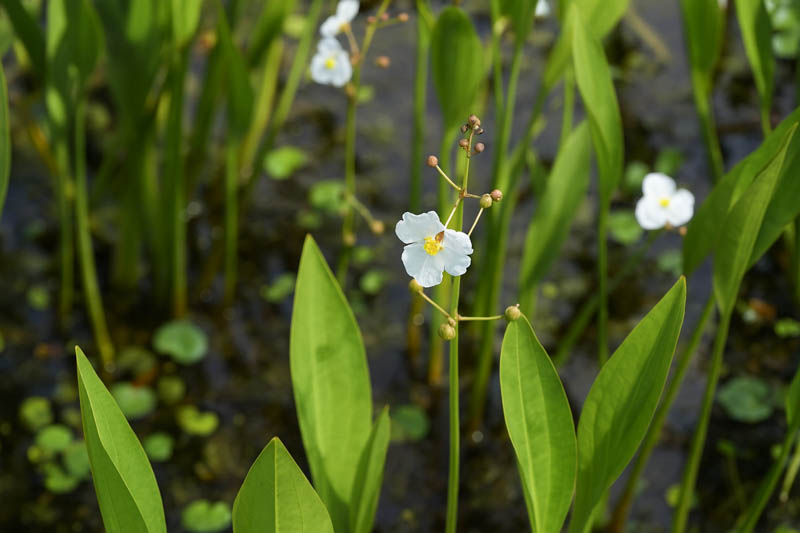
Sagittaria lancifolia really shines when its roots are in mud and its feet are wet:
Lanceleaf arrowhead is straightforward to propagate:
In suitable conditions, Sagittaria lancifolia is generally a low-maintenance, problem-free plant. Most issues relate to culture rather than specific pests.
Yes – but with a bit of management. In a small garden pond, plant it in a large pot or basket sunk into a shelf so you can limit its spread. Regular division keeps it neat while still giving you the lush look and flowers.
Most sources recommend no deeper than about 12 in. of water above the crown. Shallower (2 to 6 in.) water is perfect for quick establishment and easy maintenance.
It prefers constant moisture or standing water. In a rain garden that dries between storms, plant it in the very lowest spots where moisture lingers longest or consider lining a small pocket to hold water longer.
Within its native range, lanceleaf arrowhead is considered a vigorous native species that can dominate littoral zones if left unchecked, but it also provides important ecological benefits. Outside its native range, check local guidance before planting and avoid allowing it to escape into natural waterways.
Key information adapted from university and agency sources on Sagittaria lancifolia, including the University of Florida IFAS duck potato profile, NC State University Plant Toolbox, and related wetland plant guides.
Updated: December 2025
| Hardiness |
6 - 11 |
|---|---|
| Plant Type | Aquatic Plants, Perennials |
| Plant Family | Alismataceae |
| Common names | Arrowhead, Duck-Potato |
| Exposure | Full Sun, Partial Sun |
| Season of Interest | Spring (Late), Summer (Early, Mid, Late), Fall |
| Height | 2' - 6' (60cm - 180cm) |
| Spread | 1' - 3' (30cm - 90cm) |
| Spacing | 36" (90cm) |
| Maintenance | Low |
| Water Needs | High |
| Soil Type | Loam, Sand |
| Soil pH | Acid, Alkaline, Neutral |
| Soil Drainage | Poorly Drained |
| Characteristics | Showy |
| Native Plants | United States, Northeast, Delaware, Maryland, Southeast, Louisiana, Mississippi, North Carolina, South Carolina, Virginia, Alabama, Florida, Georgia, Southwest, Texas |
| Tolerances | Wet Soil |
| Attracts | Birds |
| Garden Uses | Ponds And Streams, Rain Gardens, Water Gardens |
| Toxic to Humans | No known toxicity |
| Toxic to Cats | No known toxicity |
| Toxic to Dogs | No known toxicity |
| Toxic to Horses | No known toxicity |


| Hardiness |
6 - 11 |
|---|---|
| Plant Type | Aquatic Plants, Perennials |
| Plant Family | Alismataceae |
| Common names | Arrowhead, Duck-Potato |
| Exposure | Full Sun, Partial Sun |
| Season of Interest | Spring (Late), Summer (Early, Mid, Late), Fall |
| Height | 2' - 6' (60cm - 180cm) |
| Spread | 1' - 3' (30cm - 90cm) |
| Spacing | 36" (90cm) |
| Maintenance | Low |
| Water Needs | High |
| Soil Type | Loam, Sand |
| Soil pH | Acid, Alkaline, Neutral |
| Soil Drainage | Poorly Drained |
| Characteristics | Showy |
| Native Plants | United States, Northeast, Delaware, Maryland, Southeast, Louisiana, Mississippi, North Carolina, South Carolina, Virginia, Alabama, Florida, Georgia, Southwest, Texas |
| Tolerances | Wet Soil |
| Attracts | Birds |
| Garden Uses | Ponds And Streams, Rain Gardens, Water Gardens |
| Toxic to Humans | No known toxicity |
| Toxic to Cats | No known toxicity |
| Toxic to Dogs | No known toxicity |
| Toxic to Horses | No known toxicity |
How many Sagittaria lancifolia (Lanceleaf Arrowhead) do I need for my garden?
| Plant | Quantity | |
|---|---|---|
| Sagittaria lancifolia (Lanceleaf Arrowhead) | N/A | Buy Plants |
Create a membership account to save your garden designs and to view them on any device.
Becoming a contributing member of Gardenia is easy and can be done in just a few minutes. If you provide us with your name, email address and the payment of a modest $25 annual membership fee, you will become a full member, enabling you to design and save up to 25 of your garden design ideas.
Join now and start creating your dream garden!
Create a membership account to save your garden designs and to view them on any device.
Becoming a contributing member of Gardenia is easy and can be done in just a few minutes. If you provide us with your name, email address and the payment of a modest $25 annual membership fee, you will become a full member, enabling you to design and save up to 25 of your garden design ideas.
Join now and start creating your dream garden!