Blue Passion Flower, Blue Crown, Common Passion Flower, Flower of Five Wounds, Southern Beauty, Wild Apricot

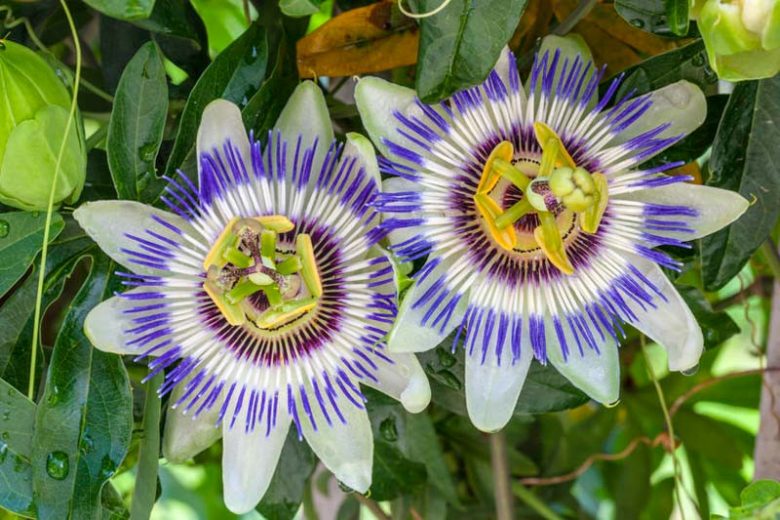


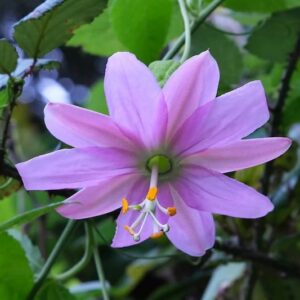
If you want a climbing vine that looks like it belongs in a botanical fantasy movie but behaves like a tough garden workhorse, Passiflora caerulea, the Blue Passion Flower, is your plant. This vigorous, semi-evergreen climber covers trellises, fences, and arches with glossy, hand-shaped leaves and spectacular, otherworldly flowers in blue, white, and purple. It is one of the most widely grown passion flowers and a favorite among tropical flower lovers.
Despite its exotic look, Passiflora caerulea care is straightforward. Give it full sun to part shade, well-drained soil, a sturdy support, and light feeding, and it will reward you with months of blooms and striking orange fruits. It is also the proud winner of the Award of Garden Merit from the Royal Horticultural Society and ranks as a top choice among tropical flowers for enthusiasts and gardeners. Popular cultivars such as Passiflora caerulea ‘Clear Sky’ and Passiflora caerulea ‘Constance Elliott’ offer even larger or pure white flowers for added impact.
Summary: Vigorous, semi-evergreen climbing vine with twining tendrils, palmately lobed leaves, and exotic star-like flowers followed by egg-sized orange fruits.
Use: Trellises, fences, walls, arbors, pergolas, wall-side borders, containers, tropical and Mediterranean-style gardens, cottage gardens, city gardens.
Highlight: Spectacular flowers with blue, purple, and white filaments, high ornamental value, butterfly attractor, and excellent vertical accent for small gardens and balconies.
Note: Hardy for a passion flower – in mild climates it can survive temperatures down to about 5°F (-15°C), dying back to the roots and resprouting from below ground in spring.
| Botanical Name | Passiflora caerulea L. |
|---|---|
| Family | Passifloraceae (passion flower family) |
| Common Names | Blue Passion Flower, Blue Passionflower, Common Passion Flower, Passion Vine |
| Native Range | Native to southern South America, especially Brazil, Argentina, Paraguay and Uruguay. Widely cultivated in warm temperate to subtropical regions around the world and naturalized in some mild climates. |
| Plant Type and Habit | Semi-evergreen to deciduous climber with twining tendrils. Will die back in cold winters and regrow from the base in spring. |
| Hardiness (approx. USDA) | Typically hardy in about USDA Zones 6 to 10. In mild climates it can survive lows to around 5°F (-15°C) if roots are well established and mulched. |
| Size | A fast-growing vine reaching about 10 to 40 ft. long (3 to 12 m) given time and support, with a similar spread as it clambers over structures. |
| Sun and Exposure | Full sun to part shade. In very hot climates, some afternoon shade can help prevent stress, especially in containers. |
| Soil | Prefers loose, sandy or gravelly, well-drained soils. Good drainage is essential. Thrives in moist but not waterlogged soil; keep on the dry side in winter. |
| Seasonal Interest | White to pale pink flowers with blue and purple filaments from early summer to early fall, followed by deep orange egg-sized fruits from late summer into fall. |
| Primary Uses | Trellises, walls, fences, arbors, pergolas, wall-side borders, large containers, tropical and Mediterranean-style gardens, cottage gardens, city gardens. |
Passiflora caerulea is a large, twining, semi-evergreen climber known for its dramatic, star-shaped flowers and vigorous growth. Stems carry palmately lobed leaves with 5 to 7 fingers, giving the vine a tropical, lacy texture even when it is not in bloom.
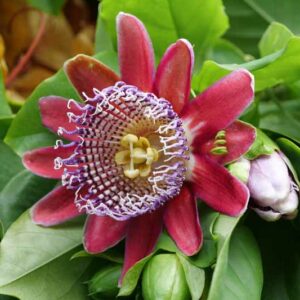
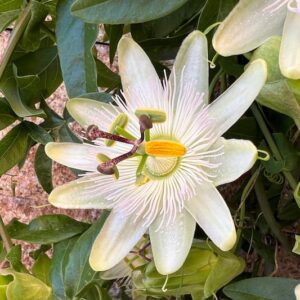
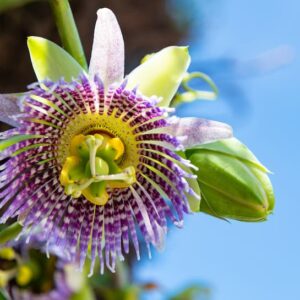
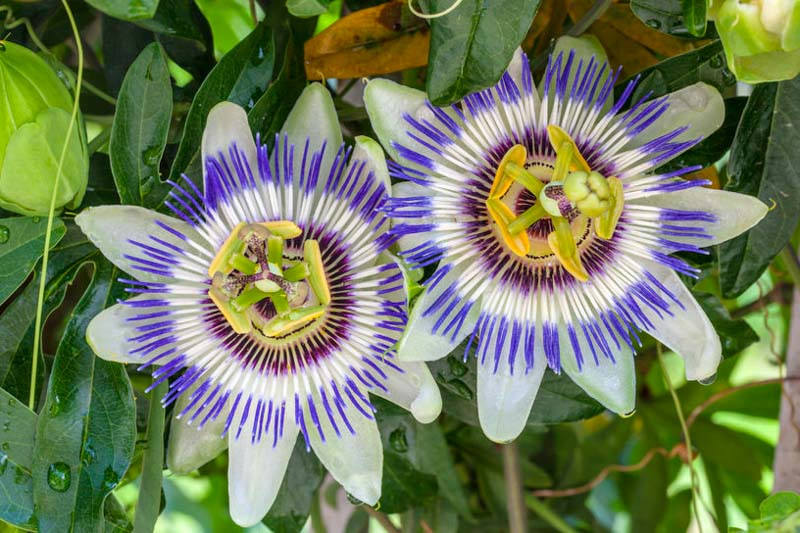
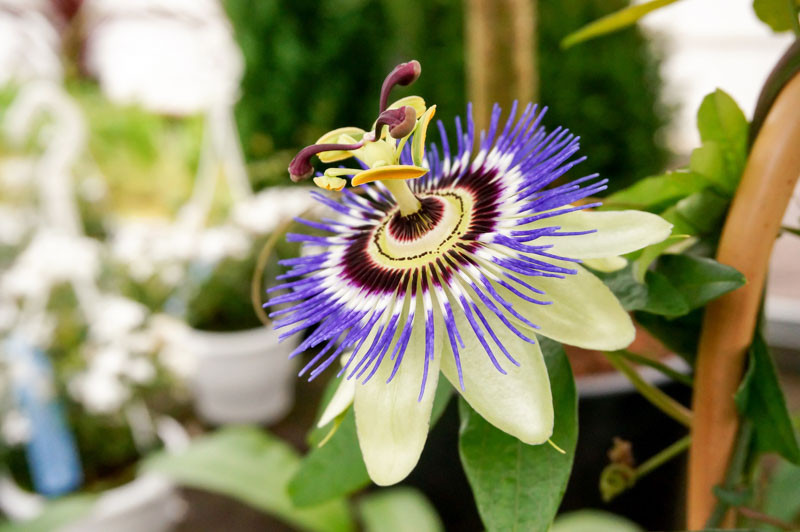
The flowers are where Blue Passion Flower really steals the show. Typical blossoms are about 3 in. across (8 cm), with white petals sometimes flushed pale pink and a bold ring of blue, white, and purple filaments at the center. The complex floral structure is part of what makes passion flowers so beloved and gives them a strong presence in any garden or container.
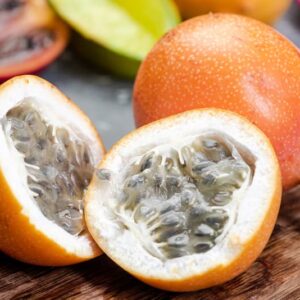
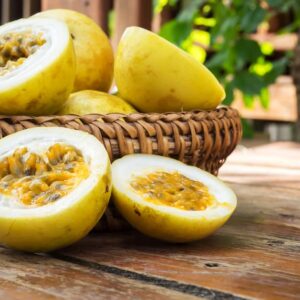
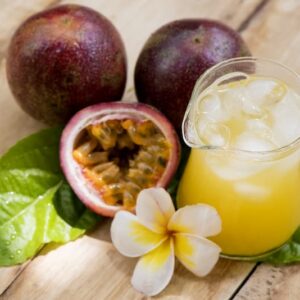
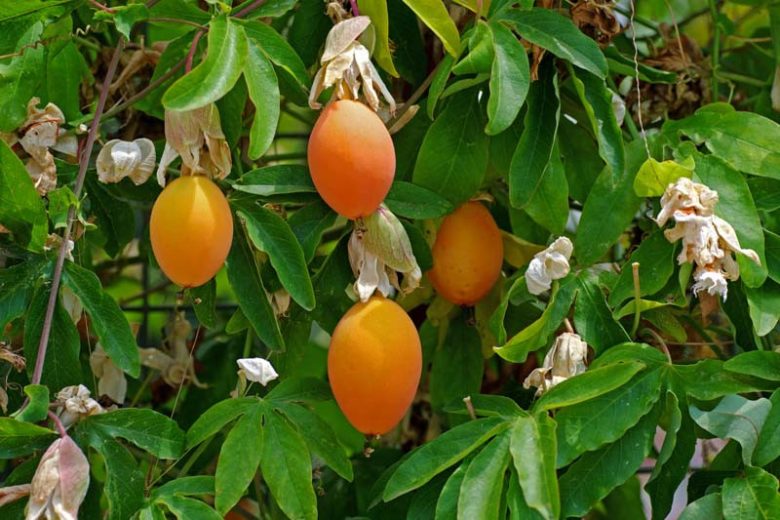
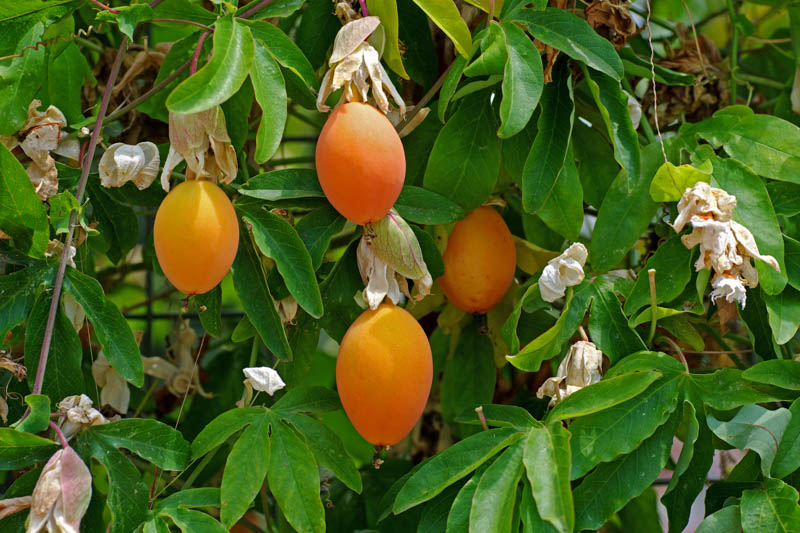
After flowering, the vine produces egg-sized, deep orange fruits from late summer into fall. The fruits are technically edible and have a mild, slightly sweet flavor somewhat reminiscent of blackberry, but they are not considered especially tasty. Most gardeners grow Blue Passion Flower primarily for its ornamental value rather than as a fruit crop, especially compared to passion fruit species like P. edulis. For more on the difference, see Passion Flower vs Passion Fruit: What’s the Difference?.
Blue Passion Flower is the recipient of the prestigious Award of Garden Merit of the Royal Horticultural Society for its noteworthy qualities.
Blue Passion Flower is native to southern South America, especially Brazil, Argentina, Paraguay and Uruguay, where it grows in warm, often humid regions with well-drained soils. In those climates it behaves as an evergreen climber.
In cooler climates, including many temperate gardens, Passiflora caerulea is deciduous or semi-evergreen. It often dies back to ground level in harsh winters but can resprout from its deep, hardy root system once spring returns, provided roots are well protected and not waterlogged.
This passion flower is a fast-growing, twining vine. In good conditions it can quickly reach 10 to 40 ft. long (3 to 12 m), scrambling up and over nearby structures. Because it climbs by slender twining stems and tendrils, it does not damage masonry or wooden fences like some woody vines can.
It is usually best to avoid training Passiflora too neatly. The stems that are allowed to hang and droop often produce more flowers. Think loose, romantic growth over an arbor, arch, or fence rather than a rigidly clipped wall shrub.
Bloom time runs from early summer to early fall, with flowers produced sporadically through the warm season. Each flower is short-lived, but the vine produces them in succession, so a mature plant can seem to be in near-constant bloom.
The decorative orange fruits develop after flowering. While the pulp is edible, most gardeners find it only mildly appealing, and some forms may be seedy or insipid. If you are seeking passion fruit for the kitchen, species like Passiflora edulis are much better choices.
The foliage consists of shiny, rich green leaves with 5 to 7 lobes. In climates with mild winters, the plant may hold some or most of its leaves year-round, giving it a semi-evergreen presence. In colder regions, leaves are lost in late fall and reappear in spring as shoots resprout.
Between the sculptural leaf shape, dramatic flowers, and colorful fruit, Blue Passion Flower offers multi-season interest and looks especially striking when allowed to frame windows, doors, or garden views.
Native to warm climates, Passiflora caerulea is nevertheless one of the hardiest passion flowers. It has been known to survive temperatures as low as 5°F (-15°C) when the ground was frozen over two feet deep. Above-ground growth may be killed in severe cold, but the plant can resprout from deep, insulated roots in spring. Best Climbing Plants That Thrive in USDA Zone 8
You can use Blue Passion Flower in many garden settings:
This trouble-free climber uses tendrils to cling, so it does not usually damage brickwork or sound fencing, making it an excellent choice where you want lush coverage without structural worries.
Butterflies are particularly fond of passion flowers, visiting the blooms for nectar. In some regions, Passiflora species also serve as host plants for butterfly larvae, though specific host relationships vary by species and location. The colorful fruits may also attract birds and small wildlife.
If you are building a wildlife-friendly garden, consider combining Blue Passion Flower with other nectar plants and structural shrubs for a layered, habitat-rich planting. For more unusual blooms, see Discover unique flowers for a stunning and unforgettable garden.
While the ripe fruit of Passiflora caerulea is often described as technically edible but not particularly delicious, the leaves and stems are considered toxic. They contain cyanogenic glycosides that can cause medium-severity symptoms if ingested, including nausea, vomiting, drowsiness, and irregular heartbeat in humans and animals.
Passiflora caerulea is toxic to humans, cats, dogs, and horses. Contact dermatitis is not typically an issue, but do not allow children or pets to chew on leaves or stems. For a broader overview of garden plant risks, see Poisonous flowers and plants: Identifying toxic risks around you.
In many climates, Passiflora caerulea is an enthusiastic but manageable grower. However, in very mild regions without hard freezes, it may spread from roots or seed and become persistent. Regular pruning and monitoring for unwanted suckers or seedlings keeps it within bounds.
Blue Passion Flower prefers:
Avoid heavy, waterlogged soils. If you garden on clay, consider raised beds, mounds, or mixing in grit and organic matter to improve drainage.
Blue Passion Flower blooms on new growth, so pruning is typically done in late winter or early spring before vigorous growth resumes.
Passiflora caerulea is relatively easy to propagate:
In general, Passiflora caerulea is a vigorous, relatively problem-free climber when grown in appropriate conditions.
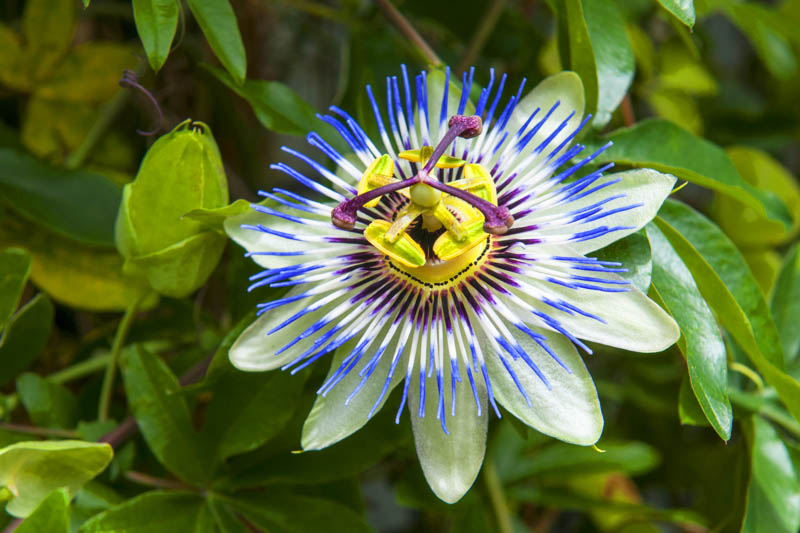
Passiflora caerulea, commonly called Blue Passion Flower, is a vigorous, twining, semi-evergreen climber in the passion flower family (Passifloraceae). It has 5–7 lobed, glossy green leaves; intricate white flowers with blue and purple filaments; and egg-shaped orange fruits that follow the blooms. It’s native to South America (mainly Brazil and Argentina) and is widely grown as an ornamental vine on walls, fences, trellises, and arbors in mild to warm climates.
Blue Passion Flower is one of the hardiest passion vines. Most references place it around USDA Zones 6–10, with especially reliable performance in Zones 7–10. It can survive temperatures down to about –10 to –15 °C (14–5 °F) if well established and in a sheltered site; in colder winters the top growth often dies, but the deep roots can resprout in spring. In very mild climates it may remain evergreen, while in cooler climates it behaves as semi-evergreen or deciduous.
It depends on climate. In warm, frost-free or very mild regions, Passiflora caerulea can be fully evergreen, holding its leaves year-round. In areas with cool or cold winters it is usually semi-evergreen or deciduous: foliage and stems may be killed back by frost, but the plant often re-emerges from its root system in spring if the crown and roots are not badly damaged by cold or waterlogging.
Under good conditions, Blue Passion Flower is a fast grower and can reach roughly 10–40 ft (3–12 m) tall and several feet wide as it clambers over supports. Individual references typically list mature heights around 20–30 ft, but older plants in ideal climates can be larger. Because it climbs by twining stems and tendrils, it needs something to wrap around, such as wires, trellis panels, fences, or neighboring shrubs.
Blue Passion Flower thrives in full sun to partial sun. In hot, dry climates, some afternoon shade can help prevent leaf scorch and stress. It prefers loose, well-drained soil (often sandy or gravelly) that stays evenly moist but not waterlogged. Once established, it tolerates short dry spells but flowers best with regular watering during the growing season. Poor drainage and constantly wet, cold soil increase the risk of root and crown rot.
Passiflora caerulea typically blooms from early summer into early or mid-autumn, depending on climate. The flowers are about 7–8 cm (around 3 in) across, with white petals and a prominent ring of blue and purple filaments. After flowering, it often sets egg-sized orange fruits that ripen from late summer through fall. The fruits are technically edible but usually described as mild or insipid in flavor, so the plant is mostly grown for ornament rather than for fruit production.
The ripe fruit of Passiflora caerulea is generally considered edible but not especially tasty; many gardeners describe the flavor as mild and seedy compared with commercial passion fruit (Passiflora edulis). However, the rest of the plant is treated with caution. Leaves and unripe fruits contain cyanogenic glycosides, compounds that can release cyanide and may cause medium-severity poisoning if ingested in quantity by humans or animals. Because of this, the species is often listed as having “poisonous” foliage, and it is best not to use the leaves as a substitute for culinary passion fruit or to allow pets and children to chew plant parts.
Passiflora caerulea can be considered invasive or weedy in some regions but not in others. In parts of Australia and New Zealand, for example, it is listed as an environmental weed, capable of smothering native vegetation. In other climates it is simply a vigorous garden plant that may spread by suckers or self-seeding. Many references note that it can “become invasive” if not managed, with new shoots appearing where roots spread, particularly in mild regions without hard freezes. Gardeners in sensitive ecosystems should check local guidance before planting and be prepared to prune and remove unwanted suckers or seedlings.
Unlike ivy and some other climbers, Passiflora caerulea climbs by twining stems and tendrils rather than by adhesive pads or clinging roots. That means it usually does not penetrate or directly damage sound brickwork, stucco, or wood. However, like any vigorous vine, it can get heavy and may pull on weak trellis panels, old fences, or gutters if allowed to ramble unchecked. Good practice is to give it a separate support structure (wires or trellis) and keep it pruned back from rooflines and vents.
Blue Passion Flower flowers mainly on new growth, so pruning is usually done in late winter or early spring before vigorous growth begins. Many gardeners cut back the previous season’s long, wandering stems by roughly one-third to one-half, and remove weak, dead, or crossing shoots to keep the framework open and manageable. During the growing season you can tie in new stems to wires or trellis and pinch out overly long tips to encourage branching and more flowering shoots. In very cold climates where the top growth is killed, you can cut the plant back hard to live wood in spring; it often resprouts from the base.
Yes. Blue Passion Flower adapts well to large containers as long as it has a strong support (such as a tripod, obelisk, or mini-trellis) and a free-draining potting mix. Container plants usually need more frequent watering and regular but moderate feeding during the growing season. In cold climates, many people grow it in a pot outdoors for summer and then move it into a cool, bright, frost-free place (such as a sunroom or greenhouse) for winter. Indoors it tends to grow less vigorously and may flower less, but it can still be an attractive foliage and occasional-flowering plant if it gets plenty of light.
Common reasons for poor flowering or fruiting include:
• Insufficient light – plants in heavy shade may produce mostly foliage.
• Excessive nitrogen – high-nitrogen fertilizers encourage leafy growth at the expense of flowers.
• Immaturity – young vines often need a season or two before they bloom heavily.
• Pruning at the wrong time – cutting hard in mid- to late summer can remove developing flower buds.
• Stress – drought, waterlogging, or root disturbance may reduce flowering.
Fruit set also depends on pollination; in some climates or under glass, hand pollination may help if natural pollinators are scarce.
Yes. The complex flowers are rich in nectar and attract bees, butterflies, and other pollinating insects. The orange fruits are eaten by some birds and small mammals. In certain regions, Passiflora species are larval host plants for butterfly species such as the gulf fritillary, which lay eggs on passion vines and whose caterpillars feed on the foliage. Even where it’s grown purely as an ornamental, Blue Passion Flower can contribute to a more pollinator-friendly garden.
Several named forms of Passiflora caerulea are widely grown. Well-known cultivars include ‘Constance Elliott’, which has fragrant, pure white flowers, and ‘Clear Sky’, selected for large, clear light-blue blooms. Both share the vigor and general hardiness of the species but offer slightly different color effects. Other selections and hybrids exist as well, many using P. caerulea as a parent for improved flower size or color.
Royal Horticultural Society – Passiflora caerulea (blue passion flower)
For broader context on passion flowers and other striking blooms, see Passiflora (Passion Flower) and Unique flowers that will make your garden stand out. Key horticultural details draw on passion flower references, nursery trial notes, and practical garden experience with Passiflora caerulea.
Updated: December 2025
| Hardiness |
6 - 10 |
|---|---|
| Heat Zones |
6 - 9 |
| Climate Zones | 5, 6, 7, 8, 9, 12, 13, 14, 15, 16, 17, 18, 19, 20, 21, 22, 23, 24, H1, H2 |
| Plant Type | Climbers |
| Plant Family | Passifloraceae |
| Genus | Passiflora |
| Common names | Passion Flower |
| Exposure | Full Sun, Partial Sun |
| Season of Interest | Summer (Early, Mid, Late), Fall |
| Height | 10' - 40' (3m - 12.2m) |
| Spread | 3' - 6' (90cm - 180cm) |
| Maintenance | Low, Average |
| Water Needs | Average |
| Soil Type | Chalk, Clay, Loam, Sand |
| Soil pH | Acid, Alkaline, Neutral |
| Soil Drainage | Moist but Well-Drained |
| Characteristics | Plant of Merit, Showy, Semi-Evergreen, Fruit & Berries |
| Tolerances | Heat, Humidity |
| Attracts | Bees, Butterflies |
| Garden Uses | Arbors, Pergolas, Trellises, Patio And Containers, Wall-Side Borders, Walls And Fences |
| Garden Styles | City and Courtyard, Informal and Cottage, Mediterranean Garden |
| Toxic to Humans | Medium severity |
| Toxic to Cats | No known toxicity |
| Toxic to Dogs | No known toxicity |
| Toxic to Horses | No known toxicity |


| Hardiness |
6 - 10 |
|---|---|
| Heat Zones |
6 - 9 |
| Climate Zones | 5, 6, 7, 8, 9, 12, 13, 14, 15, 16, 17, 18, 19, 20, 21, 22, 23, 24, H1, H2 |
| Plant Type | Climbers |
| Plant Family | Passifloraceae |
| Genus | Passiflora |
| Common names | Passion Flower |
| Exposure | Full Sun, Partial Sun |
| Season of Interest | Summer (Early, Mid, Late), Fall |
| Height | 10' - 40' (3m - 12.2m) |
| Spread | 3' - 6' (90cm - 180cm) |
| Maintenance | Low, Average |
| Water Needs | Average |
| Soil Type | Chalk, Clay, Loam, Sand |
| Soil pH | Acid, Alkaline, Neutral |
| Soil Drainage | Moist but Well-Drained |
| Characteristics | Plant of Merit, Showy, Semi-Evergreen, Fruit & Berries |
| Tolerances | Heat, Humidity |
| Attracts | Bees, Butterflies |
| Garden Uses | Arbors, Pergolas, Trellises, Patio And Containers, Wall-Side Borders, Walls And Fences |
| Garden Styles | City and Courtyard, Informal and Cottage, Mediterranean Garden |
| Toxic to Humans | Medium severity |
| Toxic to Cats | No known toxicity |
| Toxic to Dogs | No known toxicity |
| Toxic to Horses | No known toxicity |
How many Passiflora caerulea (Blue Passion Flower) do I need for my garden?
| Plant | Quantity | |
|---|---|---|
| Passiflora caerulea (Blue Passion Flower) | N/A | Buy Plants |
Create a membership account to save your garden designs and to view them on any device.
Becoming a contributing member of Gardenia is easy and can be done in just a few minutes. If you provide us with your name, email address and the payment of a modest $25 annual membership fee, you will become a full member, enabling you to design and save up to 25 of your garden design ideas.
Join now and start creating your dream garden!
Create a membership account to save your garden designs and to view them on any device.
Becoming a contributing member of Gardenia is easy and can be done in just a few minutes. If you provide us with your name, email address and the payment of a modest $25 annual membership fee, you will become a full member, enabling you to design and save up to 25 of your garden design ideas.
Join now and start creating your dream garden!